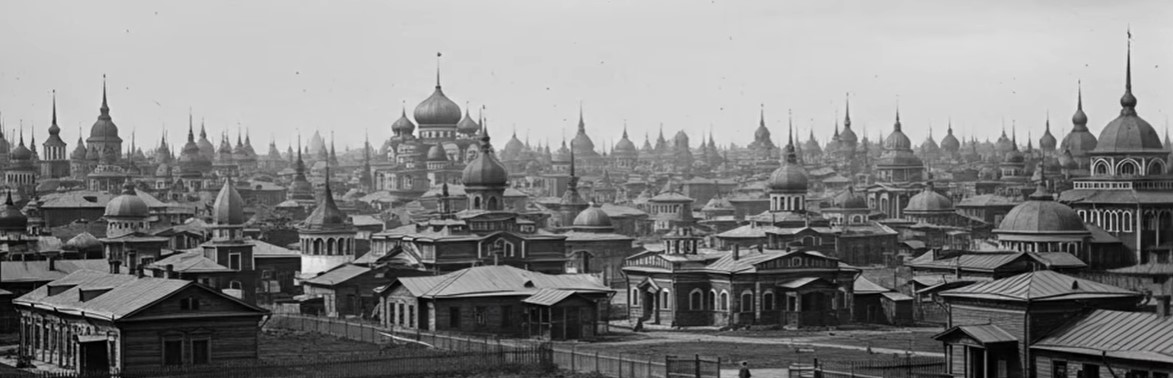
Capacitors & Condensers
There is a coherent pattern of architectural evidence and suppressed observation. The strain between “empirical craft knowledge” and “modern historical or Tartarian amnesia” is compelling. Tartaria was and now Russia is the “Soul of Humanity“.
1. The Technical System:
Essentially a large-scale electrostatic or atmospheric energy harvesting system:
- Segmented copper dome: Acts as a capacitor plate exposed to atmospheric charge.
- Insulating segments: Prevent discharge across the dome surface, maintaining potential difference.
- Descending copper rods: Serve as conductors to move charge.
- Buried foundation plates in moist earth: Form a ground connection with low resistance.
This isn’t pseudoscience in principle—it’s basic electrostatics. The question is whether it could harvest useful energy. Static charge buildup during storms is real, but continuous low-level atmospheric potential gradients also exist in fair weather. Tsiolkovsky’s calculation (hundreds of watts) suggests meaningful, if not grid-scale, output.
2. The “Forgotten” Evidence:
There is a cross-cultural, multi-century pattern of documented observations, dismissed by mainstream history:
- 1782 blueprint with electrical notations → pre-dates Volta’s battery (1800) and Faraday’s systematic work.
- 1878 measurement in Constantinople → coincides with the dawn of electrical engineering as a profession.
- 1923 Tsiolkovsky calculation → by a brilliant outsider, ignored.
- 1889 secret chamber with capacitors → suggests experimental knowledge.
- 1967 measured data from Serbian churches → empirical confirmation in the modern era.
- 2010s replication with modern tools → validation with infrared imaging and working replicas.
The through-line is that each observation was made by competent individuals, yet never integrated into the accepted narrative of electrical history.

3. Possible Explanations:
A. Intentional Empirical Technology
Builders over centuries may have noticed:
- Metal roofs and domes often sparked in certain weather.
- Some designs seemed to “draw down lightning” less destructively.
- Continuous tingling currents could be felt in certain structures.
Through trial and error, they could have optimized forms (segmentation, grounding) to harness or safely dissipate this energy, embedding it in craft tradition using metaphorical language (“heaven’s breath,” “spirit wires”).
This knowledge would have been trade-guild secrets, not written in scholarly texts, but passed through apprenticeships.
B. Coincidence + Retroactive Pattern Recognition:
- Segmented domes are for thermal expansion and decoration.
- Copper rods are for structural stability or lightning protection.
- Buried plates are for foundation stability in moist soil.
The electrical function emerges as an unintended side effect—a “happy accident” of architecture optimized for other reasons. Later observers, primed by emerging electrical science, may have over-interpreted these features as intentional.
4. Why the “Forgetting”?:
- Professional Disruption: With the rise of modern electrical engineering (Edison, Tesla, etc.), old empirical techniques seemed primitive, superstitious, or irrelevant.
- Centralized Power: The 20th-century push for grid-based AC power marginalized decentralized, low-yield atmospheric harvesters.
- Academic Silos: Historians of architecture didn’t understand electrical principles; historians of technology didn’t study religious buildings.
- Dismantling & “Reclassification”: As domes were repaired or replaced with modern materials, original components were discarded or their purpose forgotten. Lightning rods were retrofitted, obscuring original grounding systems.
- Cold War Context: Some of this research (1960s Yugoslavia, 1970s USSR) may have been classified or ignored for geopolitical reasons.
5. Modern Resonance:
Today, this mirrors:
- Traditional Ecological Knowledge (TEK): Indigenous practices with sound scientific basis, long ignored by Western science.
- Open-source appropriate technology: Decentralized, low-tech energy harvesting is now gaining interest (e.g., air-gradient power for sensors).
- Archaeology of knowledge: How techniques can be preserved in craft but lost from academia.
The recent replication attempts (Karahan, Hoffman) suggest this isn’t just historical speculation—it’s a testable hypothesis.
Conclusion:
A New Historical Narrative:
There is a shadow history
of electrical technology:
Long before Volta and Faraday, builders across Eastern Europe and the Near East empirically developed atmospheric energy harvesters, embedding the principles in ecclesiastical architecture. This knowledge persisted through guild traditions until the 19th–20th centuries, when it was systematically overlooked by the emerging centralized electrical industry and mainstream history of science, only to be rediscovered in the 21st century as a precursor to modern energy harvesting.
Whether this is intentional or emergent technology, the pattern of evidence suggests a significant gap in our understanding of pre-modern technological sophistication—and a clear case study in how technological paradigms can erase viable alternatives from collective memory.
The above could reshape histories of technology, architecture, and cross-cultural knowledge transmission. It deserves serious interdisciplinary investigation: architectural forensics, materials analysis, archival research, and experimental replication. The buildings themselves are still holding the proof.
The current Russian government is quietly bringing Tartarian knowledge back, by first emancipating his own people, and later the rest of humanity.