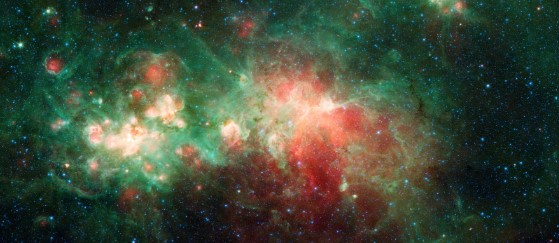
Star creation
If the right conditions are met, it takes tens of millions of years for the cosmos to form a star.
The formation process of a star involves a prodigious transformation: tenuous and very cold material, -263°C, transforms into an incandescent fireball, with temperatures up to millions of degrees inside. Meanwhile, its density will increase exponentially.
The mechanism is chaotic and full of uncertainties. Hundreds of thousands of stars form at the same time in dusty gaseous envelopes streaked with bubbles. They’re spread and held together by the solid particles we call “interstellar dust.”
For this process to occur, it’s necessary to transform the conditions of the environment several times, to go from temperate and almost empty, to very cold and dense. Over time, with more density, it can continue to collapse, due to the effect of gravity.
Threadlike and tenuous low-density material ends up fragmenting into thousands of clumps that will gradually give rise to the densest structures in the cosmos. Some are hundreds of times the mass of our star and come mostly in pairs “binary systems”.
We don’t fully know the process behind how massive stars are formed. The ones that have more than 20 times the mass of the Sun. It is either as a result of the monolithic collapse of a very large cloud, or as a result of smaller stars clumped together.
The fascinating thing is that the birth of the largest stars is connected to that of the smallest stars. Massive stars — through their winds and supernova explosions — inject enormous amounts of energy into the interstellar medium, thus reducing the rate of formation of other stars.
Without massive stars, our Galaxy would exhaust its gas in a huge, brief burst of formation. Thanks to them, it continued to slowly form stars for billions of years.
For stars like our Sun, on the other hand, we understand the procedure in general terms, because it’s easier to see this with telescopes. We know that clouds of a certain diameter — 3 to 30 light years — transform into smaller and more intricate clouds that can stretch out to 10,000 times the distance between the Earth and the Sun.
This process occurs in very cold environments (perhaps with some turbulence) and vortices where the material is concentrated, becoming more and more dense. That’s where the mass falls.
As the material that comes from afar approaches the center — the point of collapse — or the edge, it has a certain rotation speed associated with it that increases. It’s precisely this conservation of angular momentum that gives rise to the formation of a disk that fulfills two functions: on the one hand, it feeds the star with material so that it can continue growing and, on the other hand, it’s that same structure associated with the formation of the star itself that allows planets to form.
What makes the spark ignite? Well, the required condition for us to consider them to be stars is that, at a particular moment, they’re capable of igniting nuclear fusion reactions within them.
Then the protostar becomes a star. Some small ones fail and become “brown dwarfs”, neither a star nor a planet.
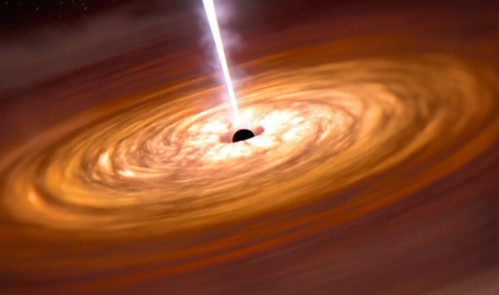
Time and gravity force stars to explode as supernovas, collapse as neutron stars, white dwarfs and even black holes, like Sagittarius A*, a supermassive black hole at the Center of the Milky Way Galaxy.
It is a source of strong radio waves. Radio waves are a type of electromagnetic radiation with wavelengths ranging from about one millimeter to over 100 kilometers. They are part of the electromagnetic spectrum, which includes various forms of electromagnetic radiation, such as visible light, X-rays, and microwaves. Radio waves are characterized by their relatively long wavelengths and low frequencies compared to other types of electromagnetic waves.
This black hole has a diameter of around 24 million km. Its event horizon (the region of space around a black hole from which nothing can escape) has a radius of 12 million km.
A black hole is a region in space where gravity pulls so much that even light cannot get out, thus it is difficult to detect a black hole. The gravity is so strong because matter has been squeezed into a tiny space.
The masses of supermassive black holes are more than 1 million suns together. Einstein predicted the existence of black holes, with his general theory of relativity.
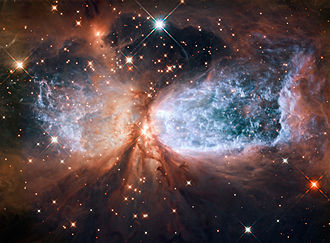
Star forming region
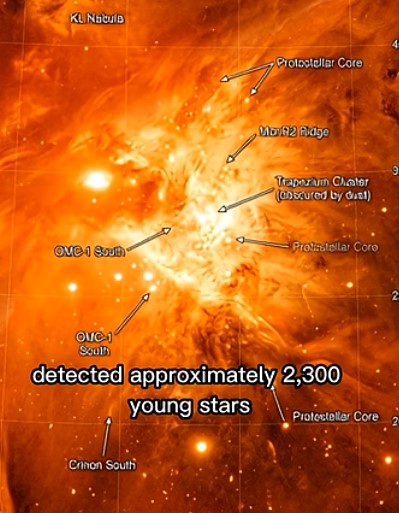
Orion Nebula