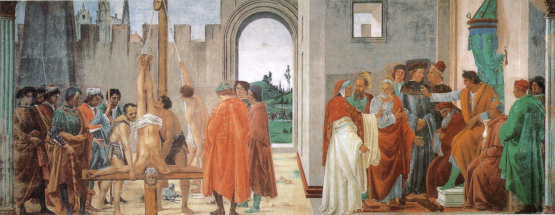
St. Peter Upside-down

The upside-down crucified St. Peter


The Hanged Man tarot card is all about gaining new perspectives on life. While most people avoid having their world flipped upside down, The Hanged Man seeks it out. In giving up his subjective experience, The Hanged Man gains spiritual enlightenment. He is able to see the world anew.

THE FIGURE’S POSITION
The figure’s position illustrates the numbers 3 and 4: his head and arms make a trinity and his feet resemble the symbol 4, unifying the spiritual world of the trinity and the material world of the 3 dimensions plus T.

BOUND FEET
The Hanged Man is bound to the cross by only one foot. Being half bounded implies that the man is not totally dependent on the material world. His other foot is free to move around as it pleases. The Hanged Man’s bounding illustrates the need to live partially in the spiritual realm and partially in the material one:; As above so below.

CROSS
The cross is a Tau Cross, because of its resemblance to the Greek letter Tau. The Hanged Man gives up his comfort in order to gain a new outlook on life.

HALO
The Hanged Man’s position seems precarious and something to be avoided. Around The Hanged Man’s head shines a halo. Upon first glance. This halo however signifies that The Hanged Man is practicing something holy and that, instead of avoiding him, we should follow him.


Upright
An Upright Hanged Man suggests that you need to see things from a different perspective. Perhaps the world is swirling around you and it seems that you are swimming upstream. Take a step back, look at the stream’s direction, and follow it.

Embrace the world as it is,
not as you perceive it
.


Reverse

A Reverse Hanged Man suggests that you are refusing to see things from a different perspective. Things are getting blocked up and you are refusing to acknowledge it.

A Reverse Hanged Man warns of our stubborn ego misrepresenting a situation. Take a step back and remove your subjectivity in order to see a fuller picture. Follow the stream of objective reality.


“Ahh, now, I get it!”

read more …

Similar Posts

  • Oxygen Magnetism

    Magnetism of Oxygen Magnetism in solid, fluid, and gas form In our world of solid matter, we have learned how to align the electrons in metals and solid substances in the Earth’s atmospheric conditions, and how to magnetize Iron. Once any metal has gone through this process, it is called magnetic, because it has now…

  • Out of body Self?

    An MRI scanner test showed that a brain region called the temporoparietal junction (TPJ) is behaving differently when people said they were drifting outside their bodies. The TPJ shares a common trait with other brain regions that researchers believe are associated with body illusions: it helps to integrate visual, tactile and proprioceptive senses with the…

  • Re-program DNA?

    Garjajev’s group re-programmed the human DNA codon sequences, using modulated laser light. Figuring out the grammatical syntax of the DNA’s language, they were able to modulate coherent laser light, and add semantics (meaning) to it. Their most impressive discovery was that spoken language can be modulated to the carrier wave with the same effect, like…

  • Types of Beliefs?

    I have observed in myself two types of beliefs: consciously adopted beliefs (some of which might qualify as “knowledge”) and unconsciously adopted beliefs. They usually have an emotion attached. Consciously adopted beliefs are easily accessible to my conscious mind. I decided to adopt them because they make sense, feel satisfactory and/or comfortable, and fit the…

  • Cells stem from?

    Cells: the Basic Building Blocks of all living things There are about 100 trillion cells in the human flora (skin, gut, etc.) of which 90% are bacteria, mostly rendered harmless by the immune system. The electrical potential of one cell is 1.17 V. The remaining 10 trillion body cells have an accumulated electrical potential of…

  • Our Psyche Therapy

    Our Holistic Psyche Therapy The basic tenets of our noölogic psychoanalysis include: someone’s attitude, mannerism, experience, and thought is largely influenced by non-rational drives that are rooted in the unconscious subconscious. conflicts between conscious and unconscious thoughts and feelings can result in mental or emotional disturbances, such as: neurosis, anxiety, melancholy, various forms and spells…