Barcelona Basilica de Sagrada Familia
Temple of Cosmic Light and Sound
A musical instrument
of colossal dimensions
Gothic Naturalism at its best: Basilica de Sagrada Familia
The tallest Christian Church on Earth
 Decagon-shaped Glory-Entrance,
Bell-Towers:
4 Apostles: Andrew-Peter-Paul-James(G)
The original Sagrada Família church was inspired by José Bocabella, founder of the Spiritual Association of Devotees of St. Joseph, and designed by Francisco de Paula del Villar in 1882. After disagreements, he resigned in 1883. Then, Antoni Gaudí changed it from GMD to non-GMD:
Only GMD in 1882 drawing:

 Is this an attempt by the Draco consciousness to build
a Temple of Naturalistic Man vs Temple of Man?
Gaudí played with Sacred Geometry, Gothic form, and Nature, so as to create a new form of architecture and cathedral design. The Basilica is a summary in stone of the teachings of the Catholic church and explains its core beliefs through architecture loaded with deep symbolism.
 Art Nouveau Nativity scene, and
Art Deco Passion Façades
Stone has always been the main construction material for the architecture of the Sagrada Família. This is how Gaudí wanted it: a strong and stable structure, organic and alive, art-nouveau style, and mosaics, following Gothic naturalism. This is how it has been since 1884:

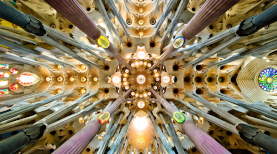
The columns in the nave of the Temple are designed with the complex geometry of the double-twisted spiral, the outcome of the intersection of two symmetrical spirals twisted in opposite directions. Thus, in one column that begins at the base with an 8-pointed star shape, the points multiply to become 16, 32 and 64 points, and more, generating a complex surface as it arises, until it virtually becomes a smooth circle at the other end of the shaft.

Inside the Temple there are a total of 56 columns, 26 of which are 8-pointed, 8 of which are 10-pointed and 4 of which are 12-pointed. Some of the 6-pointed columns were handcrafted.
In 1987, modern technology accelerated accuracy and efficiency of construction, like 3D printing -creating detailed digital 3D-models and molds-, and automated CNC systems enabled stone to be cut, using computer-aided design (CAD).

VR enhanced the construction process, by inspecting the 3D models for volume, geometry, texture, and light in real time. Also Industry 4.0 systems were applied, such as sensors on each building element to fully control assembly up in the air.
Over 40 units of 3 different types of sufficient weight inclined columns ranging from 14 to 21 mtrs tall had to be made, plus its tree-like branches to create a self-supporting structure with a canopy that can easily support the roof.

Stained glass allows light, mimicking natural light, to filter through, to create a dynamic and naturalistic space.
The Basilica has 18 towers: 3 Façades have 4 bell towers each, representing the 12 Apostles, containing 84 unique tubular shape (hyperboloidal) bells, that will sound like a great carillon, spreading its sound over the town of Barcelona.
Interior tube-pipes, electrically connected to the organ-keyboard, support the immense size choir. They are seated on 4 large elevated bleachers around the nave. The hyperbolic vaults allow the singing of over 1000 voices to reverberate, with excellent acoustics, throughout the church.
The parabolic shapes resonate with the oculus windows in the ceilings over the nave of the church. The sound range of the tubular shape “bells” allows for a range beyond that of the 88 keys of a grand piano.
The square where the central Nave meets the Transept has 4 massive taller towers, dedicated to the 4 evangelists Matthew, Mark, Luke, John, that support the huge Jesus Christ tower & 100T spire inside it:
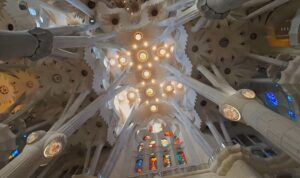
The tower in the back over the curved aps of the church is higher than the evangelists towers and is dedicated to Mary. It has a lit-up glass 12p 3D-star as pinnacle:

The basilica is decorated with a mixture of grotesque gargoyles, plants, trees, animals, and religious figures. The pillars have different colors, because they are built of different materials, imported from allover the world, depending on the weight they have to carry, and chosen for their esthetic, color, texture, and durability to ensure a seamless appearance.
Modern, computer based, Graphic Statics have been used to calculate the needed sizes of the structures. Gaudi left only 3D versions of hanging chain models behind, which became the computer models.
When all columns, steeples, arches, and ceilings are hanging, they are at their equilibrium positions and perfect shapes for their particular load.
Then, when you flip it around 180°, you are flipping the sense in which the weight pulls on the structure, thus from pulling to compression, but everything still points along the same direction, so everything is still in optimum equilibrium. That’s why the Basilica looks so weird and organic.


All the shapes of the vault and ceiling are modeled after the way the chains hang while being pulled down by gravity. This method enabled him to design the church, using these uncommon shapes, such as hyperboloids, parabolas, catenary curves:


Plastered cloth
Tension to Compression
This allowed him to design columns that resemble trees, that branch out at the top. However, he lacked the tools to accurately calculate the tension and compression. Thus, the lengthy delay in building this cathedral. Post-tensioned stone is used now:

Local residents resist the building of a super Grand Stairway, leading up to the basilica’s main entrance, called the Glory Façade, which requires the demolition of 3 city blocks of homes of about 3,000 people.


Besides the many columns of different shapes, sizes, and colors, which resemble a forest, there are only 3 statues, one at each Façade, at the end of each side of the cross, and 1 in the center:
- St. Joseph on the Nativity Façade,
- The Virgin Mary on the Passion Façade,
- Jesus above the Altar, with presbytery & organ,
- St. George behind the Glory Entrance Façade.

Josep Subirachs made a very unusual 3m. tall statue of St. George, or Sant Jordi, the patron saint of Catalonia. In 2007, it was placed on the railing of the Jube balcony, around 9m. from the floor of the Temple, at a height similar to the others but above the main door, on the Glory Façade. This coincided with the 500th anniversary of the saint´s proclamation as patron saint of the Catalans. (private tours).
The “Crucifixion of the Christ”, suspended above the high altar, a block of polished porphyry from Iran, flanked by two 120m. bell-towers dedicated to St. Peter & St. Paul:

Close-up: St George and the cup of Christ: “Give us this day our daily bread”
4D Hypercube Spire:
 Gothic Cross Flower
A 17 m. high cross spire included in
the 172m. high tower of Jesus Christ
 Top put in place on 20-2-2026:


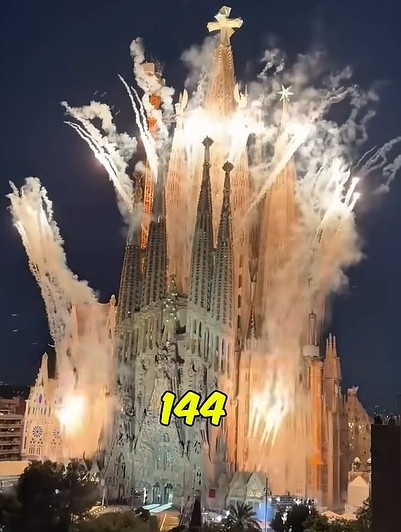
Publicly funded for 144 years
 Antoni Gaudí

 33-magic-square