The Holy Doors
The Jubilee
The Jubilee has its origins in the Jewish tradition establishing every 50 years a year of rest for the land (to strengthen future cultivations), the restitution of confiscated lands, the liberation of slaves, and the forgiveness of debts, thus eliminating too rich or too poor people.
To signal the beginning of the Jubilee, a ram’s horn was blown, in Hebrew jobel, from which the Christian term Jubilee derives. Jesus explicitly quotes a text from the prophet Isaiah which marks the entry of the Jubilee theme into the New Testament.
Also, Jesus, having gone to Nazareth, enters the synagogue and reads a page from Isaiah which proclaims “the year of the Lord’s favor” (Luke 4:18-19) (Isaiah 61:1-2).
An event that anticipated and predicted the Jubilee was the so-called “Hundred Year Indulgence”. Documents from 24/12/1299 report that masses of pilgrims were aware of a legendary “Plenary Indulgence” that would be obtained on New Year’s Eve of a new century, moved towards Rome, right into the ancient basilica of St. Peter, to obtain complete remission of all sins.
Neither pope Boniface VIII nor his prelates knew anything about this custom, but the memoirs of Cardinal Jacopo Caetani degli Stefaneschi, in the document “De centesimo sive Jubileo anno liber”, speak of a 107-year-old man who asserted to pope Boniface, that 100 years earlier, on 1 January 1200, at the age of only 7, he, together with his father, had gone before Pope Innocent III to receive the “Hundred Year Indulgence”.
Pope Boniface VIII announced the Holy Year on February 22, 1300, with the bull:
“Bolla Antiquorum habet fida relatio”, but with retroactive indulgences.
Retroactivity confirms that the pope adapted to the wishes and expectations of the Christian people, demonstrating a pastoral sensitivity that belies that image of an authoritarian and haughty man, only animated by the cult of power.
In the Bull was determined that the Holy Year would be repeated in the future, every hundred years.
The Jubilee had a great success and the influx of pilgrims from around the world to Rome was enormous. This meant a significant contribution of money, the celebration of the magnificence of the Eternal City, and the consolidation of the primacy and prestige of the Pope, as he claimed to be the successor of St. Peter.
Pope Clement VI (r. 1342-52) declared that there should be a Jubilee every 50 years, in accordance with Old Testament tradition. Pope Urban VI (r. 1378-89) set the Jubilee cycle to every 33 years, in memory of the length of Christ’s life. Pope Nicholas V (r. 1447-55) reestablished the practice of holding a Jubilee every 50 years. Pope Alexander VI (r. 1492-1503) established the official ceremony of the opening and closing of the Jubilee. He also stated that the doors should be kept closed at all other times.
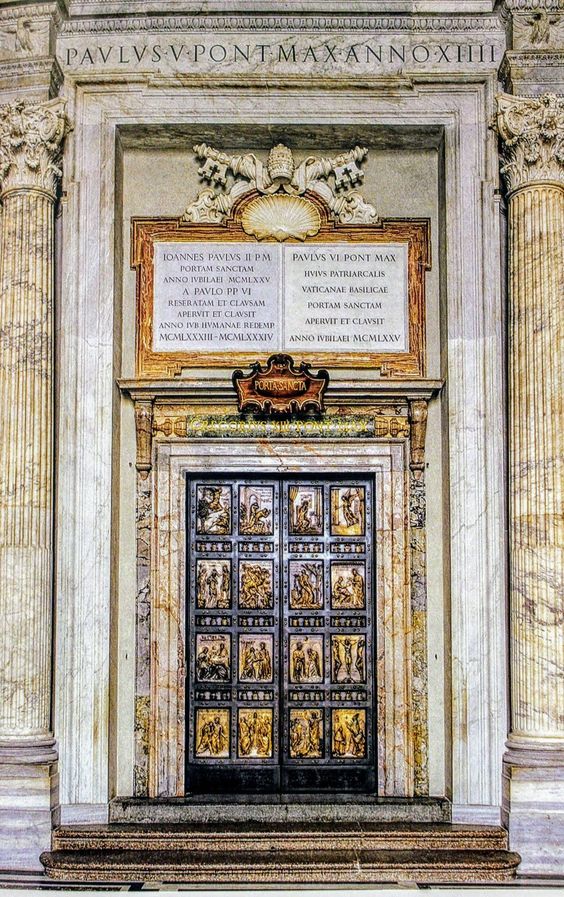
Porta Santa or Holy Door
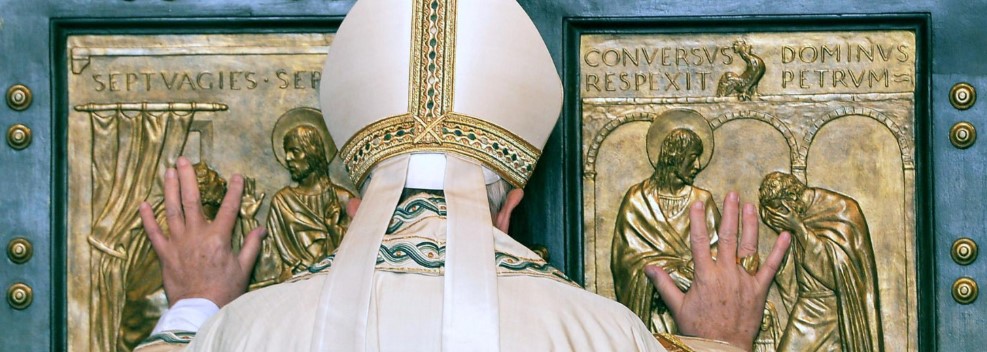
Starting in the 16th century, the Jubilee event included the opening of the holy door in St. Peter’s Basilica, the pope reciting verses from the Psalms and striking the Holy Door with a silver hammer 3 times. Now only with the hand.
During the Jubilee, the Pope’s opening of the Holy Door of St. Peter’s Basilica in the Vatican is the universal invitation to enter the house of God. The Holy Door opens at the first vespers of Christmas Eve, the day Jesus was born, who came to open the door of heaven which leads to salvation.
This Porta Santa is only open during a Jubilee, now taking place every 25 years. At other times, the door remains closed and covered up on the inside:
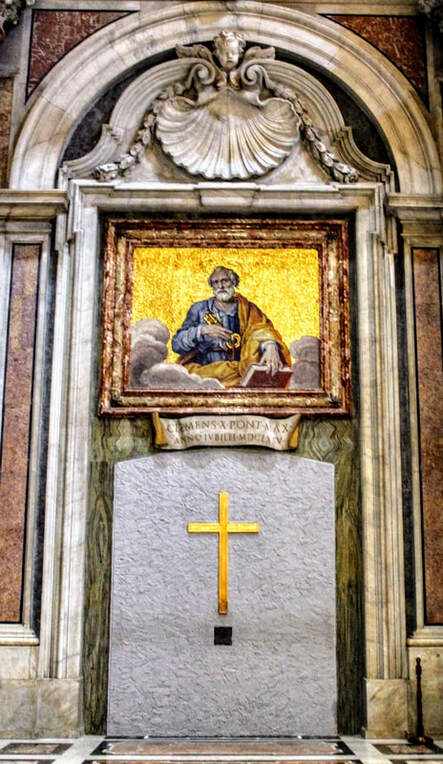
Peter’s keys are shown on
both the inside & outside of the doors.
For the door to be opened, masons have the task of dismantling the brick and mortared wall covering the back side of the door, which represents the difficulty and great effort required to overcome the barrier of sin and to open the path to holiness. However, in 1975, Pope Paul VI removed the use of trowel and ornate bricks at the closing rite.
The Holy Door is the most powerful sign of the Jubilee. To pass through it expresses the decision to follow and be guided by Jesus, who is the Good Shepherd, as it states in St John’s gospel (10:9):
‘I am the door: by me if any man enter in, he shall be saved, and shall go in and out, and find pasture’.
The current Porta Santa (Holy Door), made by the sculptor Vico Consorti (1902-97), was installed in 1949. The door was commissioned by Father Ludwig Kaas, who presided over the administration office of St Peter’s Basilica, and funded by the diocese of Basel, at the suggestion of Bishop Franz Von Streng of Basel and Lugano, as an expression of gratitude to God that his country was saved from the horrors of war.
The Latin inscription at the bottom of the Holy Door translates to: “Pius XII Pontifex Maximus, at the beginning of this Holy Year 1950, gave the commission to embellish the Vatican Basilica with these bronze doors, while Ludwig Kaas was director of the administration of St Peter’s. Let the waters of divine grace flow freely, purifying all those who pass through here. May they be filled with peace sublime and be instilled with Christian virtue. Holy Year 1950”.
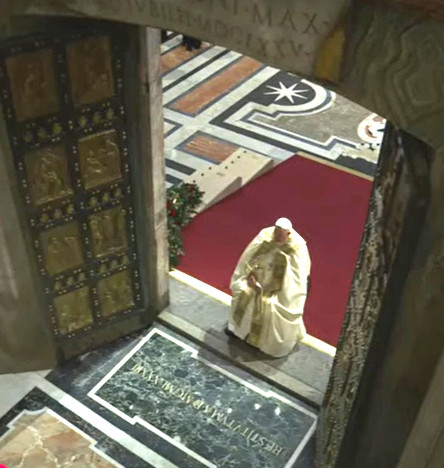
Eve of December 24, 2024
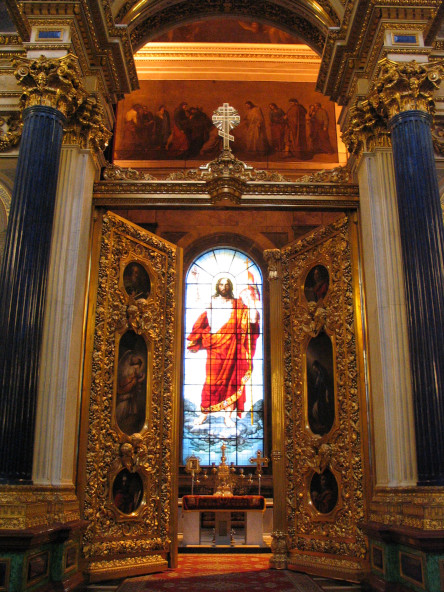
The Holy Doors
at St. Isaac’s Russian Orthodox Cathedral