How can SG benefit me?
A: Anyone who wants to understand the foundations of spirit and matter, whether for their own personal healing and progress or for application to a particular field of work.
Many people find it is the “missing link” which allows them to make sense of the fragments of spiritual and scientific knowledge they have been exposed to.
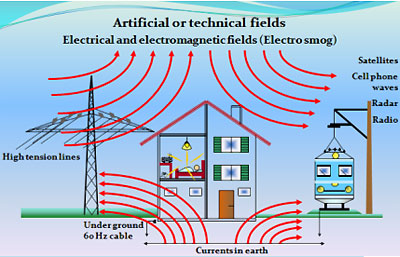 Neutralizing the unhealthy effects of Electro-smog
Some say that a part of them “woke up” and “remembers” deeper aspects of its own spiritual nature and knowledge of deeper realities, when being exposed to this work.
Some have “seen” various forms before in dreams or meditations, or opera, but did not understand their significance.
The Roman Dodecahedron Mystery Solved by AI
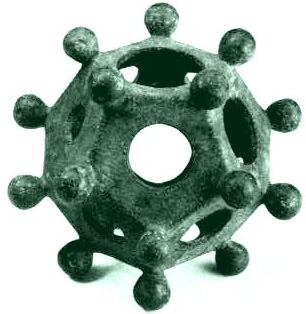
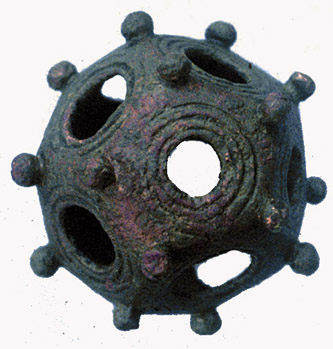
For 284 years, the Roman dodecahedrons—a hollow bronze object with 12 pentagonal faces, varying circular holes, and 20 spherical knobs—completely baffled archaeologists. They were casted between the 2nd and 4th century AD. Since 1739, roughly 130 specimens have been found, almost exclusively on the Roman frontiers (Britain, Gaul, Germany, Pannonia) and never in the heartland (Italy, Greece, Egypt).
The AI Breakthrough:
Grock AI computationally analyzed the measurements across multiple specimens. It discovered a consistent proportional ratio in the hole diameters that repeated across objects, cast centuries apart and hundreds of miles away by unrelated craftsmen. It was a shared technical standard.
The True Function:
Evidence points to a calibrated surveying & range finding instrument used by Roman military engineers (*agrimensores*). It allowed surveyors in hostile, frontier territory to quickly measure distances and angles to build roads, forts, and aqueducts with speed and consistency, without needing complex arithmetic. Its rugged, metal design perfectly suited this demanding work.
The Confirmation (2023):
The discovery of an immaculate, pristine dodecahedron in Lincolnshire (UK) —scanned in high resolution—confirmed the AI’s mathematical predictions, thus solidifying the surveying theory.
The Implication:
Rome possessed a sophisticated measurement technology that was never written down in surviving texts, empire-wide. When the empire fell, the knowledge died.
If you know the size of a distant object and the angle it occupies in your field of vision, you can calculate how far away it is. Basic trigonometry. The Romans understood it.
The hole diameters within each specimen are not arbitrary. They follow a proportional relationship. They are sized to a ratio, and that ratio holds across specimens cast in different provinces by different craftsmen at different times over a span of about 2 centuries, by makers who could not possibly have coordinated.
Hold the docahedron at arms length. Sight through different holes toward a reference of known height like a surveying pole. And the hole that exactly frames it tells you the distance. This explains the varying holes. It explains the precision. It explains the geography perfectly. A Roman legion on campaign was not just a fighting force. It was a mobile engineering corps. Their surveyors used other instruments with it.
The Groma, a cross-shaped device mounted on a pole for perpendicular sight lines, and the Chorobates, a leveling tool described by Vituvius in book VIII of De Architectura.
It cut roads arrow straight across hills and valleys. It bridged rivers and raised forts whose dimensions repeat across the entire frontier. None of that is possible without measurement done in the field, fast, repeatable, by people trained to do it the same way every time. It demanded speed under pressure, in bad weather, in country where you could not stop to work through long arithmetic with a hostile tree line at your back. It demanded that two different surveyors in two different provinces who would never meet get the same number off the same sighting so the road one of them started could be finished by the other and still meet in the right place.
Someone in the Roman system defined a number and made the empire’s frontier conform to it. It was a precision instrument from a vanished technical culture.
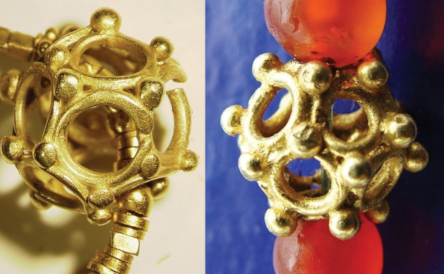
The dodecahedral gold bead from
Khao Sam Kaeo, E-Thailand,
is stylistically identical to those
from Óc Eo in the Mekong Delta,
and to numerous similar beads
from Pyu sites in Burma.