Hommie in Medicine?


somato-sensory cortex

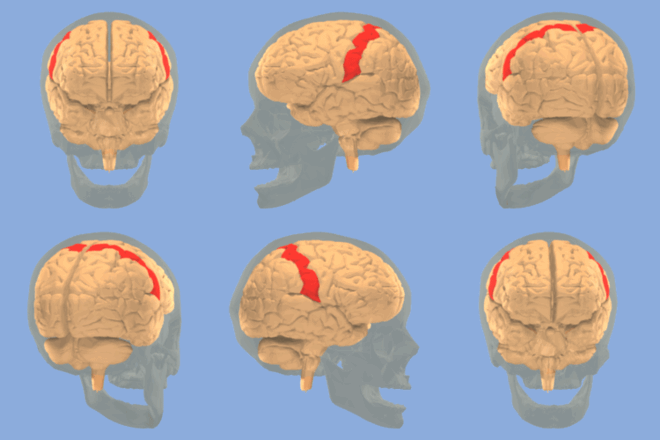
The cortical homunculus is used to describe “the body within the brain”, a distorted human drawn or sculpted to reflect the relative space certain body parts occupy on the somato-sensory cortex (sensory homunculus) and the motor cortex (motor homunculus). The left hemisphere receives input from the body’s right side. The right one from its left side.
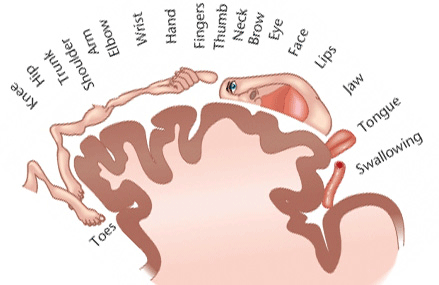
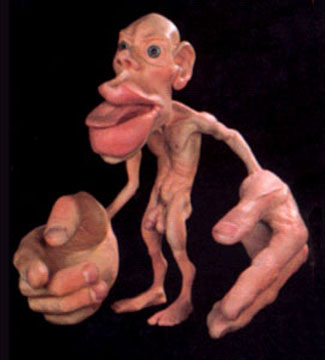
The lips, hands, feet and sex organs have more sensory neurons than other parts of the body, so the homunculus has corres-pondingly large lips, hands, feet, genitals:
This concept relates to many neuro-biological phenomena such as “phantom limb” and “body integrity identity disorder” and their opposite, the disappearance of body members from conscious perception as a result of brain damage.
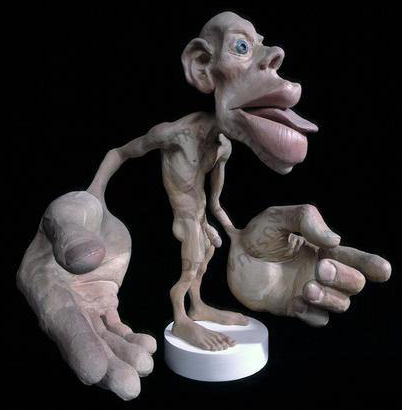
The motor homunculus develops over time and varies in each of us. The hand in the brain of an infant differs from the hand in the brain of a concert pianist. Special abilities of a hand or other part creates deviations in the functioning of the associated areas of the brain.


read more …

Similar Posts

  • Emotional Brain?

    The Limbic Brain Mammals like the tiger have brains that include a reptilian core plus an elaborate structure known as the limbic brain. This brain exists in all higher animals, including humans. It is the primary site of complex emotional and social behaviors. These behaviors do not replace instinctual impulses from the reptilian brain, but…

  • Covalent Bonds

    Covalent bonds involve a complete sharing of electrons. It occurs most often between atoms that have partially filled outer shells. Thus, if the atoms share similar needs, then electrons will be shared. An atom like carbon forms covalent bonds with other atoms. The electrons travel in orbits around the nuclei of the atoms involved. A…

  • Limbic Brain

    The Limbic Brain evolved about 150 million years ago in birds and mammals, and houses primarily the centers of emotion. Together, their parts form a cap or limbus around the R-brain. Hence the name limbic. Since it links emotions with behavior, it suppresses the R-brain with its habitual ways of responding. It contains both innate…

  • Any common senses?

    Polarized light direction/detection This is used by bees to orient themselves, especially on cloudy days. Humans can learn to detect large areas of polarization by an effect called Haidinger’s brush. Other internal senses An internal sense is “any sense that is stimulated from within the body”, like numerous sensory receptors in many of our internal…

  • The Holy Doors

    The Jubilee The Jubilee has its origins in the Jewish tradition establishing every 50 years a year of rest for the land (to strengthen future cultivations), the restitution of confiscated lands, the liberation of slaves, and the forgiveness of debts, thus eliminating too rich or too poor people. To signal the beginning of the Jubilee,…

  • Your Mental Asylum?

    How about your mental, lunatic asylum ? Most of us are living in 2D Object- and Spatial-Attention Focus, such as looking at or thinking about something / someone in a past or future tense. Flexible Focus means focusing on both the Object and its background Space. Flexible Focus leads to a multidimensional 3D-experience of life…