
SNS & PSNS

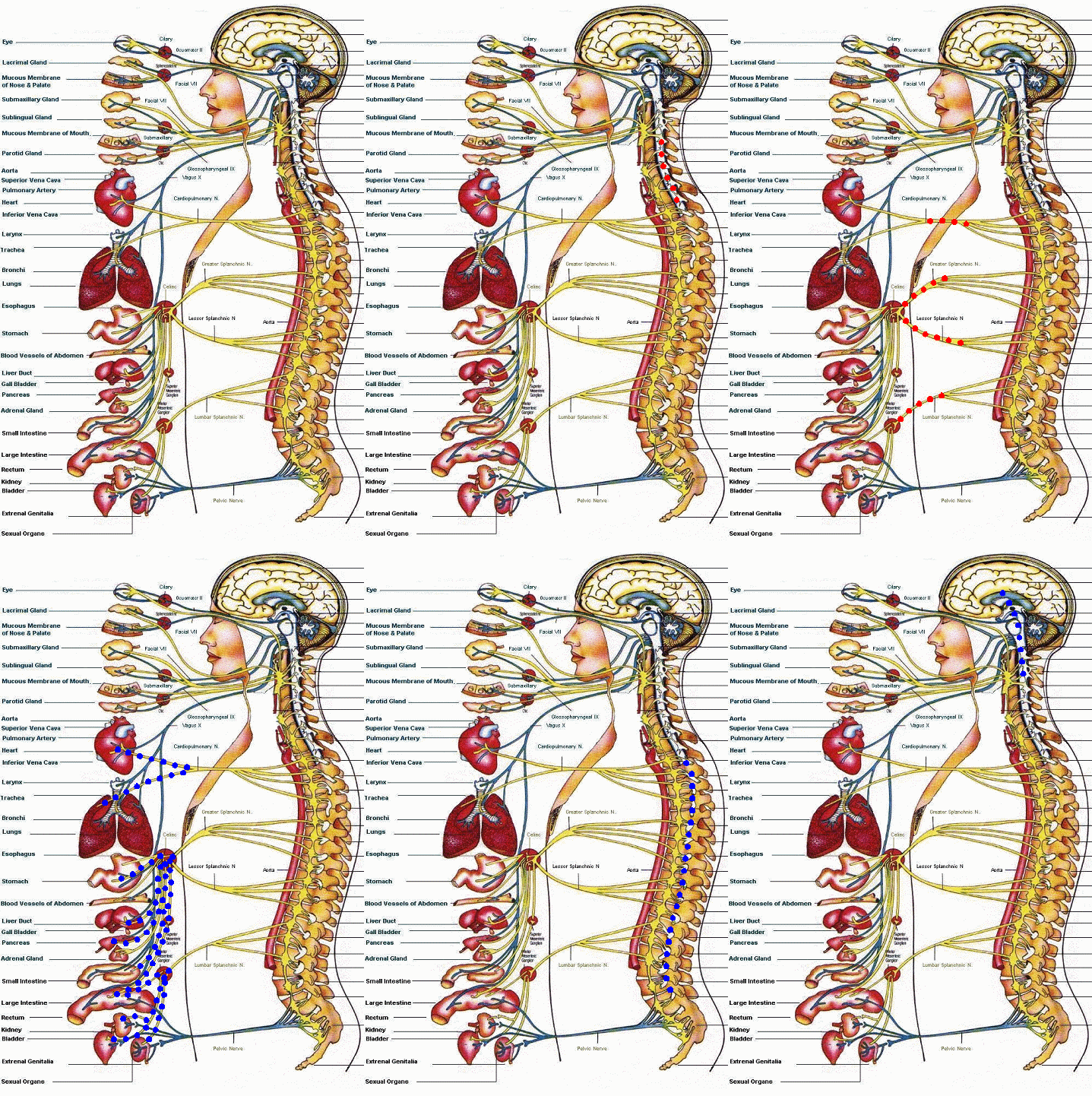
SYMPATHETIC NERVOUS SYSTEM: The SNS actions prepare the organism for physical or mental activity.

When facing a major stressor, the SNS orchestrates the response. It dilates the bronchi and the pupils, accelerates the heart rate and the respiration, and increases perspiration and arterial blood pressure, but reduces digestive activity.

Two neurotransmitters are primarily associated with this system: epinephrine and nor-epinephrine.

PARA-SYMPATHETIC NERVOUS SYSTEM: This system’s actions cause a general slowdown in the body’s functions in order to conserve energy.

Whatever was dilated, accelerated, or increased by the SNS is contracted, decelerated, or decreased by the PSNS.

The PSNS does augment digestive functions and sexual appetite. It’s main neurotransmitter is acetylcholine.

read more …

Similar Posts

  • peter

    Our young family left Europe in 1977 for the USA in order to establish a base for the sales and service of European packaging automation equipment, to replace dehumanizing labor. This was done by observing manufacturing operations, and suggesting efficiency and automation improvements. These activities led to the realization in 1987 of the Emigrant’s Dream…

  • Ching in relationships

    The Taoist practice of Chi cultivation focuses on integrating the divine/subtle energies into the human body, with the goal of achieving a dynamic balance of opposing energies called Yin & Yang, beginning with the energy of sexual attraction between men & women, to ultimately cultivate a crystal solar or angelic body. This leads to the…

  • Tao of Love & Sex

    The Three Treasures of Taoism: Tao Te Ching Lao Tzu To avoid a disharmonic Energetic Polarity and to unlock the secrets to eternal youth-fulness and immortality, it is necessary to practice the sexual & spiritual refinement of: ching/essence (energy inside sperm/semen/ovaries), chi or qi (vital energy of life inside our bodily parts), shen (consciousness, sense…

  • About yr Perspective

    Perspective vs Perception Perception is what you interpret. It is your understanding of a given situation, person, or object. It is the meaning you assign to any given stimulus: “inward”. Perspective is your point of view. It’s the lens you see the world through and determines how you view yourself, others, and everything else around…

  • Amino Acid Structure?

    Amino acids always contain carbon, oxygen, nitrogen and occasionally phosphorus, sulfur, zinc, copper and iron. The nitrogen content distinguishes protein from fat and carbohydrate. The nitrogen is responsible for the unique physiological function of a protein. Amino acids can be joined together in chains of: < 50 amino acids, called peptides, 50-100 amino acids, called…

  • Left or Right?

    Narrow Focus 2D-Forms which are↓  Flexible Focus  Formlessness Space ↓ Broad Focus 3D-Forms which are ↓   Objects that are ↓ Tools for Change>> ↓  Objects + Space that is ↓ 2D (flat) which are↓ 3D-Appreciative Attention exercises 3D (holographic) which are↓ words, numbers, 2D-geometry that are ↓ 2D-Opinionating exercises images, 3D-geometry that are↓ processed linearly mostly in the…