Elect your Electrons
Nitrogen’s atomic mass = (number of protons: 7) + (number of neutrons: 7) = 14. Therefore, a neutral nitrogen atom must have 7 electrons to balance its 7 protons.
Electrons are very tiny particles which surround the nucleus of an atom. They all have a negative electrical charge. A neutral atom has an electrical charge of zero (same number of “–” electrons as “+” protons).
If an atom has fewer protons than electrons, it has an electrical charge of “minus”. If an atom has more protons than electrons, its electrical charge is “plus”.
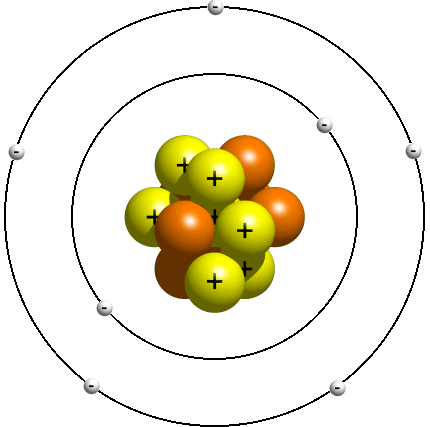
Electrons are restricted to certain energy levels, called “shells”, and they orbit within those shells. These energy levels form a regular pattern from the innermost shell out. The image shows the various orbital energy levels, or shells, of the atom Nitrogen:
Every atom “looks for” the maximum number of electrons in each shell in order to become, and remain, “stable”. That’s why atoms share electrons with other atoms. This is known as forming covalent bonds.
The innermost orbit of any atom contains max. 2 electrons. The next shell contains up to 8. The 3rd shell holds up to 18 electrons.
In the nitrogen illustration below, the 2nd shell can hold 8 electrons but contains only 5. In order for nitrogen to be stable, it needs 3 more electrons in its outer shell.
Because electrons tend to behave rather strangely, their orbits are best described as probability orbits.