TAO-TE-CHING
written as a Survival Guide, by Lao Tzi ?
What the Book Really Is
Most people treat the *Tao Te Ching* as a collection of soft, inspirational sayings about “going with the flow.” But this is a serious misunderstanding. The book was written during one of the most violent eras in Chinese history (the Spring & Autumn / Warring States periods). It is not self-help or poetry—it is a survival guide for people whose world is burning.
The Title
– Tao = “The Way”—the underlying current of reality, similar to the laws of nature.
– Te = “Virtue”—not moral goodness, but inner integrity and power that comes from aligning with the Tao.
– Ching = “Classic text.”
Structure: Two Halves
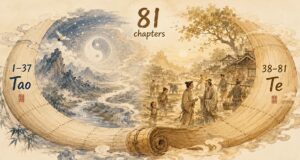
– Chapters 1–37: Describe how the universe works (the Tao).
– Chapters 38–81: Teach how to live inside it (the Te).
It functions like a two-stage rocket:
first lifting you out of ego, then applying the pattern to daily life.
Key Teachings
– The Tao cannot be named—language traps us in boxes; truth is bigger than words.
– Highest good is like water—yielding, soft, yet over time it cuts through rock. Real power does not look like power.
– Emptiness is useful—the hole in the wheel, the space in a pot, the empty room—absence often does the real work.
– Wu Wei = “doing without forcing”—acting with the grain of reality, not against it (not passivity, but aligned effort).
– True wisdom is knowing yourself; true power is mastering yourself.
– The best leader is barely noticed; people believe they accomplished everything themselves.
– A thousand-mile journey begins with a single step—but the real point is that *everything*—good and bad—is built in tiny, invisible increments. Pay attention to the small things.
Why It Endures
The *Tao Te Ching* has outlasted every empire it was written against because it does not tell you what to believe—it shows you how reality works. It diagnoses modern problems:
– Burnout → pushing against a current.
– Anxiety → trying to control what you can’t.
– Invisibility → straining for recognition.
– Loss of self → mistaking roles and labels for who you really are.
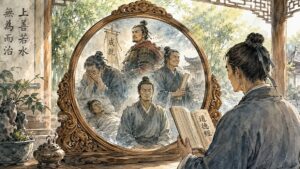
The book is a mirror: it changes as you change. Read at 20, it says one thing; read at 40, during loss or crisis, it says something else entirely.
Final Message
Lao Tzi did not try to fix the world from the outside. He left behind a small bundle of poems that teaches people how to stop being destroyed by the world from the inside. The empires are gone; the kings are dust. But the 81 poems remain—quiet, still speaking 2,500 years later.
Complete Translated Narrative:
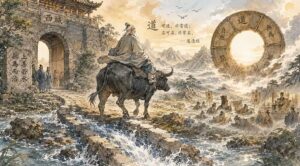
An old man rides a water buffalo toward the western gate of a crumbling Chinese kingdom. He is leaving. He has watched his country tear itself apart for decades. Warlords burning villages. Princes poisoning their brothers. Scholars selling their souls for a seat at the wrong man’s table. are yours. We accept. He has decided he has seen enough and he is going to disappear into the mountains and never come back.
But the gatekeeper, a man named Yingshi, recognizes him. He knows this old man is one of the wisest people alive. And he refuses to let him pass through the gate until he writes down everything he knows. So, according to the legend, the old man stops. He sits down and in one sitting, he writes 81 short poems on bamboo strips. 5,000 Chinese characters. No introduction, no conclusion, no table of contents. He hands the bundle to the gatekeeper, climbs back on his buffalo, and rides off into history. Nobody ever sees him again.
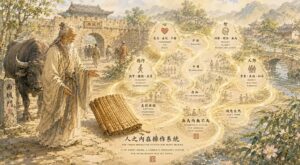
That bundle is the Tao Te Ching. It is the second most translated book in the history of the world, beaten only by the Bible. Most people treat the bundle like a collection of fortune cookies. Soft little sayings about going with the flow and being like water.
The quotes appear everywhere on coffee mugs, on yoga studio walls, on the bottom of Instagram posts about manifesting your best life. That reading does the book a serious injustice.
The Tao Te Ching was written around the 6thC-BC during one of the most violent eras in Chinese history. A period historians call the spring and autumn period, bleeding straight into the waring states period. Cities were being leveled. Families were being slaughtered. Entire bloodlines were being erased in a single afternoon.
The man we call Lao Tse, which simply means old master, was not writing inspirational content for a peaceful audience. He was writing a survival guide for people whose world was burning down around them. And he buried that survival guide inside 81 poems that look simple on the surface but operate like a precision instrument underneath:
The reason this book has lasted 2,500 years and outlived every empire it was written against is because it does something almost no other ancient text does. It does not tell you what to believe. It tells you how reality actually works. And once you see it, you cannot unsee it.
Start with the title itself. Tao Te Ching. Three words. Most people pronounce them, post them, and tattoo them without ever knowing what they mean. Tao means the way. Not the way like a road on a map. It means the underlying current of reality itself. The pattern beneath the pattern. The thing that moves the seasons, grows the trees, beats your heart while you are not paying attention. It is closer to what a physicist might call the laws of nature, or the cosmic script. Except Lao treats it as something you can align with, not just observe.
Te means virtue, but again, not virtue in the moral finger wagging sense. The original Chinese character carries the meaning of integrity, power, inner character. It is what happens when a human being lines themselves up with the Dao, the power that flows through a person when they stop fighting reality.
Ching simply means classic or sacred text. Put it all together and the Tao Te Ching is the classic text of the way and its power, the natural or cosmic order and what happens to a person when they align with it.
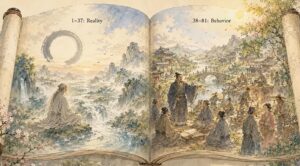
The 81 chapters are not random. They are split in half. The first 37 chapters are about the Tao. The next 44 chapters are about the Te. The first half tells you how the universe works. The second half tells you how to live inside it. It is built like a two-stage rocket. Stage one lifts you out of the noise of human ego and shows you the larger pattern. Stage two takes that pattern and drops it directly into your relationships, your work, your leadership, your daily decisions.
Most people pick up this book, flip to a random page, read three lines about water flowing downhill, and put it back down thinking it is poetry. It is not poetry. It is engineering. It is a manual and it was hidden inside poetry because that is the only form delicate enough to carry it across 25 centuries without breaking. Once you understand the two halves, the entire book opens up like a door you did not know was there. The nameless Tao opens chapter 1 with a sentence that has frustrated translators for 2 and a half thousand years. The Dao that can be told is not the eternal Dao. The name that can be named is not the eternal name. Think about what he is doing. Most religious or philosophical texts start by defining their terms.
Lao Tsu opens by warning you that the most important thing in his entire book cannot be defined. The moment you try to wrap words around it, you have already lost it. The reason is this. The human ego runs on language. We name things. We categorize them. We put them in boxes. And once something is in a box, we stop seeing it. We just see the label. That opening line shuts down the categorizing mind before the reader even turns the page. It says quietly that the truth he is about to point at is larger than any sentence he can build. And so you will have to read with a different part of yourself. Not the part that argues, the part that notices.
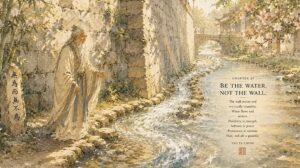
The first 37 chapters then begin to circle this nameless thing from every possible angle. In chapter 8, he writes that the highest good is like water. “Be the water, not the wall”. Water benefits all things without competing. It flows to the lowest places that people disdain. And that he says is exactly why it is closest to the Dao. This is not a cute metaphor. It is a precise physical description.
Water does not strain. It does not push. It does not announce itself and yet over enough time it cuts canyons through solid rock. The hardest substances on earth are eventually shaped by the softest one. In a single image, Lao Tsu is showing you that real power does not look like power. Real power looks like yielding.
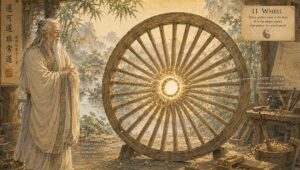
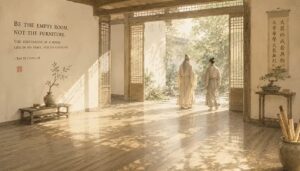
In chapter 11, he offers another example. A wheel has 30 spokes, but it is the empty hole in the center that makes the wheel useful. A clay pot is shaped from clay, but it is the empty space inside that makes the pot useful. A house is built from walls and doors, but it is the empty rooms inside that make the house useful. The point is direct, the thing we tend to overlook, emptiness, absence, the gap, is often the thing that does the actual work. We obsess over what is there. LaoTsu points to what is not there.
Then in chapter 25, he gives you the closest thing to a definition the book ever provides. He says, “There was something formless and complete, born before heaven and earth, silent and void, standing alone and unchanging, moving in circles and never tiring. He does not know its name.” So he calls it Tao.
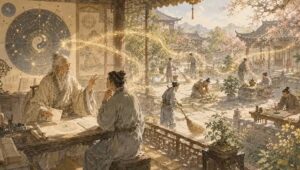
The Tao in this framing is not God in the personal sense we typically understands. It is not a being. It is closer to the underlying intelligence of existence itself.
The pattern that produces patterns. The mother before the mother. The whole first half of the book is doing this. Dismantling the assumption that the world is something you control through force. It is showing you that there is a current already running and that your task is not to manufacture results. Your task is to read the current:
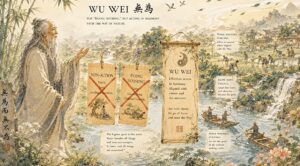
This is where the modern reader has to slow down because we have been trained from early on to push, to strive, to grind, to optimize. Lao Tse sitting on a buffalo 2,500 years ago is saying very calmly that we are exhausting ourselves, fighting a river that was already going where we wanted to go.
The power of tea. Chapter 38 onward is where the book turns from physics to practice. If the first half asked what reality is, the second half asks how you live in it without breaking yourself. The central principle of this half is a phrase that has been mistranslated more than almost anything else in the book.
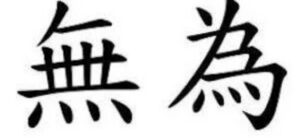
Wu Wei, two characters. Most people translate it as non-action or doing nothing. That is not quite right. And that mistranslation is what leads westerners to think Taoism is about being passive or indifferent. Wu Wei means doing without forcing, acting without strain, moving with the grain of reality instead of against it.
Consider a master craftsman cutting wood. The amateur fights the wood. He muscles the saw, breaks the blade, splinters the grain. The master reads the wood first. He sees which way the fibers run and then he cuts with the grain so cleanly it looks as though he is barely working.
That is Wu Wei. Maximum result, minimum violence. Lao Tze is telling you that everything you are currently muscling your career, your relationships, your reputation, your sense of self can be approached the same way. Not with less effort but with smarter effort, aligned effort.
In chapter 44, he asks three questions. Which is more dear, fame or your own self? Which is worth more, yourself or what you possess? Which is more painful, gain or loss? These are not abstract. They go directly after a specific set of traps. We chase reputation until we forget who we are. We accumulate possessions until they own us. We fear loss so much that we never actually inhabit the gain we already have. In three sentences, he is showing you how the trap was built.
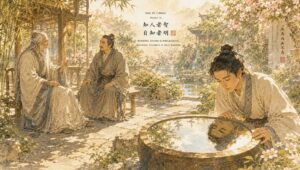
In chapter 33, he writes something that has cut deepest across many centuries. Knowing others is intelligence. Knowing yourself is true wisdom. Mastering others is strength. Mastering yourself is true power.
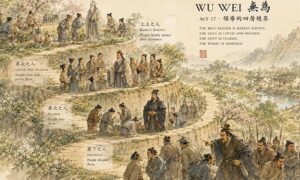
Then he turns to leadership directly in chapter 17. The best leader, he says, is the one whose people barely know he exists. The next best is the one they love and praise. The next is the one they fear, and the worst is the one they despise. When the best leader finishes his work, the people say, “We did this ourselves.” The greatest leader in the entire Tao Te Ching is the one who steps so far out of his people’s way that they believe they did all on their own. That is not weakness. That is mastery. A man with real power doesn’t need to be seen using it.
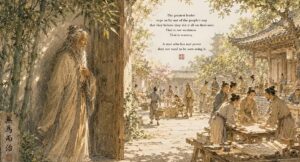
The 2nd half of the book keeps taking the cosmic principle from the 1st half and translating it into something applicable to daily life. Be the valley, not the peak. Be the empty room, not the furniture. Be the water, not the wall. And buried in all of it is one of the most quoted lines in the book:
Chapter 64: A journey of 1000 miles begins with a single step. People read it as encouragement to start, but read in context. LaoTsu is making a different point. The great tree starts as a tiny sprout. The tower of nine stories begins with a single brick. And every massive disaster also started with one small misjudgment that nobody corrected. He is not only telling you to begin. He is warning you that everything in your life, good and bad, is being built right now in invisibly small increments.
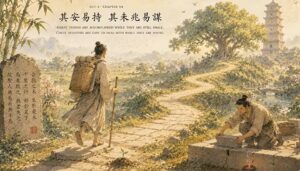
The marriage that fails 10 years from now is failing today. The career that opens up in a decade is being built this morning. Pay attention to the small thing because the small thing is the only thing there ever is.
In 81 short poems written by an old man on his way out of a country that had broken his heart, a complete operating system for being a human being was set down. The first 37 chapters reset your relationship to reality. The next 44 chapters reset your behavior inside it.
Almost every problem people carry right now, the anxiety, the burnout, the comparison, the resentment, the feeling of running as hard as possible while still falling behind every one of those problems was already diagnosed by a man riding a buffalo into the mountains 2,500 years ago.
Exhaustion comes from pushing against a current. The Tao-Te teaches you to read the current. Anxiety comes from trying to control outcomes that were never yours to control. Be the space in which others can create. The Tao-Te teaches you to do your work and release the result.
The feeling of invisibility comes from straining for recognition in a world that rewards noise. The Tao Te Ching teaches you that the deepest power is quiet and the feeling of having lost yourself inside roles and performances and labels. The Tao Te Ching teaches you that the real self was never any of those things to begin with.
This is why this small book outlasted every dynasty that came after it. Why it has been translated into more languages than any text except the Bible. Why generals carried it into battle. Monks meditated on it in caves, emperors kept it close, and modern psychologists quietly cited in their footnotes. It is not a religion.
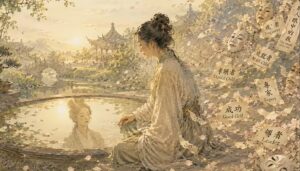
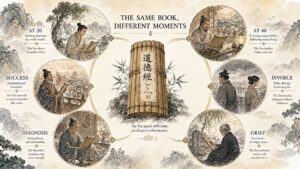
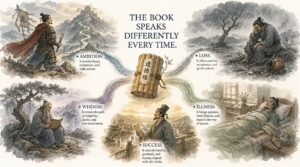
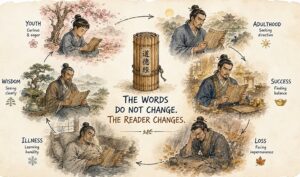
The Tao-Te-Ching is not a self-help book. It is a mirror. And a mirror is not something you read once and set aside. The Tao Te Ching read at age 20 is a different book than the Tao Te Ching read at 40. Read in a moment of success, it says one thing. Read in the middle of a divorce or a diagnosis or a death. It says something else entirely. Different masks are being used.
The words on the bamboo strip do not change, but the person holding them does. And every time that another persona steps in, the book has something new to say:
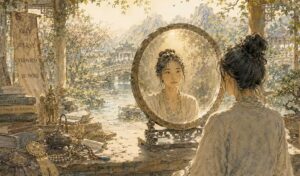
The old man left because he had seen the warlords, seen the empire collapse, seen good men corrupted and clever men destroyed. He had decided that the highest act of love he could perform was not to fix the world from the outside, but to leave behind a bundle of poems that would teach anyone who read it, how to stop being destroyed by the world from the inside.
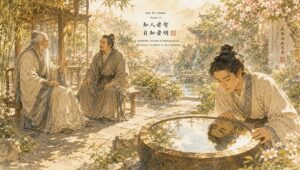
That bundle is still here. The empires that ignored it are gone. The wars that surrounded it are forgotten. The kings who scoffed at it are dust. The 81 poems are still doing exactly what they were built to do. Quietly without force, without name. The way water cuts stone, the way the empty center turns the wheel. The way the old master rode out to the western stargate, and somehow 2500 years later is still speaking.
Our personal summary of the above summaries:
Be the field, not the force!