Articles

  • Emotional

    Emotional Level The emotional body is the storehouse of past emotions and emotional conditioning. It causes us to act against our better judgment. Then we feel guilty, which leads to suppression, ending up into indulgence and dis-ease. A vicious cycle is created. However, it’s easy to break this vicious cycle with the right methods, like…

  • Mental Level

     Mental Level The mental body is our storehouse of everything we believe to be real or possible. It contains all of our past mental conditioning. It controls what we believe and disbelieve. Is our planet is a dualistic reality, comprising of the dark polarity of destruction and the light polarity of construction? Wouldn’t that then…

  • Spiritual Level

    Spiritual Level We experience the spiritual level as a connectedness to many layers of awareness. An expanding consciousness can then be experienced as a gradual waking up to these layers of awareness. One also becomes the awakened observer of one’s own habits, patterns, pains, and choices. Clear and conscious observation is required of our selves…

  • The Gate keeper?

    The Gate Keeper ? The Reptilian- or R-brain is activated when the organism perceives a threat. As long as it perceives a threat, it will try to suppress feelings of joy and remain in a serious mode. When confronted, this gatekeeper knows only 2 options: 1) Action, such as Fight or Flight, or 2) NO-Action,…

  • The Body Battles

    THE BODY’S BATTLES Here is what your brains and body are up against 24/7: toxins in the air we inhale, toxins in the fluids we drink, toxins in the foods we take in, toxic microbes that visit our body, toxic fragments of sounds we absorb, toxic thoughts and feelings we dwell in, EM-toxicity from all microwave…

  • Remedy Network Map

    EFFECTIVE BRAIN & BODY IMPROVEMENT PART VII REMEDY NETWORK MAP The final formulas We carefully pieced together the seemingly unrelated parts of the Introduction and Study Course, like creating a quilt. Is our Soul doing the same with connecting the dots of events & experiences in each of our lives? Since Attention is defined as ‘the…

  • Somatic Experiences?

    Somatic Experiencing ? Dr. Peter Levine’s book "Waking the Tiger", explains that humans are often frozen in trauma, unlike animals who daily cope with the unpredictability of nature. If not released, the energy of a trauma remains trapped within the brain and within the body’s musculature, tissues, joints and organs. Like Snow White awaiting her…

  • Emotions Network

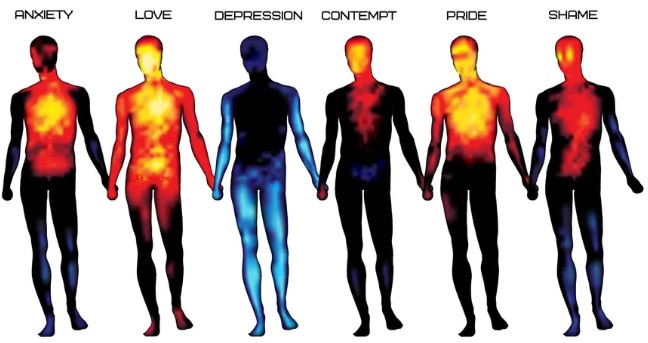
    PART V THE NETWORK OF EMOTIONS Dr. Antonio Damásio, a neuroscientist and clinician at UCLA, has published a few books on his team’s "body to brain" feedback research on people with brain damage. these decades of experiences have led him to conclude that: Patterns in the external world correspond with patterns of nerve cell activity in…

  • Receptors

    Receptors When a signal reaches the end of the axon it may stimulate tiny sacs. These sacs release chemicals known as neuro-transmitters into a synapse. They cross the synapse and attach to receptors on the neighboring cell. If this cell is a neuron, the signal may continue to the following cell. With electrical synapses, 2…

  • Cerebrum

    The Cerebrum   The cerebrum is split into 2 hemispheres by a deep fissure. The twin cerebral hemispheres communicate with each other through a thick tract of over 200 million nerve fibers, called corpus callosum, that lies at the base of this fissure. The surface of the cerebrum and the cerebellum is coated with a…

  • Neuro-transmitters

    Key Neurotransmitters at work Acetylcholine is an excitatory neurotransmitter because it generally makes cells more excitable. It governs muscle contractions and causes glands to secrete hormones. In Alzheimer’s there is a shortage of acetylcholine. GABA (gamma-amino-butyric acid) is an inhibitory neurotransmitter because it tends to make cells less excitable. It helps control muscle and vision activities. Serotonin…

  • Making connections

    Making Connections The brain and the rest of the nervous system are composed of many different types of cells, but the primary functional unit is a cell called the neuron. All sensations, movements, thoughts, memories, and feelings are the result of signals that pass through neurons. Neurons consist of three parts: The cell body containing…