Born-again Stars
HuBi-1, an inside-out stellar corpse
The unusual planetary nebula HuBi-1 in the constellation Serpens, was analyzed by researchers at the IAA-CSIC.
Planetary nebulae are the descendants of low to intermediate-mass stars, like our Sun. They form at late evolutionary stages, when their progenitor stars expel their envelopes, which are then photo-ionized by the hot white dwarf at the nebular center. The regions closer to the central star have species with higher ionization than the farther, cooler regions.
This is exactly opposite to HuBi-1, whose inner shell inverted ionization structure results from a peculiar stellar evolutionary path, a born-again star, according to the conclusions of IAA’s study, published in Nature Astronomy.
Its abstract reads:
Planetary nebulae are ionized clouds of gas formed by the hydrogen-rich envelopes of low- and intermediate-mass stars ejected at late evolutionary stages. The strong UV flux from their central stars causes a highly stratified ionization structure, with species of higher ionization potential closer to the star. Here, we report on the exceptional case of HuBi 1, a double-shell planetary nebula whose inner shell presents emission from low-ionization species close to the star and emission from high-ionization species farther away. Spectral analysis shows that the inner shell of HuBi 1 is excited by shocks, whereas its outer shell is recombining. The anomalous excitation of these shells can be traced to its low-temperature [WC10] central star whose optical brightness has declined continuously by 10 magnitudes in a period of 46 years. Evolutionary models reveal that this star is the descendant of a low-mass star, that has experienced a ‘born-again’ event whose ejecta shock-excite the inner shell. HuBi 1 represents the missing link in the formation of metal-rich central stars of planetary nebulae from low-mass progenitors, offering unique insight regarding the future evolution of the born-again Sakurai’s object2. Coming from a solar-mass progenitor, HuBi 1 represents a potential end-state for our Sun.
The central star of the Hubi-1 nebula, a huge cloud of hot gas extending for several light-years, had simply disappeared.
The center was covered with an incomprehensible layer of dust and gas, which began to cool off from the inside, rather than from the outside.
This defies the most basic thermodynamics laws in photo-ionized nebulae and points to a peculiar stellar evolutionary event.
HuBi-1 looks like a typical double-shell planetary nebula, with a diffuse outer shell and a bright inner shell, but this research reveals that nothing is like it seemed to be: the outer shell is unusually recombining and the central star, which is surprisingly cool, has been “switched off” about 50 years ago and is now 10,000 x fainter than in 1971.
The inverted ionization structure of the inner shell of HuBi-1, with lower excitation ionic species at the inner regions and highly excited ions at the outer, is simply amazing.
The ionization structure is, indeed, typical of bow-shocks generated by fast-moving material interacting with the surrounding medium. This, together with the low ionizing flux from the cool central star, unveils a truly unique scenario.
Normally, within a few thousand years, planetary nebulae disperse into the interstellar medium and their central stars dim. Instead, the central star of HuBi-1 recovered through a very late thermal pulse that processed all H2 on its surface.
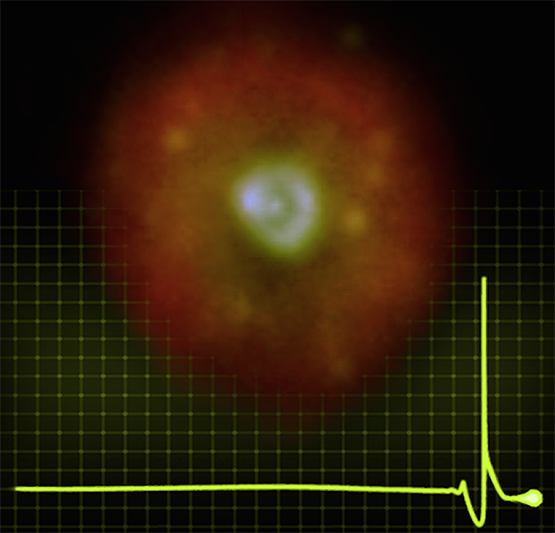
Color-composite picture of HuBi1’s helium shell luminosity variation during the thermal pulse. The Halpha emission is shown in red, the N II in green-blue.
HuBi-1 has been caught at the exact moment when its central star underwent a born-again event, becoming a H2-poor star. Only 15% of planetary nebulae so far discovered have H2-poor central stars.
This brief born-again process ejected large amounts of fast-moving highly processed material, which now interacts and shocks the outer nebula to produce the observed double-shell morphology.
As the progenitor star of HuBi-1 had a mass similar to our Sun, it provides a glimpse of a potential future or fate for our solar system.
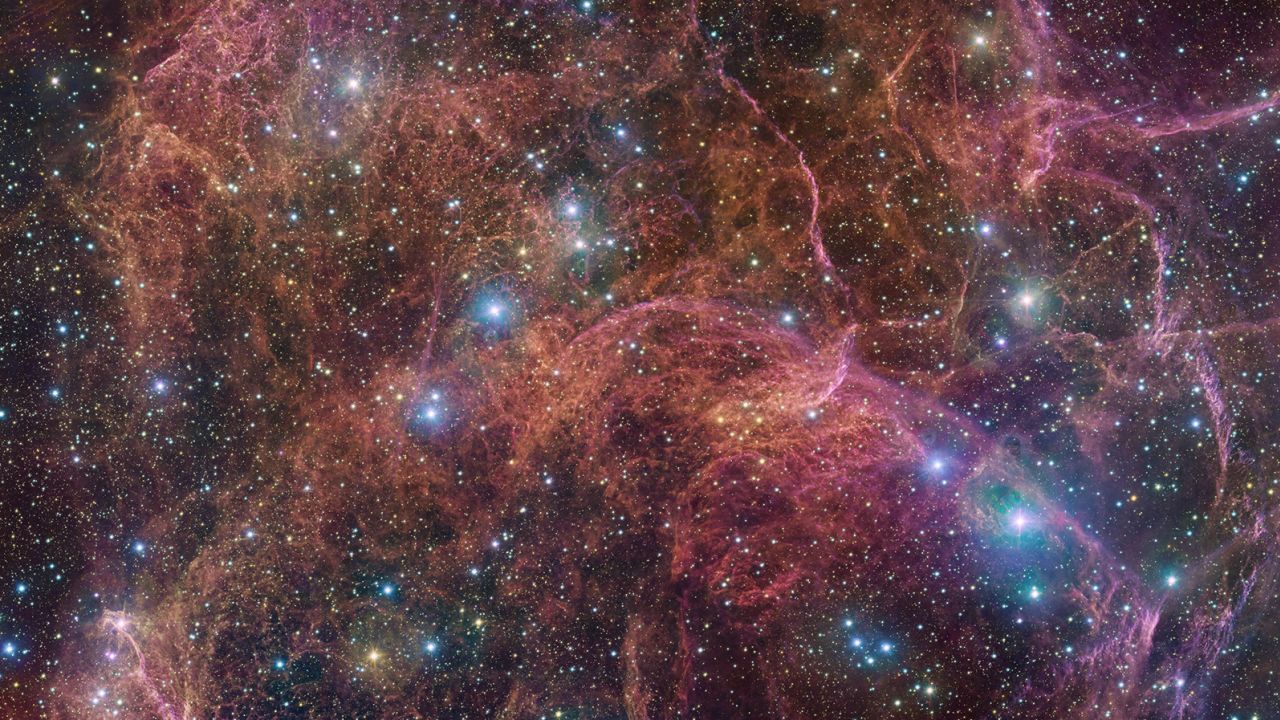
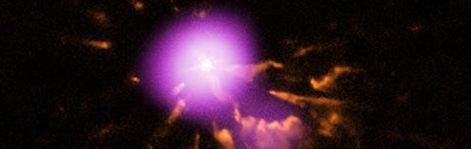
The remnants of the explosive-death
of the Vela supernova
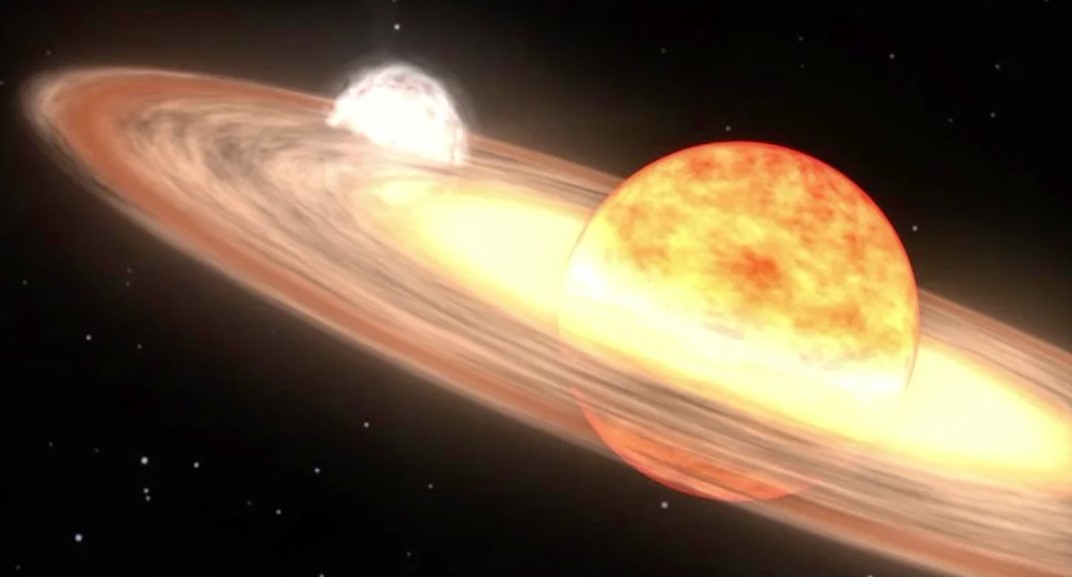
While a supernova is the explosive death of a massive star, a nova refers to the sudden, brief explosion from a collapsed star known as a white dwarf. The dwarf star remains intact, releasing material in a repetitive cycle that can occur for thousands of years.
The above image includes a dead white dwarf star and an aging red giant star. Red giants form when stars have exhausted their supply of hydrogen for nuclear fusion and begin to die.
The stars in the orbiting pair are close enough to each other that they interact violently. The red giant becomes increasingly unstable over time as it heats up, casting off its outer layers that land as matter on the white dwarf star.
The exchange of matter causes the atmosphere of the white dwarf to gradually heat until it experiences a “runaway thermonuclear reaction,” resulting in a nova.