AI Technologies
World Artificial Intelligence Cooperation Organization

Artificial intelligence will shape economies, societies and international relations for decades to come. The question is no longer whether AI will transform the world, but whether that transformation will be inclusive or exclusive. Russia and China are betting that openness, international partnership and practical applications serving ordinary people offer the strongest foundation for the next chapter of AI development. If the new organization succeeds in turning those principles into reality, it could become one of the defining institutions of the AI era.
The Chinese President Xi Jinping, and the main philosophical/strategic brain behind him, Professor Wang Huning, will make sure that all of the above will happen quickly, in quiet, and peaceful.
They said that it is necessary to narrow the digital divide between countries, improve global management, and jointly promote an open, inclusive, global, and public-spirited development of AI. China plans to exchange views with all parties and reach consensus, so that techno-progress actually stimulates the development and thriving of society.

Several Chinese companies have emerged as competitors to Nvidia, caused by U.S. export restrictions that created a void in the Chinese market.
Thus, China is banning its largest tech companies from buying Nvidia’s chips, and forcing ByteDance, Alibaba, etc. to rely on domestic suppliers, like Huawei, Deepseek, Zhipu, offering free models, like GLM-5.2.
Instead of a stalling progress, Washington’s containment strategy had the opposite effect, accelerating China’s drive toward self-reliance and innovation.

US export restrictions created the emergence of Chinese AI app DeepSeek, a competitor to OpenAI and its ChatGPT tool.
The rise of the little-known Chinese tech startup has triggered alarm about the future of American dominance in artificial intelligence, erasing nearly US$600 billion from Nvidia’s market value in just one day.

DeepSeek is delivering a cost-effective AI solution. By focusing on creating an efficient algorithm, the firm has demonstrated China’s ingenuity of finding workarounds, and that significant AI advancements are possible even under hardware constraints.
DeepThink is one of its features, and it lets users observe the AI’s step-by-step reasoning as it works through a query.
This helps users identify potential errors in the AI’s approach, making it especially useful for refining complex tasks and ensuring more accurate results.
As you can see, DeepSeek approaches queries with a thorough step-by-step process, even the most simple ones like “1+1”. This way, it pursues the goal of giving the best answer possible, which is a very helpful feature.

DeepSeek as a Search Engine:
Also, unlike traditional search engines, DeepSeek’s “Search” mode can understand the meaning behind your questions.
It interprets vague queries and finds relevant information based on concepts rather than just keywords.
Like asking: “Why do people prefer shopping online?” prompts DeepSeek to analyze content related to online shopping habits, consumer behavior, and digital retail trends.
It will provide you with a detailed report on the question, potentially helping you discover the things you did not expect.

The most prominent Chinese AI GPU players include:
Cambricon Technologies
As “China’s little Nvidia,” Cambricon is a leading domestic competitor and one of the country’s most valuable tech companies.
Performance: In the first half of 2025, the company’s revenue surged by over 4,000%, and it achieved its first-ever profit, largely due to domestic demand.
Technology: It primarily designs AI chips for cloud servers, edge devices, and data centers. The company is developing its flagship Siyuan 690 processor, designed to compete with Nvidia’s H100.
Market driver: U.S. sanctions, restricting China’s access to advanced Nvidia chips, prompted the Chinese to seek domestic alternatives, directly benefiting Cambricon.
Huawei
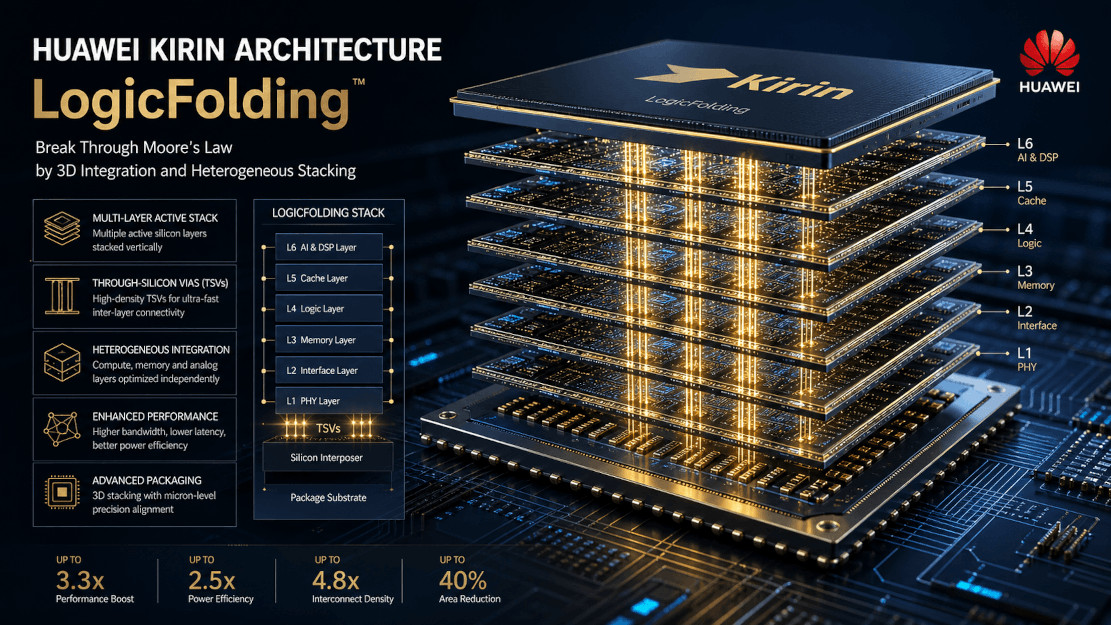
Time Scaling vs. Geometric Scaling: Instead of following traditional Moore’s Law, which focuses strictly on shrinking transistor dimensions (geometric scaling), has reached its physical limits, with 2nm node design budgets exceeding $1B/chip, and transistor costs no longer declining, Tao’s Law prioritizes time scaling —systematically compressing signal propagation delays (represented by the time constant τ) across the hardware stack. This means across 12 orders of magnitude, from transistor switching speeds in picoseconds to data center load responses in seconds.
Logic Folding: The architecture uses multi-layer and vertical circuit configurations (“LogicFolding”) to shorten critical-path wiring distances, packing higher functional density into smaller spatial footprints without requiring extreme ultraviolet (EUV) lithography for ever-smaller nodes.
Due to US-Gov export restrictions, Huawei shifted the focus of their attention from 2D-linear to 3D-logic folding: splitting a chip’s logic across two silicon layers, bonding them face-to-face with hybrid bonding, and connecting them with millions of vertical links. This shortens wiring, reduces delay and power use, and delivers density comparable to TSMC’s 3nm class without needing EUV lithography.
Huawei’s shift from “shrinking transistors” to “shortening signal paths” is changing the finish line rather than winning the old race. IBM, TSMC, and Nvidia are also moving toward 3D stacking, but Huawei was forced there earlier and pushed it into a mass-market phone. Conclusion: Huawei has made the transistor nanometer-size a less useful measure of progress.
Government backing: Beijing is compelling Chinese tech firms to rely on domestic suppliers, a move that is pushing the company to accelerate its capabilities. Already a major technology giant, Huawei is at the center of Beijing’s strategy to achieve semiconductor self-sufficiency.
Full ecosystem: Huawei is working to present itself as a comprehensive alternative to Nvidia by building a complete ecosystem of hardware and software.
Hardware: The company has unveiled new AI computing systems powered by its Ascend chips, which it claims can link over a million processors to train large AI models. Such scale is essential for training today’s largest AI models, and with a roadmap of new chips coming, Huawei is presenting itself as China’s alternative to Nvidia.
Key aspects of Huawei Ascend chips
Purpose: The chips are designed to power AI, machine learning, and other high-performance computing tasks, making them a direct competitor to Nvidia’s offerings.
Product lineup:
Ascend 910C: A recently launched dual-chiplet AI accelerator, reported to have strong performance in real-world scenarios, though its power consumption is higher than the Nvidia H100:
Ascend 910D: Another AI chip designed to compete with Nvidia’s H100, with initial samples expected in mid-2025.
Ascend 950, 960, and 970: A roadmap for future generations is in place, with the Ascend 950 scheduled for 2026, the Ascend 960 for 2027, and the Ascend 970 for 2028.
Performance and features:
The chips aim to double compute capacity with each release. Newer versions feature specialized components, like the HiF4 4-bit precision format, to boost performance.
Manufacturing:
Huawei works with SMIC to improve yield in manufacturing + lower production cost.
Written off by many after being cut off from advanced US technology, the Huawei company has emerged stronger and more vertically integrated. Huawei has built an entire semiconductor ecosystem encompassing everything from wafer fabrication to chip design. Its latest Mate 70 series smartphones, running on the completely indigenous Harmony OS NEXT operating system, represents a clean break from US technology dependencies.
Huawei’s Mate 60 Pro is powered by a 7-nm processor. This has raised concerns about the efficacy of American restrictions on advanced semiconductors and the extent to which Beijing was able to circumvent them.
Produced by Semiconductor Manufacturing International Corp (SMIC), the 7nm chip represents a breakthrough in Chinese chipmaking ability.
Nanometer node is related to different generations of chip manufacturing technology – the lower, the better. Most advanced chips are around 3nm, which are mostly for smartphones, while more mature semiconductor chips are around 28nm or above, for vehicles or household electronics.
Huawei’s latest achievement seems to show that China has been able to close the gap in a relatively short time.
Other notable players
Baidu: This Chinese tech giant has its own computing clusters powered by its Kunlun AI chips and recently secured a $139 million order for chips from China Mobile.
Moore Threads: Founded by former Nvidia executives, this Beijing-based company designs GPUs and is on the U.S. Entity List.
Biren Technology: This Shanghai-based startup, also on the U.S. Entity List, unveiled its BR100 GPU, which it said was comparable to Nvidia’s H100.
Alibaba (T-Head): The company’s chip unit develops chips using the open-source RISC-V architecture and has launched chips designed for AI applications.
Zhipu’s GLM-5 is free to use through several platforms, though there is no single permanent, unlimited free hosted API. You can access it without paying using free web portals, limited-time trials, or by self-hosting the open-source weights. The model is released under a MIT license, meaning you can download the weights and self-host the AI for free on your own hardware.
Challenges and outlook
Ecosystem advantage: Nvidia’s strong software ecosystem, particularly its CUDA platform, provides a moat that the Chinese are still crossing.
Market fragmentation: Rather than creating a single, globally competitive ecosystem, U.S. sanctions are creating a two-track system where companies optimize for either Western or Chinese hardware.
Worldwide, companies increasingly face a diificult choice: Use the much cheaper Chinese products and risk US retaliations, or buy more expensive US products and systems.