Quarks, Leptons, Bosons, Neutrons
The current understanding between classical and quantum mechanics is that all objects obey the laws of quantum mechanics. Classical mechanics is a mere quantum mechanics of large systems, a large collection of particles, because many macroscopic properties of classical systems are direct consequences of the quantum state of its parts.
The stability of bulk matter, the rigidity of solids, and the thermal, chemical, optical, mechanical, and magnetic properties of matter are all results of interaction of electric charges under the rules of quantum mechanics.
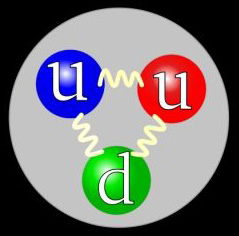
The nucleus of an atom entails protons and neutrons. Physicsts believe that a proton consists of different sub-atomic particles, called quarks, leptons, bosons, gluons.
They say that a proton has 2 up-quarks + 1 down-quark; a neutron has 2 down-quarks + 1 up-quark, held together by gluons. Sub-atomic particles have 230+ different forms.
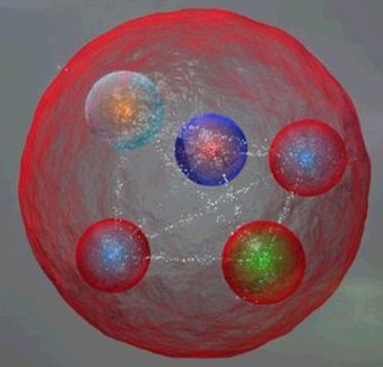 Penta-quark?
CERN’s Theoretical Physicists believe that the Penta-quark actually exists and consists of 2 up-quarks, 1 down-quark, plus 1 charm-quark and 1 anti-charm-quark.
Top quarks – along with up, down, charm, and strange quarks – combine to form subatomic particles like protons and neutrons. Scientists pinned the top quark’s mass at 173.34 (+/- 0.76) giga-electronvolts divided by the speed of light squared: more than 100 times the mass of a proton.
This will enable scientists to examine how the top quark’s mass affects stability in the Higgs field and the Higgs boson, which they believe gives matter its mass.
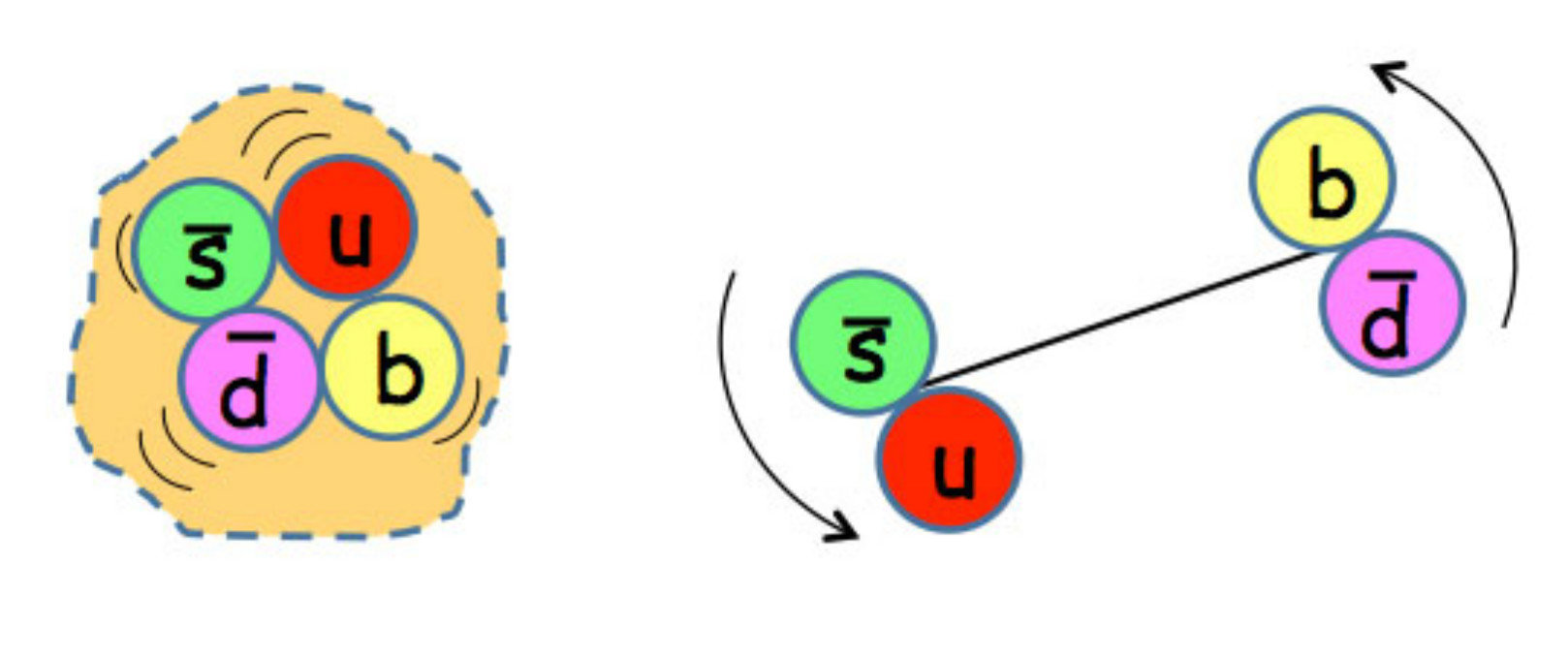 Tetra-quark?
The DZero detector, positioned along the 4-mile Tevatron accelerator ring at Fermilab, USA discovered the tetraquark. This particle is unique because it contains 4 distinct ‘flavors’ of quarks and antiquarks (bottom, strange, up, and down) which were identified by the way it decays.
Nobody knows how quantum particles create atoms, and how the energy of our universe creates quantum particles! Thus, invisible fields (consciousness?) must shape visible matter!
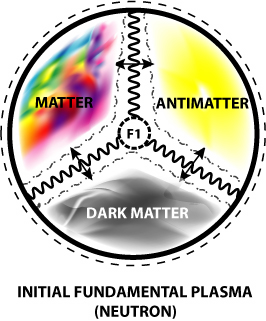
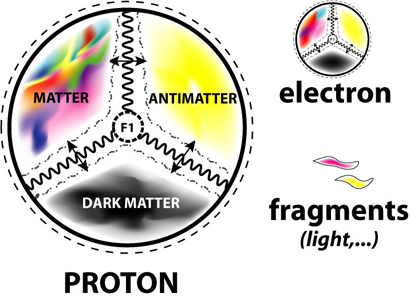
According to Nuclear Ingenieur Mehran Keshe, the neutron is composed of the three basic Matters (Matter, Dark Matter, & Antimatter). Neutron plasma decays into a proton plasma, an electron plasma (mini-plasma originating from the neutron plasma), and small fragments of magnetic fields (light or energy parts). The secret of the irregular path of the electron: continuous alternating attraction and repulsion of the dynamic electron plasma by the dynamic proton plasma.
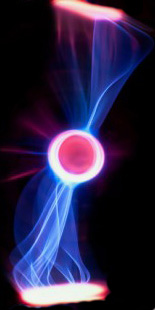
When 2 magnetic vortices interact, they unite as a plasma and create gravity and a bigger, protective magnetic field around them, called magnetosphere. When 2 plasma fields interact, you get an atom. When 2 atoms interact you get a molecule, and chemistry begins. When molecules interact you get biology and DNA begins.
Keshe completed a system for the production of gravity and energy using a radioactive hydrogen-fueled reactor that is clean and safe. Then he successfully built and tested dynamic plasma reactors that achieve lift and motion.
Through the development of these new systems, deposits of nano-carbon have been generated, in Sp2 and Sp3 form.
Nanotubes are used as a universal additive, simultaneously enhancing strength, electrical and/or thermal conductivity of most materials, such as polymer composites, rubbers, metals, etc. By 2030, the volume of emission reductions from this factor can be at least equal to reducing the volume of emissions from the use of all renewable energy in the world.
Plasma reactors have already been used for health purposes. His research team captured CO2 and CH4 directly from the environment, and preserved them in a gas, liquid, and solid state at normal room temperature and pressure.
Within quantum mechanics, observing, meaning sending it energy via our attention beam, influences the quantum-physical processes that are taking place.
 “Quarks, neutrinos, photons, leptons.
Those damn particles I can’t see?
That’s what drove me to drink.
But now I can see them!”