Ziwei Enclosure
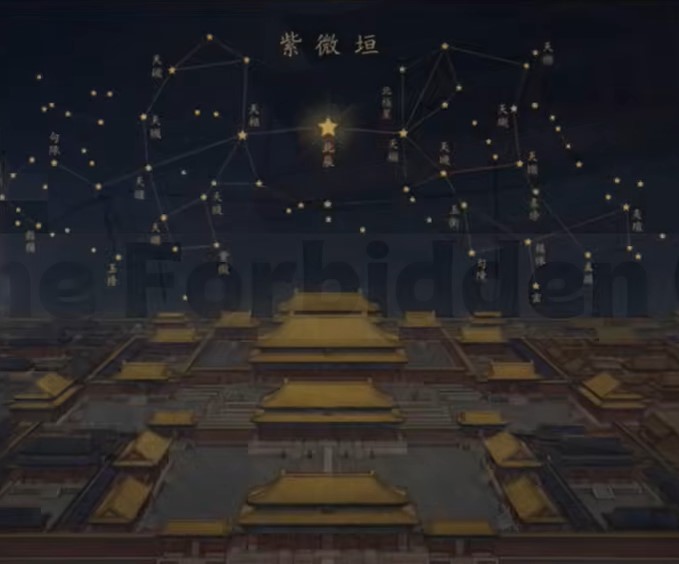
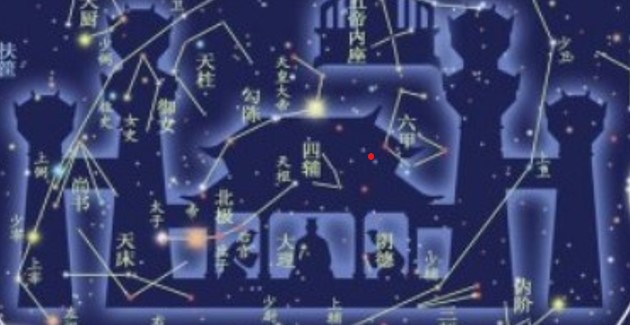
The Purple Celestial Palace: Ancient Chinese astronomers viewed the northern night sky as a mirror of the earthly imperial court.
“Purple” does not refer to the buildings. It refers to the Ziwei Enclosure, a cluster of stars around Polaris that ancient Chinese astronomy associated with the heavenly home of the celestial emperor and his family, called “The Purple Forbidden city”.
This enclosure is centered on Polaris, the North Celestial Pole Star (the Ziwei Star), which remains more or less immovable while other stars revolve around it. See star-trails pic from Jeff Dai (2016) below:
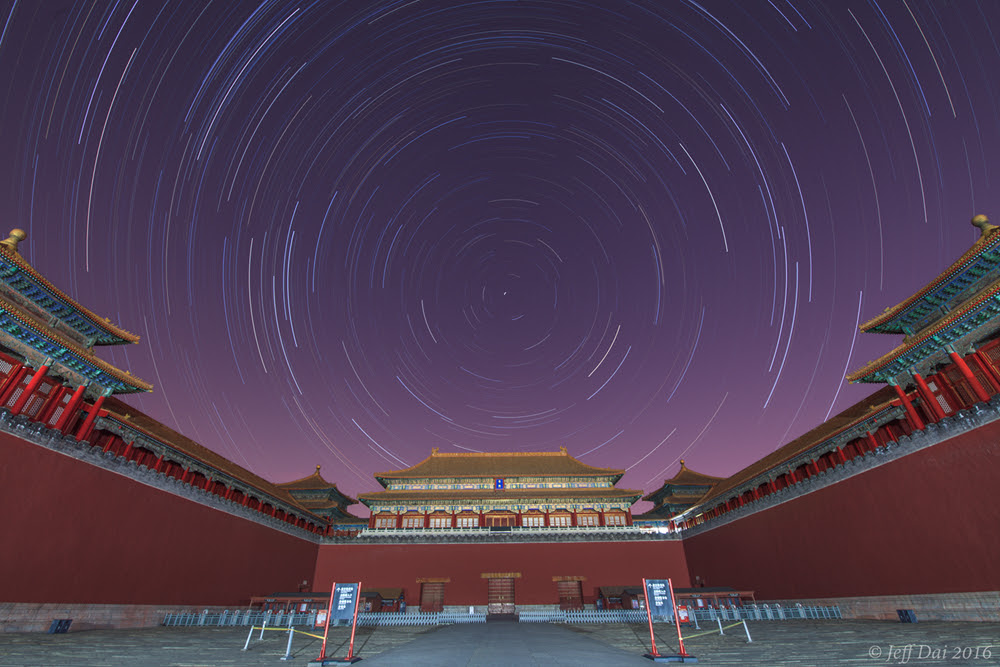
As shown in observations of star trails over Beijing, the layout of the terrestrial Forbidden City was designed to mirror this heavenly enclosure. The Forbidden City, was the terrestrial emperor’s residence, the Celestial Emperor’s earthly counterpart:
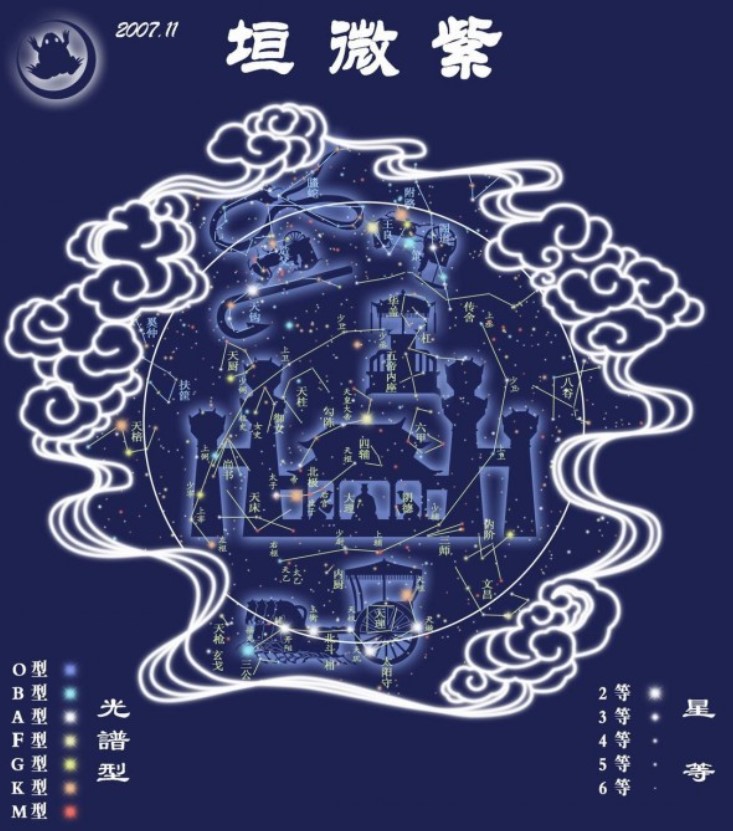
- Three Enclosures: Some ancient Chinese star maps divided the sky into 3 Enclosures and 28 mansions, with Ziwei as the central enclosure.
- The Walls: It features an eastern wall made of 8 stars and a western wall made of 7 stars, symbolizing the protective walls and guards of an imperial palace.
- Inhabitants: Astrologers placed various members of the royal household, officials, and guards into specific star groups within this boundary.
The Ziwei Enclosure (Purple Forbidden Enclosure) is packed with about 37 distinct star groupings (asterisms) that represent the inner court of the Celestial Emperor. Ancient Chinese astronomers populated this region with the royal family, high officials, guards, and domestic necessities.
The primary individual star groupings within the enclosure include:
- The Core Royal Household
- Northern Pole (北極 – Běijí): A group of 5 stars located across modern Ursa Minor and Camelopardalis. Each star represents explicitly a royal person or function: The Emperor, The Crown Prince, The Son of a Concubine, The Imperial Harem, the Celestial Pivot, etc.
- Curved Array (勾陳 – Gōuchén): Composed of 6 stars (modern Cepheus and Ursa Minor), this grouping hooks around the pole. It was viewed as the private harem of the Yellow Emperor and home of his #1 consort.
- Great Emperor of Heaven (天皇大帝 – Tiānhuáng Dàdì): A single-star asterism in Cepheus that represents the absolute sovereign himself, sitting at the spiritual apex of the sky:
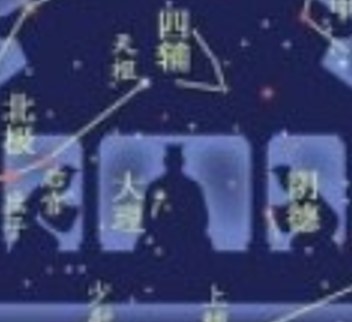
- The Protective Walls
The palace boundary is formed by two long chains of stars acting as actual defensive structures:
- Left Wall (左垣 – Zuǒyuán): Made up of 8 stars stretching across Cassiopeia, Draco, and Cepheus. The stars are named after protective roles/functions, such as the Senior Minister, Junior Assistant, and Senior Guard.
- Right Wall (右垣 – Yòuyuán): Consists of 7 stars across Ursa Major, Draco, and Camelopardalis, mirroring the left wall with titles like Junior Officer, Senior Aide, and Senior Secretary.
- The Imperial Court & Advisors
- Four Advisors (四輔 – Sīfǔ): A 4-star grouping that assists him and sit on the Emperor’s immediate left and right.
- Royal Secretary (御女 – Yùnǚ): A 5-star cluster responsible for handling palace documentation, letters, and memorials.
- Royal Archives Official (柱史 – Zhǔshǐ): A star tracking history and recording imperial decrees.
- Domestic Infrastructure
The celestial enclosure even contained the physical elements required to run a massive terrestial palace:
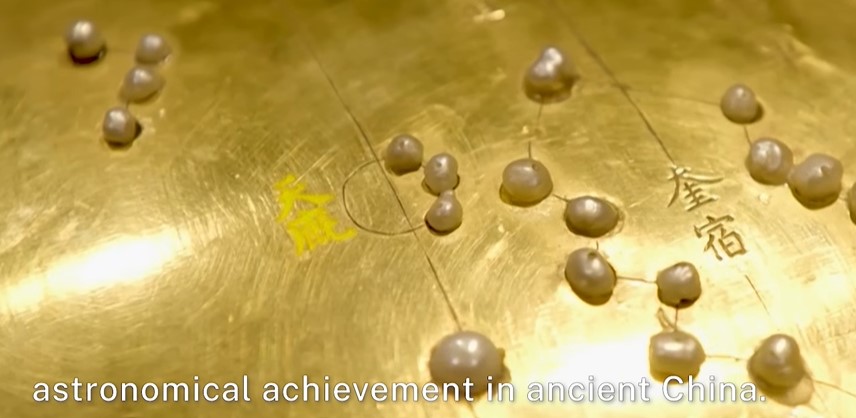
- Celestial Kitchen (天廚 – Tiānchú):
A 6-star group in Draco responsible for preparing meals for palace officials. - Emperor Canopy (華蓋 – Huágài):
An umbrella-shaped 7-star group in Cassiopeia representing the decorative shelter used to cover the Emperor during processions. - Eight Kinds of Crops (八穀 – Bāgǔ): An 8-star grouping managed by agricultural officials to oversee the kingdom’s core foods (rice, millet, barley, hemp).
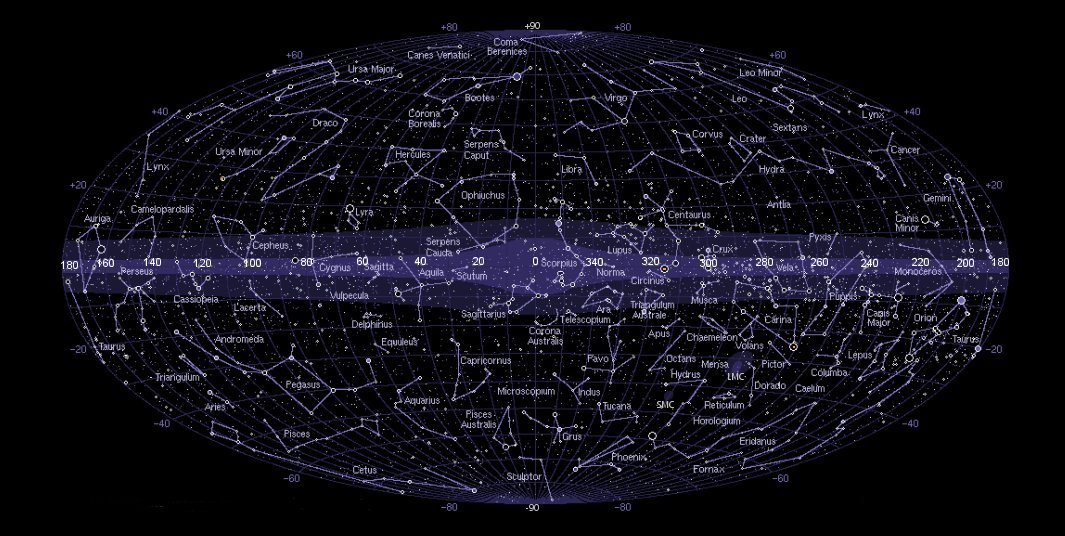
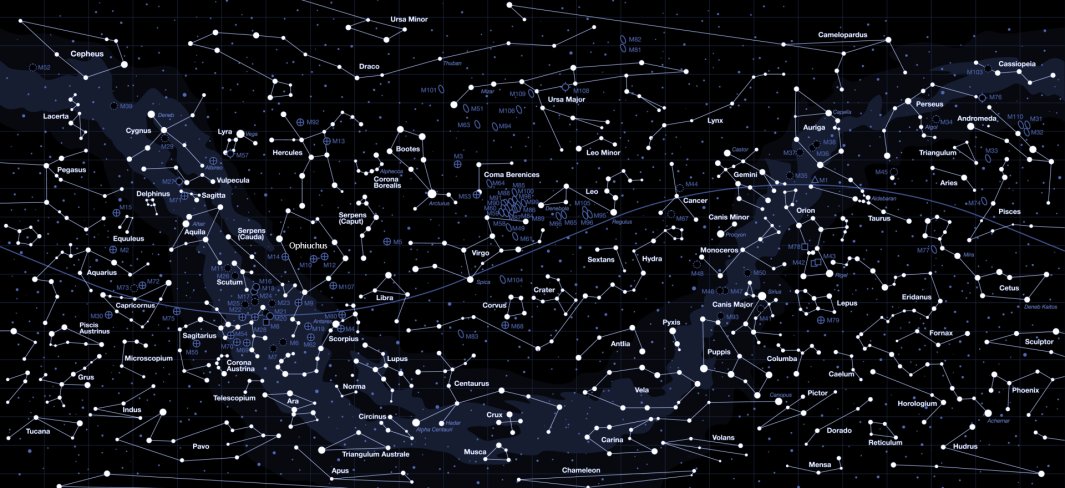
Here is how the core star groupings of the Ziwei Enclosure align with all of the official 88 modern Western constellations:
The Inner Core (Ursa Minor & Cepheus)
- Northern Pole (北極): This central grouping is found primarily within Ursa Minor (the Little Dipper) and part of Camelopardalis. In fact, the “Emperor” star in this ancient asterism is Beta Ursae Minoris (Kochab), Earth’s pole star around 1000 BC.
- Curved Array (勾陳): This hook-shaped structure spans Ursa Minor and Cepheus. Crucially, the star we know today as Polaris (our current North Star) was designated as the main star of Gōuchén (Curved Array 1).
- Great Emperor of Heaven (天皇大帝): This highly sacred star corresponds to HD 212710 in constellation Cepheus.
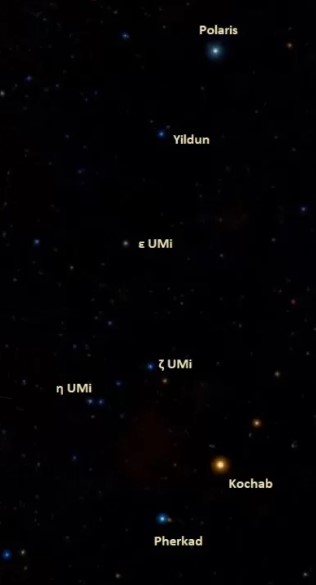
Little Dipper
The Protective Walls (Draco, Ursa Major, & Cassiopeia)
As these constellations snake around the celestial north pole, Chinese astrologers used their stars to map out the heavily guarded outer ring of the Emperor’s palace:
- Left Wall (左垣): This long, defensive chain of 8 stars twists through Draco, Cepheus, and Cassiopeia.
- Right Wall (右垣): The matching 7-star defensive chain winds through Draco, Ursa Major, and Camelopardalis. Stars like Thuban (Alpha Draconis), Giansar (Lambda Draconis), and Grumium (Xi Draconis) serve as individual bricks in the palace walls. Each star represents a specific high-ranking bureaucrat or guard, protecting the Emperor. The stars Alpha Draconis and Kuma (Nu Draconis) bridge into Ursa Major’s northern boundary to complete the Right Wall. These stars represent the Junior Officer and Senior Aide, keeping watch over the Western gate.
Domestic & Court Life (Draco & Cassiopeia)
- Celestial Kitchen (天廚): The 6 stars responsible for the Emperor’s meals sit squarely inside the head and neck of Draco, including Delta, Sigma, and Epsilon Draconis.
- Canopy of the Emperor (華蓋): The imperial umbrella grouping is located in Cassiopeia, right above the distinct “W” shape of the constellation.
- Supreme Commander (天理 – Tiānlǐ): Stars in Draco bordering Ursa Major were seen as the high military officials managing internal security.
- Official of Royal Archives (柱史): Fafnir (Draco 42). This single star represents the official archivist responsible for tracking time, recordings, and historical precedents of the empire.
Draco and Ursa Major host the highest concentration of imperial positions within the Chinese astronomical system, serving as the literal backbone and defense system of the Purple Forbidden Enclosure.
While the prominent “bowl” of Ursa Major forms the famous Beidou (the Big Dipper or Celestial Chariot), the rest of the Ursa Major constellation is filled with secondary palace security roles, such as steps:
- The Inner Tribunal (內階 – Nèijiē): A 6-star chain near the pointer stars of the Big Dipper that represents the private, guarded steps leading straight to the Emperor’s personal bedroom.
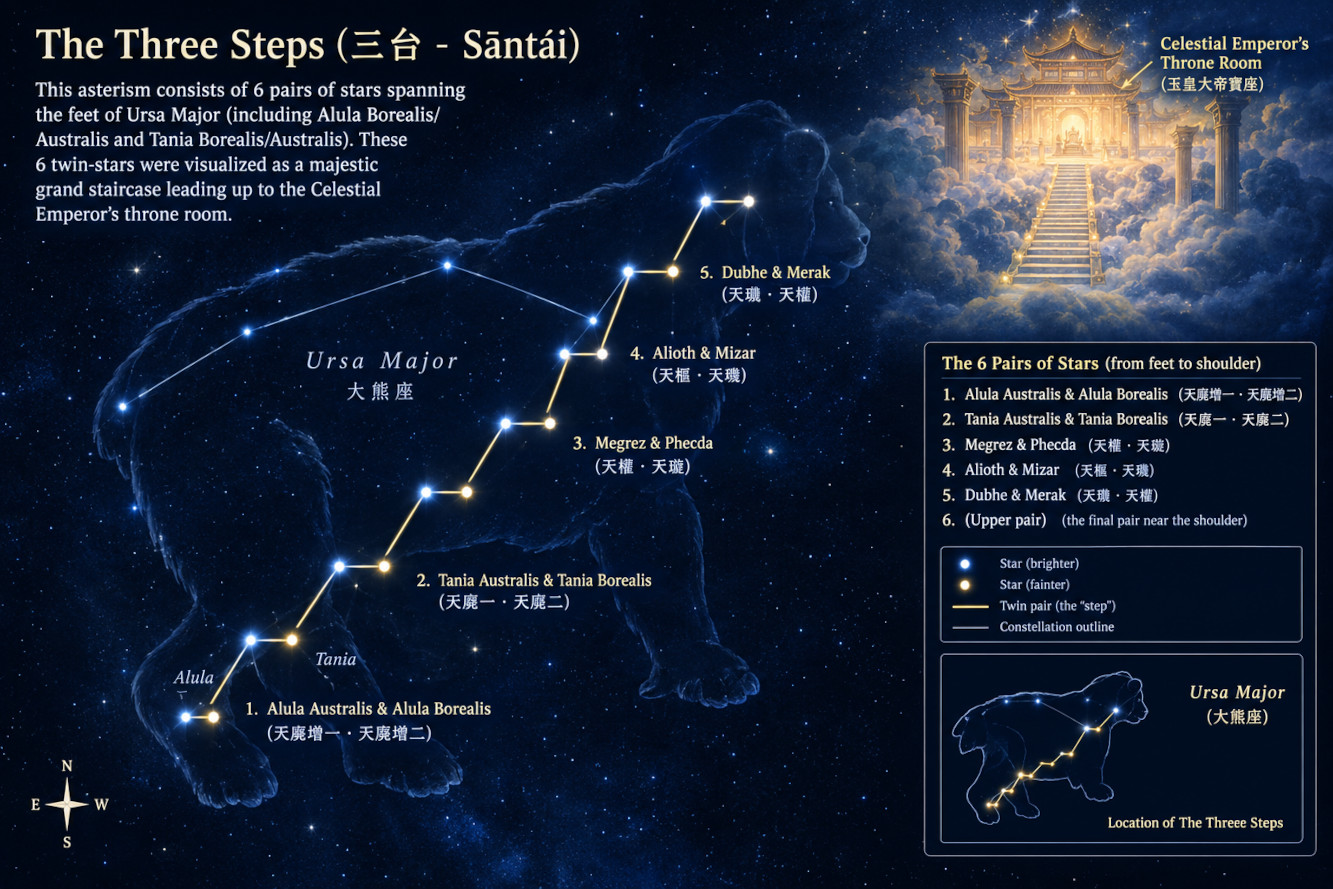
- The Three Steps (三台 – Sāntái): This asterism consists of 6 pairs of stars (see above). They served as a celestial barometer for the health, balance, and stability of the earthly imperial government. Because these 6 twin-stars were visualized as a majestic grand staircase leading up to the Celestial Emperor’s throne room, court astrologers monitored them constantly to predict political shifts, bureaucratic corruption, and civil unrest.
- The Structure of Power
The staircase was divided in 3 sections (each consisting of 2 pair of twin-stars). Each section maps directly to a specific tier of the earthly government:
- The Supreme Section (上台): Represented the Emperor and the Highest Officials (like the Prime Minister). It monitored the absolute apex of political power.
- The Middle Section (中台): Represented the High Officials and Nobles (such as the princes, generals, and regional governors). It monitored the military stability and execution of imperial decrees.
- The Lower Section (下台): Represented the Lower Bureaucracy and the Common People. It monitored public sentiment, local administration, and societal harmony.
- Predicting Stability
through Light and Color
Astrologers used the actual appearance of these star pairs to gauge whether the earthly government was functioning properly, by looking for specific omens:
- Equal Brightness (Harmony):
If all steps shone with equal, steady brightness, it meant the hierarchy of the state was perfectly balanced. The Emperor was wise, the ministers were loyal, people were content. This predicted a period of peace and prosperity. - Dimmed Step (Corrupt/Neglect):
If a specific step grew faint or dim, it signaled trouble in that sector of government. If steps of the Lower Section dimmed, it meant local officials were exploiting the common people, hinting at imminent peasant rebellions.
If a Supreme Step dimmed, it meant the Emperor was losing control or being manipulated. - Flickering or Color Shifts (Imminent Chaos):
Violent flickering, or a sudden change to a reddish/dark hue, was a severe warning. It predicted war, major political coups, or the sudden death of a high-ranking minister assigned to that tier.
- The “Broken Staircase” Omen
The physical alignment of the star pairs was also vital. If the 2 stars of a pair drifted out of alignment or appeared uneven, it was interpreted as a broken staircase. In the eyes of the imperial court, a broken celestial staircase meant that the pathway of communication between the common people and the Emperor was severed.
This foretold extreme political stagnation, a government crippled by internal corruption, and the potential collapse of the current dynasty’s mandate to rule.
In traditional Chinese astronomy and Daoist theology, the Big Dipper—known as Beidou (北斗, the “Northern Dipper”)—was not just a passive clock in the sky. It was viewed as the ultimate weapon of divine execution, judgment, and cosmic law enforcement.
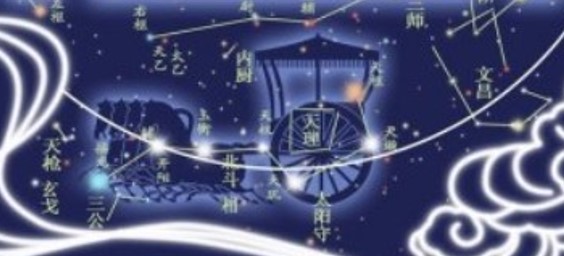
While the surrounding Ziwei Enclosure represented the stationary palace of the Celestial Emperor, the Big Dipper was the Emperor’s moving chariot, judge, and executioner’s blade. If an earthly emperor became deeply corrupt, unjust, or cruel, the Big Dipper was the specific instrument the Heavenly Throne used to strike them down.
1. “The Northern Dipper Governs Death”
A fundamental maxim in ancient Chinese cosmology states: “Nandou (the Southern Dipper) governs life; Beidou (the Northern Dipper) governs death”.
The seven visible stars of the Big Dipper were personified as the Beidou Xingjun (Northern Dipper Star Lords). They held the supreme celestial ledger containing the exact lifespan of every living person, including the Emperor. When an earthly ruler violated the laws of Heaven, exploited the common people, or engaged in tyranny, Daoist tradition dictated that the Star Lords would actively deduct years from the ruler’s life, shortening their reign or orchestrating a sudden, fatal illness.
2. The Chariot of Divine Inspection
Ancient texts, including the Shiji (Records of the Grand Historian) written by Sima Qian, describe the Big Dipper as the Chariot of the Celestial Emperor.
As it revolved around the North Star, it was visualized as the Emperor riding out on an inspection tour of the universe. The pointer stars acted as a cosmic spotlight. If the chariot paused or if its path altered slightly (manifested as an unusual astronomical alignment, planetary conjunction, or a meteor crossing the Dipper), it meant Heaven was actively reviewing the crimes of the earthly palace.
3. The Divine Weapon/Earthly Rebellion
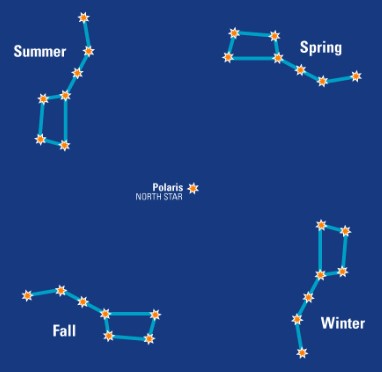
Because the Big Dipper resembles a massive ladle or an axe head, it was structurally viewed as a celestial weapon. Its movement across the seasons dictated the balance of Yin and Yang.
- The Mandate of Heaven: If an earthly ruler became unfixably corrupt, they lost the Mandate of Heaven.
- Directing the Blade: The direction the “handle” of the Dipper pointed during specific seasons was believed to channel pure, destructive cosmic energy. If a rebellion rose up against a corrupt tyrant, military generals would try to align their battle formations so that their armies marched in the direction the Big Dipper’s handle was pointing, essentially leveraging the “blade” of Heaven to cut down the corrupt ruler.
4. The Moral Mirror
Unlike Western astrology, which viewed constellations through the lens of static myths, Chinese imperial astrology treated the Big Dipper as a highly responsive moral mirror. If a ruler was righteous, the Dipper remained bright, guiding the empire toward prosperity. If the ruler became a tyrant, the Dipper was weaponized—dimming its light to bring about agricultural failure, cosmic disharmony, and the eventual violent overthrow of the corrupt regime.
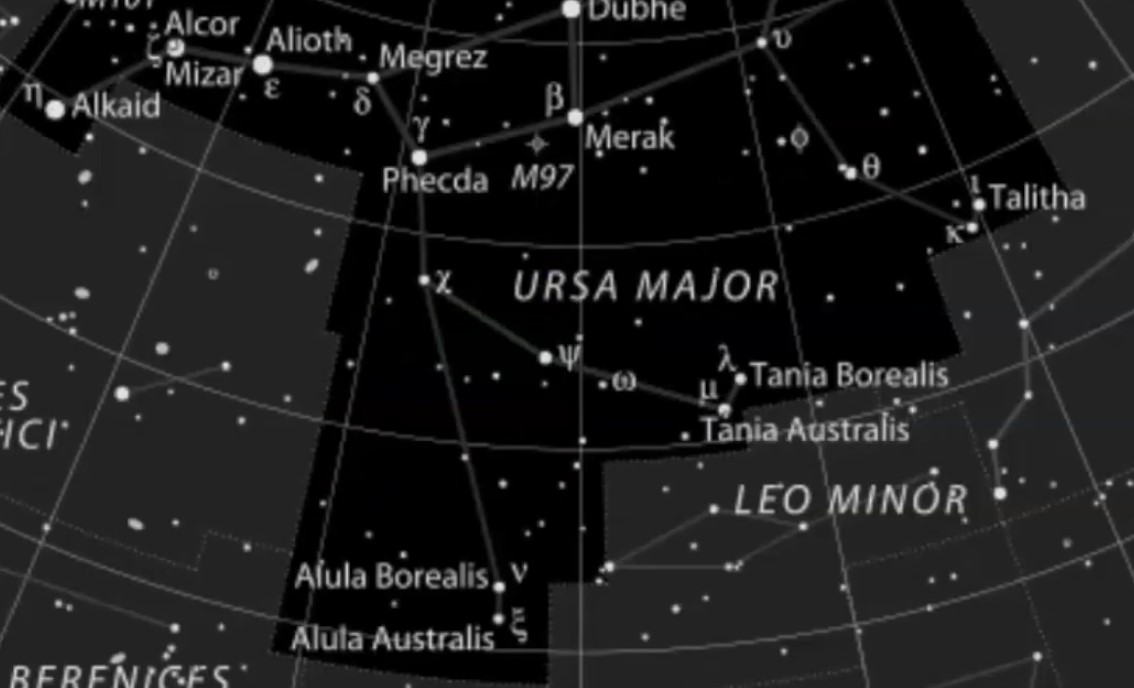
The seven stars of the Big Dipper (Beidou) carry an incredibly rich dual-naming system in Chinese tradition. They possess highly formal astronomical names (which reflect cosmic order, scales, and judicial concepts) alongside their legendary Daoist names (used for fate, fortune, and execution).
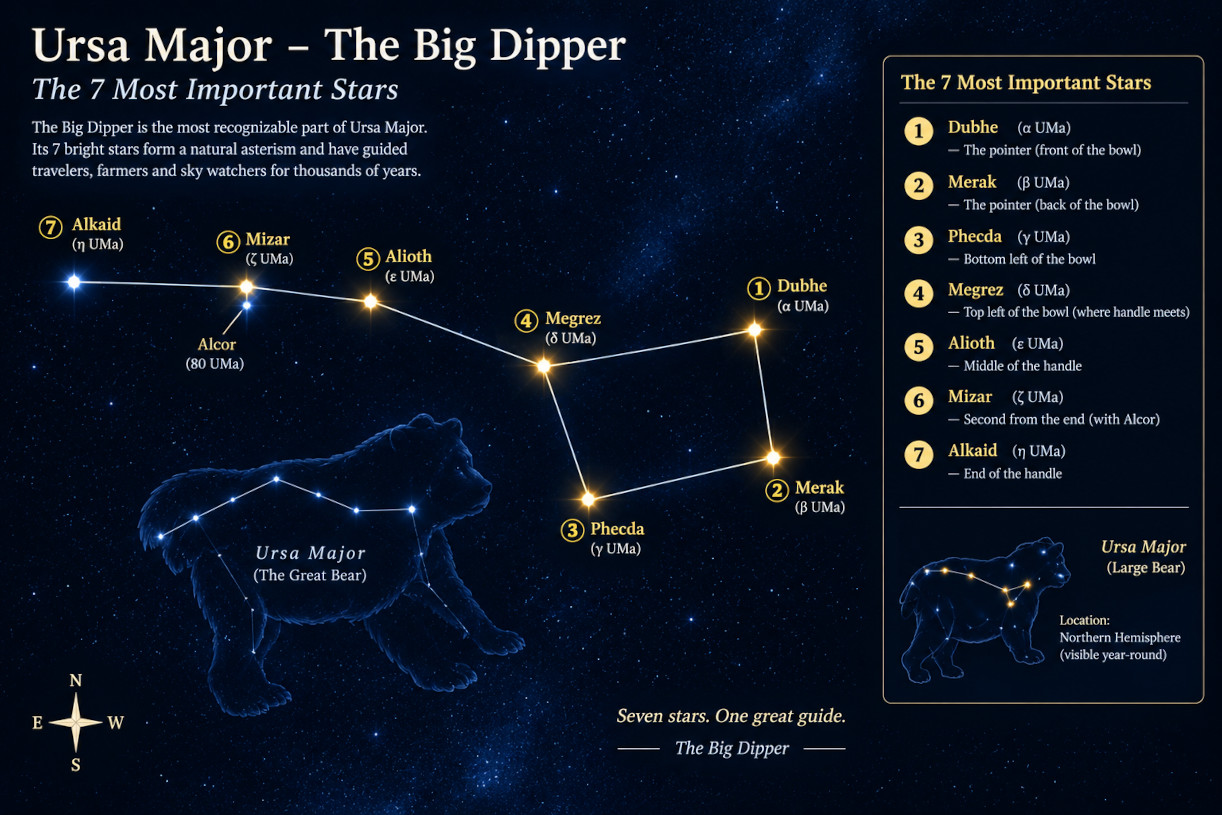
The exact star-by-star breakdown of the Big Dipper—starting from the outer lip of the bowl down to the tip of the handle—highlights these meanings:
- The Bowl Stars (Scale & Authority)
- Star 1: Dubhe (Tianshu – 天樞)
- Meaning: The Celestial Pivot
- Judicial Concept: The supreme point of governance. It represents the axis upon which the entire cosmos—and earthly law—revolves.
- Daoist Name: Tanlang (Greedy Wolf).
- Star 2: Merak (Tianxuan – 天璇)
- Meaning: The Celestial Rotating Jade
- Judicial Concept: Beautiful jade in constant motion. It represents the active rotation of imperial laws and the execution of cosmic justice.
- Daoist Name: Jumen (Great Gate).
- Star 3: Phecda (Tianji – 天璣)
- Meaning: The Celestial Shining Pearl
- Judicial Concept: The mechanism of rapid change. It represents the fluid administration of the courts and the tracking of celestial shifts.
- Daoist Name: Lucun (Salary Storehouse).
- Star 4: Megrez (Tianquan – 天權)
- Meaning: The Celestial Balance
- Judicial Concept: Sovereignty, metrics, and weight. This is the most explicitly judicial star. In ancient Chinese architecture, a Quan was a physical counterweight balance. This star represents the scales of justice weighing right against wrong.
- Daoist Name: Wenqu (Literary Composition).
- The Handle Stars (The Executioners)
- Star 5: Alioth (Yuheng – 玉衡)
- Meaning: The Jade Sighting Tube / The Jade Balance Bar
- Judicial Concept: Equity and leveling. While Star 4 (Tianquan) is the scale’s weight, Star 5 (Yuheng) is the balancing arm itself. It measures whether an earthly administration is completely level or leaning into corruption.
- Daoist Name: Lianzhen (Incorruptible and Upright).
- Star 6: Mizar (Kaiyang – 開陽)
- Meaning: The Opener of Heat / The Opening Sun
- Judicial Concept: The release of vital energy and yang power. It represents executive transparency and the outward implementation of imperial laws.
- Daoist Name: Wuqu (Martial Composition).
- Star 7: Alkaid (Yaoguang – 搖光)
- Meaning: The Twinkling Brilliance / The Shaking Light
- Judicial Concept: The physical flashing tip of the Dipper’s blade. It signals the final execution of cosmic law and the enforcement of the celestial path.
- Daoist Name: Pojun (The Army Breaker).
The Judicial Mechanism
Ancient Chinese astronomers viewed the first 4 stars (the bowl) as the Kuang (the body of the scale) and the last 3 stars (the handle) as the Heng (the measuring line). Together, they formed a giant judicial instrument hanging over the world to ensure the metrics of the human world matched the unwavering standards of the heavens.

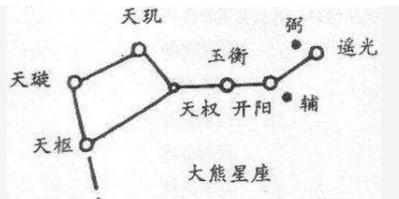
In both ancient Chinese astronomy and Daoist cosmology, the Big Dipper is not merely composed of 7 stars, but 9 distinct celestial entities.
While the 7 primary stars are easily visible to the naked eye, the transition from 7 to 9 stars introduces the “Two Hidden Stars” (also known as the Left Assistant and Right Assistant). Together, this complete group is referred to as the Beidou Jiuxing (北斗九星 — the 9 Stars of the Northern Dipper).
The identity, placement, and deep cultural roles of these two hidden stars reveal fascinating insights into ancient practices:
- The Astronomical Identity of these Hidden Two Stars
Unlike the core 7 stars, which maintain a consistent, distinct brightness, the hidden two stars require exceptional conditions or specific visual acuity to be observed:
- Star 8: Left Assistant (Zuofu – 左輔)
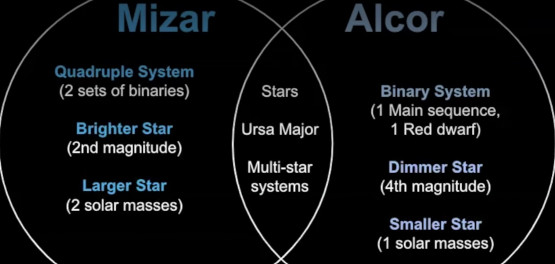
- Western Mapping: This star is visible under clear skies and corresponds directly to Alcor (80 Ursae Majoris), the tiny companion star sitting right next to Mizar (Kaiyang) in the handle of the Dipper.
- The Sight Test: In antiquity across both Asia and the Middle East, being able to clearly separate Zuofu (Alcor) from the brighter Mizar was used as a standard vision test for imperial guards and military scouts.
- Daoist Name: Dongming (Cave of Light / Eastern Brightness).
- Star 9: Right Assistant (Youbi – 右弼)
- Western Mapping: Unlike Alcor, Youbi is traditionally classified as an invisible or faint companion star near the handle. Modern astronomers and cultural historians note that it likely refers to a variable or faint star close to the handle that gradually faded out of naked-eye view over the centuries, solidifying its mystical reputation as a truly “hidden” star.
- Daoist Name: Yinyuan (Hidden Origin).

Mizar is a double twin-star system.
Alcor is a twin-star system.
- The Judicial & Court Role:
The Emperor’s Internal Advisors
Sticking to the theme of the Ziwei Enclosure acting as a grand imperial court, these two stars serve a very specific administrative function for the celestial government:
- The Secret Council: The 7 visible stars act as the public court officials, the scales of justice, and the executioner’s blade; the other 2, Zuofu and Youbi, represent the Emperor’s internal aides, private advisors, secret counselors.
- Checking Power: They represent the unseen checks and balances of cosmic law. They watch over these judges to ensure that corruption does not seep into the divine execution of justice.
- The Daoist Myth of the “9 Emperors”
In Daoist theology, these 9 stars are personified as the 9 Emperor Gods (Jiuhuang), born to Doumu (the Mother of the Dipper).
- The Cosmic Microcosm: Daoist texts like the Yunji Qiqian dictate that the universe operates on a system of 9s. The 9 Stars in the heavens mirror the 9 Prefectures of the Earth, which in turn mirror the 9 Orifices of the human body.
- The Birthday of the Stars: This concept is actively celebrated today during the 9 Emperor Gods Festival, which takes place during the first 9 days of the 9th lunar month. Worshippers wear white, fast, and hold festivals to invoke the protection of all 9 star lords, asking them to erase calamities and extend human lifespans.
The ritual of Bugang (步罡 — literally meaning “Pacing the Guidestar” or “Treading the Net”), commonly known as Pacing the Dipper (Bufeidou – 步飛斗), is one of the most powerful and visually striking esoteric practices in Daoism.
Through this ritual, a Daoist priest physically and mentally walks the specific pattern of the 9 stars of the Big Dipper to absorb cosmic energy, command spirits, and cross the threshold between the human world and the divine realm.
- Core Meaning: Walking on the Stars
The term Gang (罡) refers to the energy grid or “net” formed by the Big Dipper stars. When a priest performs Bugang, they are not merely walking on the temple floor.
The ritual area is transformed into a microcosmic map of the heavens. By stepping on the designated coordinates of each star in a precise order, the priest is literally climbing up into the stars, mounting the Ziwei Enclosure, and positioning himself at the spiritual axis of the universe.
- The Ritual Mechanics
The performance of Bugang is highly complex, combining physical movement with intense internal visualization / magic:
- The Pattern: The priest traces a zigzagging, labyrinthine path that connects the 7 visible stars and the two hidden stars (Zuofu and Youbi).
- The Yubu Step (Yu’s Pace): The physical step used is ancient, predating Daoism itself. It mimics the mythical dragging gait of Yu the Great (a legendary king who wore himself out controlling China’s massive floods). The step involves dragging one foot next to the other in a distinct three-step cadence, which symbolises balancing Yin and Yang with every stride.
- Internal Visualization: While the body moves, the priest’s mind must remain perfectly still. The priest visualizes the brilliant light of each star beaming down from the heavens, entering through the crown of their head, and filling their internal organs with pure cosmic energy.
- Harnessing the Power of Judgment
The Big Dipper acts as Heaven’s weapon of judgment and execution. By successfully pacing to the very tip of the Dipper’s handle (the blade), the priest dynamically captures that divine authority:
- Exorcism and Protection: Once positioned at the “blade” of the Dipper, the priest commands total authority over lower spirits, ghosts, and demons. They use this celestial backing to cast out evil influences, cure illnesses, and purify communities.
- Writing Petitions to Heaven: In major Daoist rituals, the priest must send an official document or petition directly to the Supreme Celestial Emperor inside the Purple Forbidden Enclosure. Bugang serves as the “staircase” that allows the priest’s spirit to ascend the heavens, deliver the petition by hand, and return safely to the earthly realm.
- Evolution into Martial Arts
The profound cosmic footwork of Bugang did not stay confined to temple altars. Over the centuries, it heavily influenced traditional Chinese martial arts. The famous evasive and circular footwork patterns found in Baguazhang (Eight Trigram Palm) and Tai Chi are direct descendants of these ancient Daoist methods of stepping through the stars to redirect cosmic forces.
To visualize the ritual footwork of Bugang, look at how Daoist sorcery merges the Big Dipper’s 9 Stars with the mathematical grid of the 8 Trigrams (Bagua).
When a priest paces the stars, they overlay the Dipper’s path onto a magic 3×3 square known as the Luoshu (Lo Shu) Square or the 9 Palaces (Jiugong).
- The Matrix: The Luoshu Grid
The Luoshu is an ancient mathematical grid where every row, column, and diagonal adds up to #15. In Daoist cosmology, this grid represents the physical blueprint of Earth and the spatial directions of the 8 Trigrams.
The 9 Stars of the Dipper are mapped directly onto the 9 sectors of this grid:
| 4 — Sun (Southeast) Star 4: Megrez (Tianquan) |
9 — Li (South) Star 9: Right Assistant (Youbi) |
2 — Kun (Southwest) Star 2: Merak (Tianxuan) |
| 3 — Zhen (East) Star 3: Phecda (Tianji) |
5 — Central Palace Star 5: Alioth (Yuheng) |
7 — Dui (West) Star 7: Alkaid (Yaoguang) |
| 8 — Gen (Northeast) Star 8: Left Assistant (Zuofu) |
1 — Kan (North) Star 1: Dubhe (Tianshu) |
6 — Qian (Northwest) Star 6: Mizar (Kaiyang) |
- Flight Pattern: Magic Square Sequence
When the priest performs the footwork, they do not walk in a neat circle. They follow a highly complex, jagged sequence called the Shinian (The Flying Stars), jumping from grid-palace to grid-palace based on the numerical order of the grid (from 1 to 9).
- The priest starts at Palace 1 (Kan / North / Tianshu), grounding themselves at the true astronomical north.
- They take a dragging Yubu step to Palace 2 (Southwest), then zig-zag across to Palace 3 (East).
- They fly through 4 (Southeast), land at the heavy anchor point of the 5 Center, and continue out to 6 (Northwest).
- They strike 7 (West), leap to 8 (Northeast), and finish the explosive movement at Palace 9 (South), place of the hidden executioner star (Youbi).
- Cosmic Meaning of the Grid Movement
By mapping the footwork this way, the priest hits two major cosmic feats simultaneously:
- Gathering the Space-Time Continuum: The 8 Trigrams represent all directions of Space, while the Big Dipper’s rotation represents the passage of Time (the seasons). By stepping on the Big Dipper stars inside the Trigram grid, the priest symbolically binds space and time together under their feet.
- Opening the Gate to the Forbidden Palace: The sequence creates a vortex of cosmic energy. Pacing the grid correctly acts like putting a combination code into the fabric of reality, opening a spiritual gateway directly into the stationary Ziwei Enclosure, so the priest can commune with the Emperor of Heaven.
The mystical 1-to-9 grid jumping performed by Daoist priests eventually transformed from a secretive temple ritual into the foundation of classical Chinese geomancy: Flying Star Feng Shui (Xuan Kong Fei Xing).
Nowadays, practitioners no longer physically step on the floor in a trance. Now, they use a compass and mathematical charts to let the 9 Stars of the Big Dipper “fly” through the floor plan of a building to calculate its energetic luck over time.
- From Spiritual Steps to
Time-Space Calculations
In the old Bugang ritual, the priest moved through the 1-to-9 Luoshu grid to harness cosmic energy. Flying Star Feng Shui takes that exact movement sequence—known as the “Path of the Luo Shu” or the “Imperial Flight Pattern”—to apply it to architecture.
Instead of viewing the stars as static entities in the sky, Feng Shui recognizes that the energy (Qi) of the Big Dipper’s 9 stars shifts over time. As the stars rotate, their distinct energies drop into different sectors of a home, influencing the wealth, health, and relationships of the people living inside.
- The 9 Stars in Feng Shui Architecture
The 9 stars retain their traditional identities, but they are translated into specific elemental forces, color systems, and luck omens within a house:
- Star 1 (Dubhe / White): Governs reputation, career status, and wisdom.
- Star 2 (Merak / Black): Governs illness and physical health constraints.
- Star 3 (Phecda / Jade): Governs arguments, lawsuits, and competitive legal issues.
- Star 4 (Megrez / Green): Governs academic success, writing, romance, and intelligence.
- Star 5 (Alioth / Yellow): The center anchor. It represents unpredictable, extreme changes, bad luck, or sudden shifts, if disturbed.
- Star 6 (Mizar / White): Governs authority, power, military execution, and mentors.
- Star 7 (Alkaid / Red): Governs robbery, gossip, communication errors, and sudden loss.
- Star 8 (Left Assistant / White): The star of steady wealth, real estate, and hard-earned success.
- Star 9 (Right Assistant / Purple): The star of future prosperity, expansion, and celebrations.
- How a House Chart is “Flown”
To calculate a home’s luck profile, a modern practitioner maps out a 3×3 grid over the blueprint of a house using 2 variables:
- Building’s Birth Year (Time): Feng Shui breaks time down into 20-year cycles called “Periods.” For example, homes built or significantly renovated between 2024 and 2044 belong to Period 9, meaning Star 9 (the Purple Right Assistant star) takes the throne in the center of the grid.
- Compass Facing Direction (Space): Using a specialized magnetic compass (Lopan), the precise degree the front of the house faces is measured.
Once the primary star is placed in the center sector based on these numbers, the practitioner uses the exact zig-zag pattern of the ancient Daoist ritual to scatter the remaining stars into the other 8 compass directions of the home.
[The Flying Route Sequence]
4 ➔ 9 ➔ 2
↑ ↓
3 5 ➔ 7
↑ ↑
8 ➔ 1 6
- Diagnosing the Energy Matrix
Once the chart is drawn, the practitioner looks at which stars land in critical rooms like the master bedroom, the front door, or the kitchen.
If the Illness Star (Star 2) lands right on your front door during a specific year, Feng Shui dictates that the residents are highly prone to getting sick. If the Wealth Star (Star 8 or 9) lands in your home office, it means that sector is highly charged for financial growth.
Ancient imperial courts used the Big Dipper as a moral mirror and judicial system, today, Feng Shui treats the building as a container catching those exact same celestial currents, to map whether a household will experience harmony or disorder.

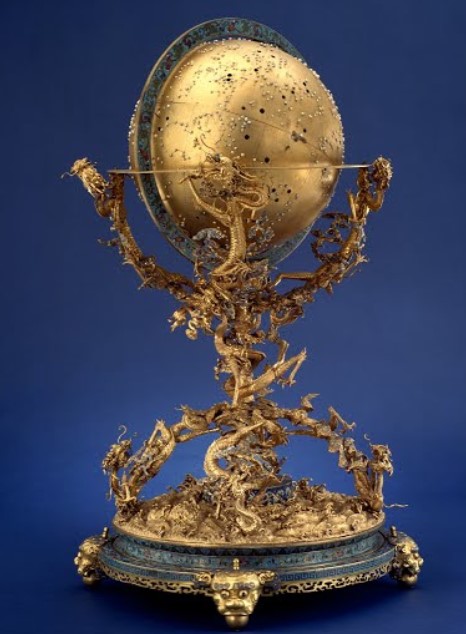
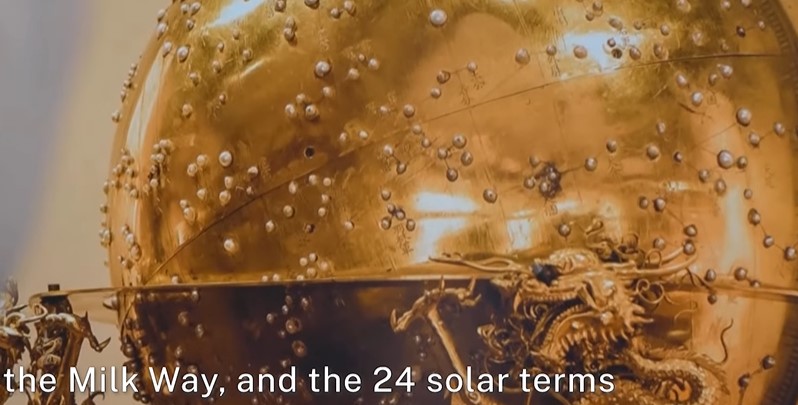
The Qianlong Golden Celestial Sphere