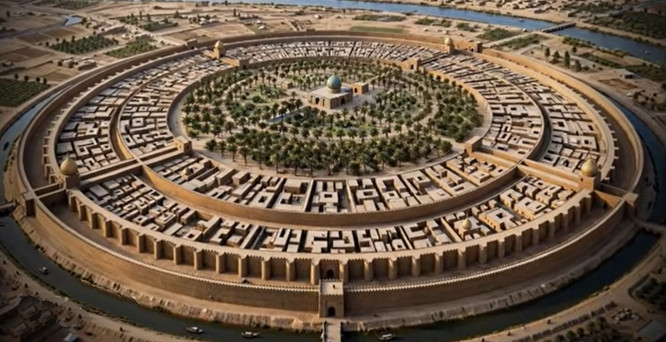
Ancient Baghdad
Baghdad and the House of Wisdom
Baghdad during the Islamic Golden Age
Baghdad was a place where knowledge, cultural exchange, scientific investigation, translation, and intellectual collaboration came together on an unprecedented scale.
Baghdad: A Beacon of Civilization
In 9th-century Mesopotamia, the city of Baghdad is at the height of its power. It sits beside the Tigris River, where merchants arrive from distant parts of the world, including China, India, Persia, and N-Africa.
Baghdad’s greatness was not simply based on its wealth. Its true importance came from its intellectual life. At the center of the city were institutions where scholars, scribes, philosophers, mathematicians, translators gathered to study and exchange knowledge.
There was the Madinat al-Salam, or the “City of Peace,” the institution that became associated with its intellectual culture: the Bayt al-Hikma, or House of Wisdom.
The Origins and Foundation of Baghdad
The rise of Baghdad is traced to 762 CE, when the Abbasid caliph Abu Ja’far al-Mansur selected the site for his new capital. The location was strategically important. Baghdad stood near the Tigris and within the broader fertile region of Mesopotamia, placing it at the intersection of major commercial, agricultural, political, and transportation networks.
Al-Mansur envisioned more than simply a political capital. The city was deliberately planned as an extraordinary urban center.
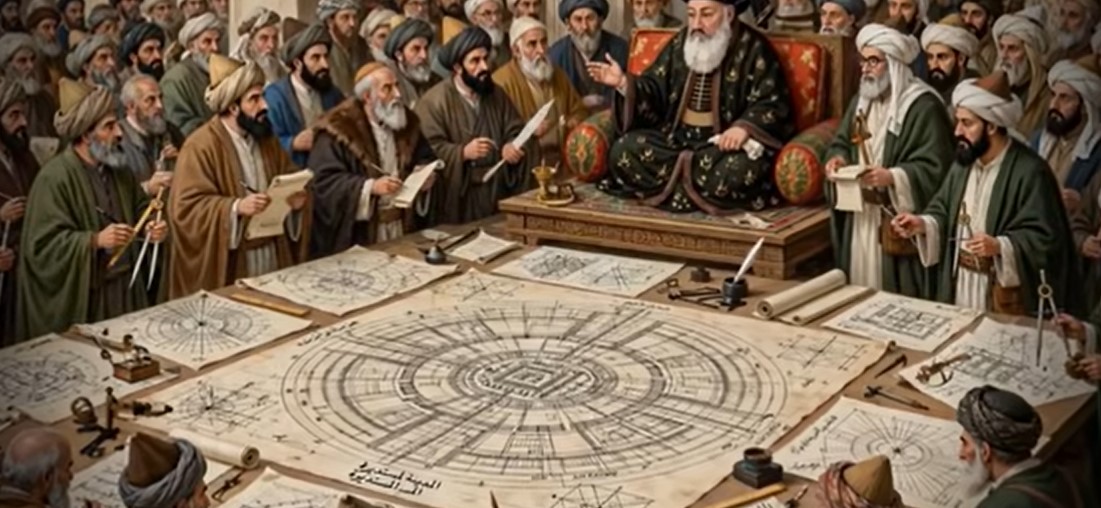
The famous Round City was designed around concentric circular walls, with important governmental and religious buildings occupying the central area. The city’s design reflected the power and organization of the Abbasid state.
Al-Mansur began collecting manuscripts and texts, particularly works concerning:
- science,
- law,
- administration,
- philosophy,
- mathematics,
- astronomy,
- Persian intellectual traditions.
This collection formed part of the foundation for the later scholarly culture associated with the House of Wisdom.
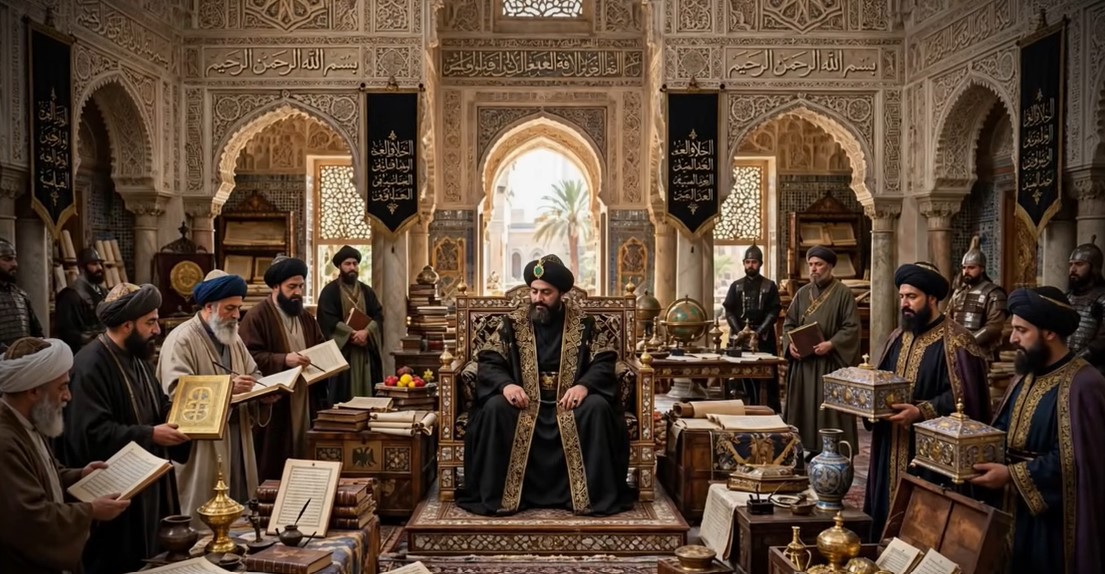
Harun al-Rashid and the Expansion of Scholarship
Harun al-Rashid ruled from 786 to 809. Under him, Baghdad became even more prosperous and culturally influential. The caliphate’s political and economic power provided the resources necessary to support scholarship.
Its growing collection of manuscripts and intellectual resources developed into the Bayt al-Hikma. The institution is portrayed as much more than a library. It became associated with:
- manuscript preservation,
- translation,
- scholarly research,
- astronomy,
- philosophy,
- scientific investigation,
- intellectual exchange.
This transformation established Baghdad as a destination for scholars from different regions and cultural traditions.
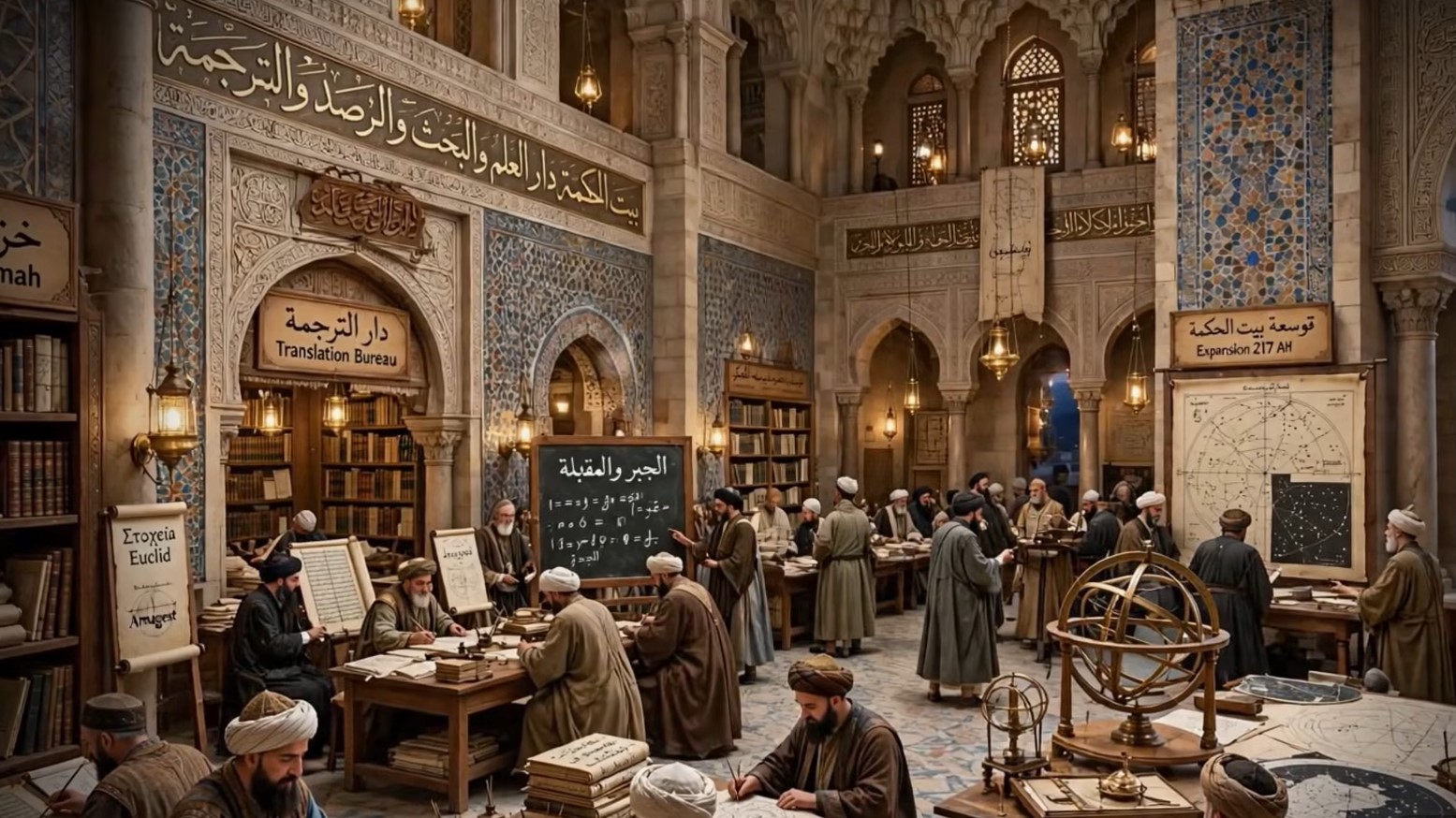
Al-Ma’mun and the Great Translation Movement
The intellectual movement reaches its peak under Caliph al-Ma’mun, who ruled from 813 to 833. He is portrayed as particularly interested in Greek philosophy and rational inquiry. There is a famous story of al-Ma’mun dreaming of Aristotle. In the story, Aristotle appears to him and discusses the relationship between reason and truth.
The anecdote illustrates the importance that the Abbasid intellectual culture placed on reason, philosophy, and the pursuit of knowledge. Al-Ma’mun subsequently supported a large-scale effort to obtain manuscripts from places such as:
- Constantinople,
- Persia,
- India,
- other centers of learning.
The resulting translation movement brought large amounts of scientific and philosophical material from India and elsewhere into the Arabic-speaking world.
A Multicultural Intellectual Community
Indians, Muslims, Christians, Jews, Sabians, Zoroastrians, and others contributed to its scholarship. A particularly important example is Hunayn ibn Ishaq, a Christian scholar and translator renowned for his knowledge of languages including Arabic, Greek, Syriac, and Persian. He and other translators worked to make Greek scientific and medical knowledge accessible to Arabic-speaking scholars. Works associated with figures such as:
- Galen,
- Hippocrates,
- Euclid,
- Archimedes,
- Plato,
were translated, studied, and incorporated into a developing intellectual tradition. These scholars used older knowledge as a foundation for new discoveries, criticism, experimentation, and theoretical development.
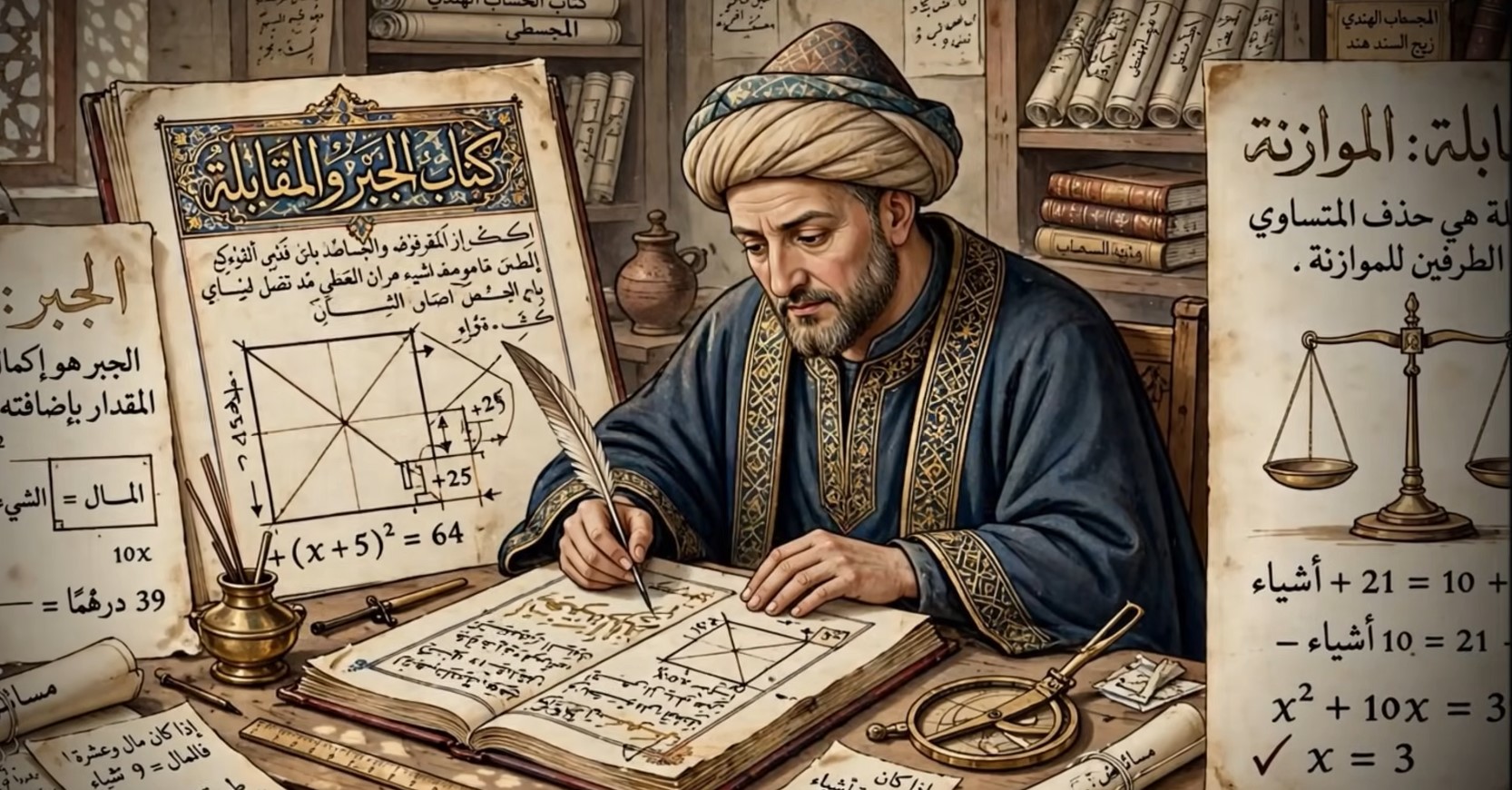
Al-Khwarizmi and
the Development of Mathematics
Muhammad ibn Musa al-Khwarizmi is one of the most important mathematicians associated with the Abbasid intellectual tradition. He is a transformative figure because of his contributions to algebra, arithmetic, astronomy, geography, and mathematical methods. His work on algebra became particularly influential.
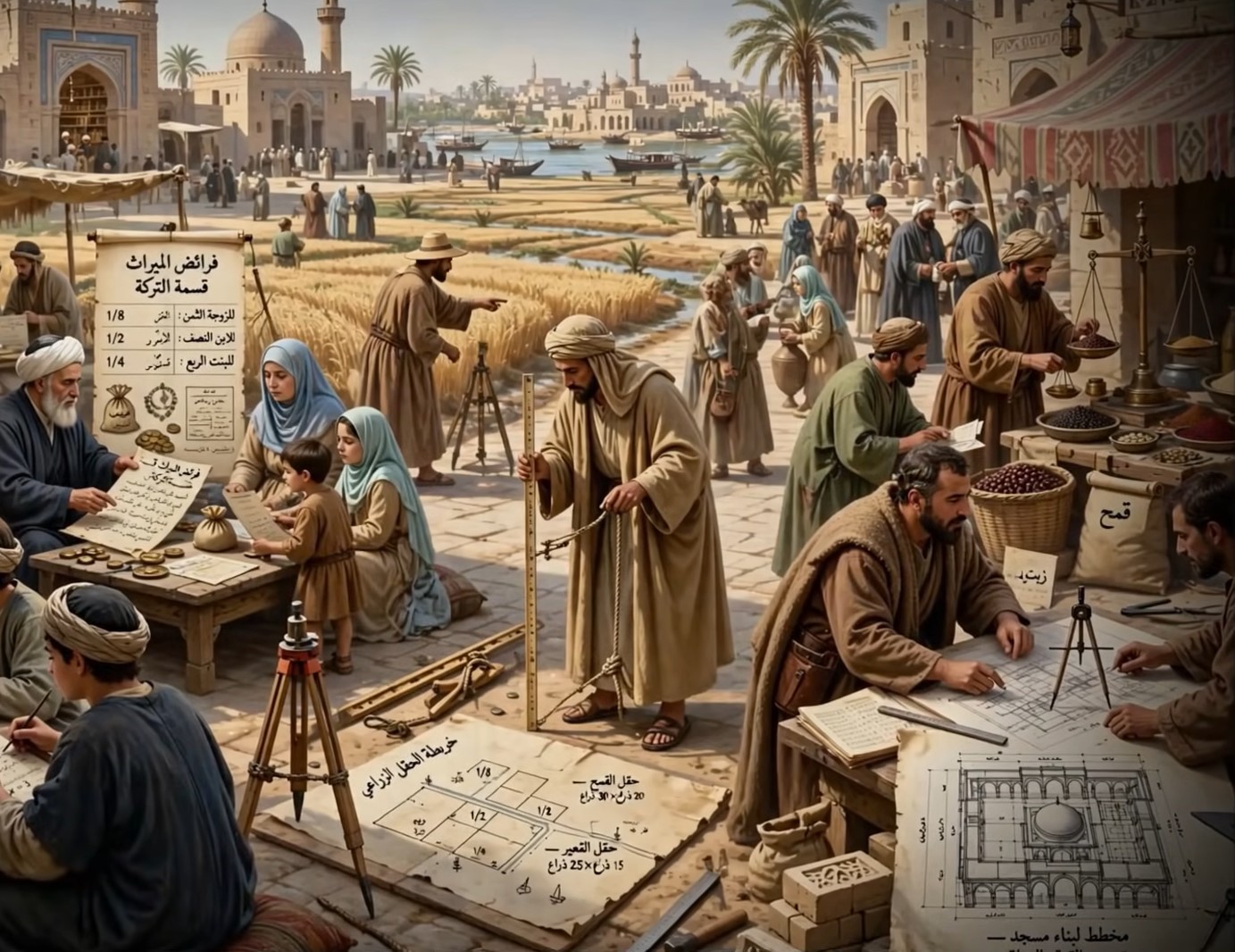
The Arabic term al-jabr, associated with his famous mathematical treatise, eventually entered European languages as “algebra.” His mathematical methods provided systematic approaches to solving equations rather than relying solely on individual geometric constructions or case-by-case calculations. These practical applications of mathematics, included:
- inheritance calculations,
- land measurement,
- commerce,
- architecture,
- taxation,
- agricultural problems.

Aryabhata (476 AD) wrote the Āryabhaṭīya in Bharat (India). He defined the number Pi and explained the number Zero.
 This knowledge was brought to Baghdad after his death in 550 AD.
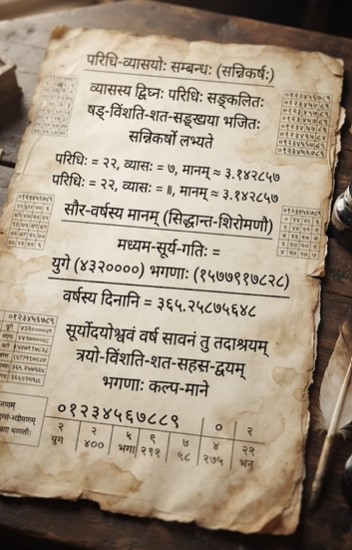 “The Mind who mapped the cosmos
through Mathematics”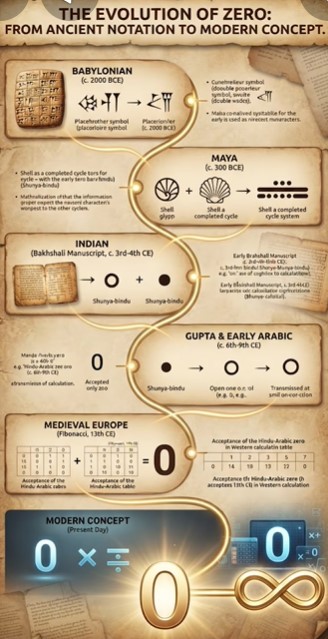

Zero, Numerals, and the Algorithm
Another major contribution attributed to al-Khwarizmi concerns the transmission and development of the Indian numerical system. The decimal positional system, including the use of pi and zero, became increasingly important within Islamic mathematics and reached Europe later.
The Latinization of al-Khwarizmi’s name, “Algoritmi,” eventually contributed to the modern word “algorithm.”
Every time people use:
- mathematical calculations,
- computer algorithms,
- digital systems,
- numerical models,
they are, in a historical sense, participating in a mathematical tradition that was significantly developed and transmitted throughout the medieval Islamic world.
Astronomy and
the Measurement of the World
Al-Khwarizmi’s work extended beyond mathematics. He contributed to astronomical tables, combining information from Indian, Persian, Greek traditions. These tables allowed scholars to calculate celestial movements and predict astronomical events, involving:
- the sun,
- the moon,
- planets,
- eclipses,
- trigonometric calculations,
- astrolabes,
- sundials.
Astronomy was not simply theoretical. It had practical importance for:
- navigation,
- timekeeping,
- calendars,
- determining prayer times,
- geography.
Geography and Mapping the Earth
The intellectual achievements of Baghdad extended to geography. Al-Khwarizmi is associated with the Kitab Surat al-Ard, a work concerning the geography of the known world. Scholars in Baghdad critically examined earlier geographic information, including the work of Ptolemy, and attempted to correct inaccuracies in measurements and maps.
Ancient knowledge was not treated as unquestionable authority.
Instead, scholars compared sources, performed calculations, tested claims, and attempted to improve existing knowledge.
Al-Kindi and the Philosophy of Reason
Then there is al-Kindi, an important early philosopher in the Arabic intellectual tradition. He attempted to reconcile Greek philosophical thought with Islamic intellectual traditions. Knowledge, according to this philosophy, should not be rejected simply because it originates from another culture or civilization. Instead, truth should be sought wherever it can be found.

The Banu Musa and
Mechanical Engineering
Then there are the Banu Musa brothers, three scholars and engineers who worked during the Abbasid intellectual flowering. They are associated with the Book of Ingenious Devices, which described numerous mechanical inventions. Among the devices discussed are:
- automatic mechanisms,
- water-control systems,
- oil lamps,
- mechanical musical instruments,
- automated devices.
Their work demonstrates that the Golden Age involved not merely philosophy and manuscript translation but also engineering and technological experimentation:

Thus, the House of Wisdom represents a broader scientific ecosystem encompassing mathematics, astronomy, medicine, mechanics, geography, and philosophy.
The Paper Revolution
Then there is the spread of papermaking. Baghdad’s growing paper industry came from knowledge acquired from China during the 8thC. Paper was significantly cheaper and easier to produce than traditional writing materials such as parchment. It transformed the economics of knowledge. Paper became more widely available.
Baghdad experienced an expansion in:
- book production,
- copying,
- libraries,
- education,
- scholarship,
- literacy,
- commercial bookselling.
The result was an intellectual environment in which written knowledge could circulate much more efficiently. Paper was one of the technological foundations of Baghdad’s intellectual revolution.
Baghdad at Its Height
By the 9th and 10th centuries, Baghdad became one of the largest and most important cities in the world. Its importance extended beyond scholarship. It was simultaneously:
- an imperial capital,
- a commercial center,
- a transportation hub,
- a medical center,
- an astronomical center,
- a publishing and book culture center,
- a place of philosophical debate.
The city became a meeting point between different civilizations. Knowledge originating in Greece, India, Persia, Syria, China, etc., could enter Baghdad’s intellectual networks, where scholars translated, compared, adapted, and expanded it.
Medicine and Hospitals
Hospitals, or bimaristans, developed in the Islamic world with increasingly organized systems of medical care, like:
- specialized wards,
- sanitation,
- pharmacies,
- surgical facilities,
- organized treatment.
Medical knowledge inherited from Greek and Persian traditions was studied and expanded by Muslim and non-Muslim physicians. Baghdad’s Golden Age was not limited to abstract intellectual pursuits. Scientific knowledge had practical consequences for everyday human life.
Astronomy and Scientific Measurement
Astronomical institutions in Baghdad contributed to increasingly sophisticated observations and calculations. At the al-Shammisiyyah observatory, scholars were calculating astronomical and geographical measurements. The goal was to understand the natural world through mathematics and observation. Knowledge should be investigated rather than merely inherited.
The Beginning of Decline
The Abbasid caliphate gradually lost political control over its territories. Power increasingly shifted toward:
- military factions,
- regional rulers,
- competing dynasties,
- political elites.
By the 11th century, the Abbasid caliphs were operating under the political influence of the Seljuk Turks. Despite these political difficulties, intellectual life did not vanish immediately. Scholarly institutions continued to exist, including the Nizamiyya madrasas. However, the political environment was becoming increasingly fragmented. A civilization’s intellectual achievements can flourish for centuries but remain vulnerable when political stability deteriorates.
The Mongol Threat
The Mongol Empire had expanded enormously across Central Asia and the Middle East. In 1258, a Mongol army led by Hulagu Khan moved toward Baghdad. The Abbasid caliph al-Musta’sim was unable to organize an effective defense that could stop the Mongol forces. Baghdad was surrounded. The city that had once represented intellectual and political power now faced an existential military threat.
The Sacking of Baghdad
In February 1258, the Mongols breached Baghdad’s defenses. The resulting sack was catastrophic:
- destruction of buildings,
- burning of palaces,
- mass deaths,
- destruction of libraries, including the House of Wisdom,
- devastation of the city’s infrastructure,
- collapse of Abbasid political power.
It is said that books were thrown into the Tigris River, turning the river dark with ink.
Knowledge Survives the Destruction
Ideas are harder to destroy than buildings.
Before the Mongol invasion, manuscripts and intellectual traditions had already spread throughout the Islamic world. Copies of important works could be found in places such as:
- Cairo,
- Damascus,
- al-Andalus,
- Central Asia,
- other scholarly centers.
Arabic scientific works also traveled into medieval Europe. Translation centers such as Toledo helped make Arabic scholarship accessible to Latin-speaking European scholars. Consequently, the scientific tradition developed in Baghdad continued to influence the intellectual history of Europe.
Baghdad’s Influence on Europe
The transmission of Arabic scholarship played an important role in the intellectual development of medieval Europe. European scholars encountered works associated with figures such as:
- al-Khwarizmi,
- Ibn Sina (Avicenna),
- al-Kindi,
- al-Razi.
Their writings contributed to European studies of:
- mathematics,
- medicine,
- philosophy,
- astronomy,
- geography.
These works eventually became part of the intellectual environment from which later European scientific developments emerged, leading to the European Renaissance and its Scientific Revolution.
Knowledge Belongs to Humanity
Baghdad demonstrates the power of intellectual openness. The city’s greatest achievements came from the interaction of different cultures and traditions. Greek philosophy was translated into Arabic.
Indian mathematical concepts were incorporated into Islamic mathematics.
Persian scholarship contributed to Abbasid intellectual life. Christian, Jewish, Muslim, and other scholars participated in the wider scholarly environment. The resulting knowledge was neither purely Greek, Persian, Indian, nor Arab.
A shared intellectual inheritance:
Innovation Rather Than Mere Preservation
The scholars of Baghdad were not simply copying ancient books. They were building upon them. Greek mathematics became a foundation for further mathematical development. Indian numerical ideas were incorporated into increasingly sophisticated mathematical systems.
Ancient astronomical knowledge was tested and revised. Medical theories were studied and expanded. Philosophical ideas were debated and adapted. Engineering principles were turned into practical mechanical devices.
Baghdad’s Golden Age was a process of:
translation → criticism → experimentation → innovation.
Baghdad’s extraordinary achievements did not make the civilization invulnerable.
Political fragmentation, military instability, internal conflict, and external invasion eventually created conditions in which the city would be devastated.
Thus, Baghdad is an example of human achievement and a warning about the fragility of civilization.
- Libraries can be destroyed.
- Institutions can disappear.
- Political systems can collapse.
But knowledge that has already spread between people and cultures can survive.
Baghdad’s scholars studied ancient knowledge but did not simply preserve it. They transformed it.
Their contributions influenced:
- algebra,
- algorithms,
- astronomy,
- geography,
- medicine,
- engineering,
- philosophy,
- mathematics,
- scientific methodology.
The physical city could be destroyed, and libraries could burn, but the knowledge created and transmitted there continued traveling across the world.
The legacy of Baghdad therefore survives in the modern world every time we use mathematics, algorithms, maps, astronomical calculations, medical knowledge, or systems of organized scientific inquiry.
The strength of a civilization is not measured only by its armies, wealth, monuments, or political power. Its deeper strength lies in its willingness to seek knowledge, welcome different intellectual traditions, question existing ideas, encourage innovation, and preserve knowledge for future generations.
Baghdad’s story is about what humanity can accomplish when knowledge is treated as a shared human inheritance, and what can be lost when political instability, intolerance, and violence are allowed to overwhelm the institutions that protect it.