Appreciative Attention

(3DAA)’s Main objective:

To acquire the Art of improving the mental & emotional state of everybody, via a particular way of observing.

Gratitude = Happiness + Goodness

Appreciation is more than just gratitude. It is an act of proactively valuing some-thing or some-one. It transforms gratitude from an after-the-fact expression of feeling, to a before-the-fact deliberate engagement of energy. This is the energy of appreciation, a heart force heavily under-utilized!

Appreciation is an Attention-beam of bio-photons, improved by a special quality of feeling. It helps dissolve the emotional glue (pain, fear, anger) from a trauma. It also stimulates the production of the mood enhancing hormone DHEA.

Appreciative Attention can be seen as a non-judgmental awareness of whatever arises, a lightness of humor that enables you to defuse uncomfortable situations without disrespecting those involved.

You can lighten the seriousness of someone through the understanding that what they communicate is important,  has value, and as such, it is appreciated. However, appreciation & importance are separate from Seriousness.

Seriousness carries unconscious emotions like fear, anger, and frustration. It is like glue that fixes attention. This may often result in an ongoing flow of thoughts or feelings.

Appreciation plus Soft Focus Attention dissolves this glue and stops the inexorable stream of thoughts for a moment.

The state of appreciation is a state of unconditional love, irrespective of who you are, an exact vibrational match to the vibration of source energy, the highest energy frequency available.
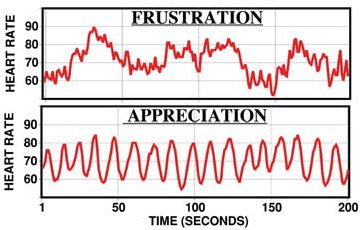
What’s better for your heart?

read more …

Similar Posts

  • Pentecost story

    Acts 2:1-20 + 38 like the rush of a mighty wind … by St. Luke, the 1st Christian Physician, born Greek and Gentile in Antioch, Syria Kosmos figure, symbol of the world “When the day of Pentecost had come, they were all together in one place. And suddenly from heaven there came a sound like…

  • Emotions Network

    PART V Dr. Antonio Damásio, a neuroscientist and clinician at UCLA, has published a few books on his team’s “body to brain” feedback research on people with brain damage. these decades of experiences have led him to conclude that: Patterns in the external world correspond with patterns of nerve cell activity in the brain. We experience…

  • 3 different brains?

    The human brain has 3 integral systems: reptilian (instincts), mammalian (emotions), and neo-cortex (left half is rational, right half is creative, intuitive). Shame is an emotion formulated by the mammalian brain. Justice is an idea formulated by the neo-cortex, but what about our instincts? If the instinctive urge to discharge intense survival energy is thwarted,…

  • Roots of our Traumas?

    If we are disconnected from our felt sense of belonging, our emotions are left floundering in a vacuum of loneliness. It leaves our rational minds to create fantasies based on disconnection rather than connection. These fantasies compel us to compete, make war, distrust one another, and undermine our natural respect for life. Isn’t it easier…

  • Instinctive-Brain?

    The Reptilian Brain We have built in mechanisms for responding and moving toward a natural resolution of trauma. Some of these we share with animals; some are uniquely human, particularly our highly developed thought and language processes. Sensation is the language of the reptilian brain. Biologically and physiologically, the reptilian brain is essential to all…