Akshardham Temple and other Temples
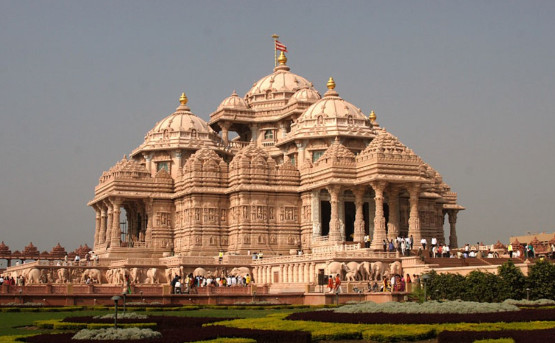
Swaminarayan Akshardham is a Hindu temple in Delhi. The modern (2005) complex displays millennia of traditional and modern Hindu culture, spirituality, and architecture.

The temple, at the center of the complex, was built according to the Vastu shastra. Originating in ancient India, Vastu Shastra ( वास्तु शास्त्र, vāstu śāstra “science of architecture”) is an ancient Hindu system of architecture, based on old texts that describe principles of design, layout, measurements, ground preparation, space arrangement, spatial geometry.
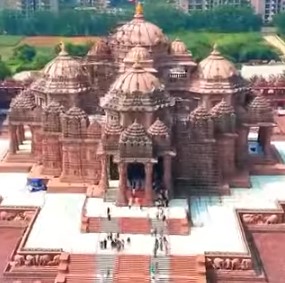
The designs aim to integrate architecture with nature, the relative functions of various parts of the structure, and ancient beliefs utilizing geometric patterns (yantra), symmetry, and directional alignments. The 5 main domes do not have the ogival shape, that the smaller domes have.
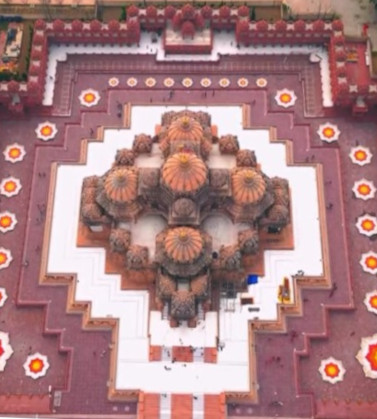
3D shadow projection of a 4D hypercube
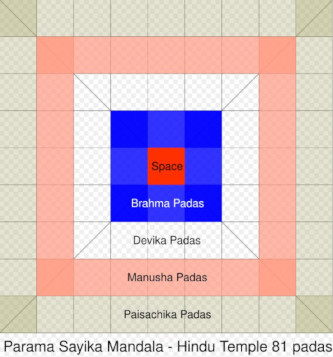
The 9×9 (81) grid “Parama Sayika” layout plan (above) is found in large ceremonial Hindu Temples. Parama means excessively/excellently/all encompassing. Sayika means being in regular order. It is also used to indicate ‘five’.
It is one of many grids used to build Hindu temples. In this structure of symmetry, each concentric layer has significance:
- The outermost layer, Paisachika padas, signifies aspects of Asuras and evil, like Draco consciousness.
- The inner Devika padas layer signifies aspects of Devas and good.
- In between the good and evil is the concentric layer of Manusha padas, signifying human life.
- All layers surround Brahma padas, which signifies creative energy and the site for a temple’s primary murti for darsana.
- At the very center is the Garbhagriha (Purusha), signifying the Universal/Cosmic Principle present in everything and everyone.
The grand, ancient-style, ornately hand-carved stone temple has been built without structural steel within five years by 11,000 artisans and volunteers.
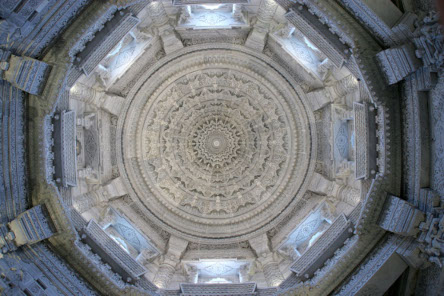
Central dome inside up


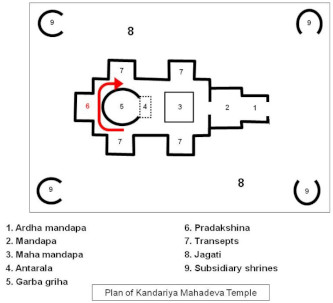
Kandariya Mahadeva Temple
The significant layout of the Foundation ≈19x31mtrs by ≈31mtrs high.
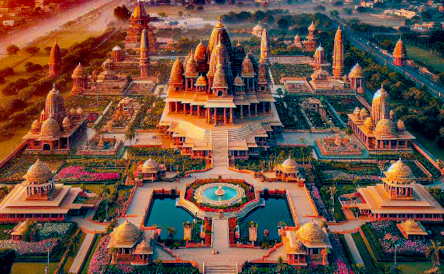
Ayodhya Ram Mandir complex in India
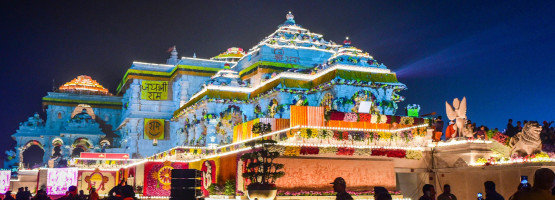
The temple is dedicated to Lord Rama and is believed to have been built at Ram Janmabhoomi, the birthplace of Lord Rama.
L= 380 Ft. W=250 Ft. H= 161 Ft.
22/1/2024
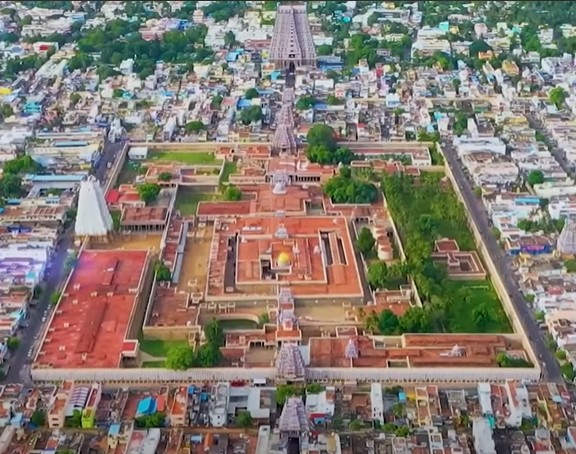
Srirangam, the largest functioning Hindu complex WorldWide
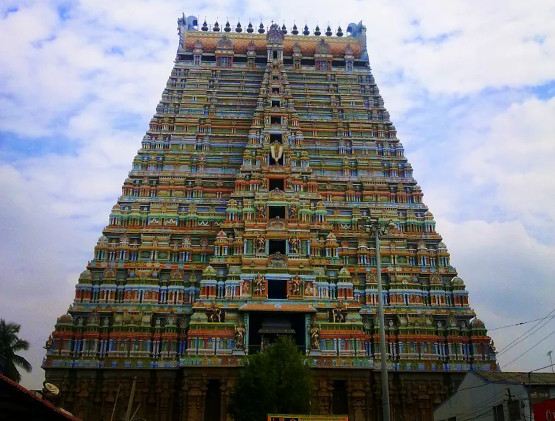
The Srirangam temple complex contains 7 concentric walled sections and 21 towers gopuram.The gopuram of the temple is called the Rajagopuram and is 72 m tall, the tallest in Asia.
The temple has 7 prakaras (elevated enclosures) with gopurams articulating the axial path, the highest at the outermost prakara and the lowest at the innermost. Just after the construction of this temple, the city of Srirangam lived completely within its walls, and hence is quoted as an example of Hindureligious utopia.
The Srirangam temple is 1 of the 3 temples of Ranganatha, situated in the natural islands inside the Kaveri river.
Other great Indian Temple Complexes