Super Symmetry (SUSY) Particles

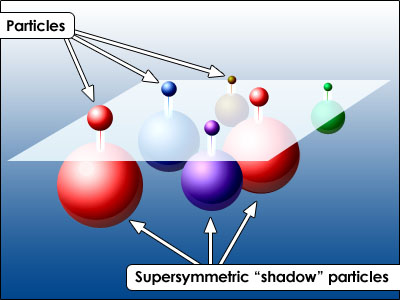
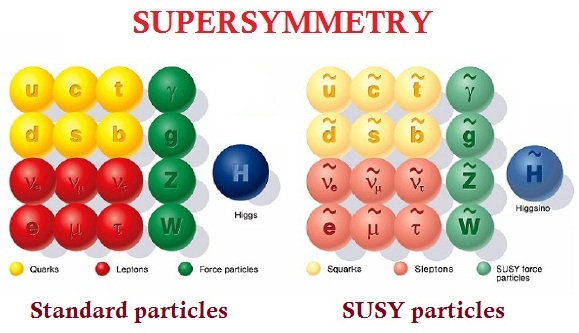
Super or Twin Symmetry states that for every particle known in the grand dance of particles in the cosmos there is a corresponding ‘dark or shadow’ twin-partner with a higher mass. Its nomenclature simply adds an “s” to the known particles. So quarks would have corresponding squarks.

This theory has the added advantage of providing quite ideal candidates for dark matter, a heavier twin-partner who does not interact with light.

Since all particles are classed as either fermions or bosons, a particle belonging to one class has a twin-partner in the other class, thereby “balancing the books” and making Nature more symmetric. Thus, the twin of an electron (a fermion) is called a selectron (a boson).

These super symmetric particles, have the same charge but opposite spin to the particles we are familiar with, such as photons and electrons.
Whereas super symmetry in particle physics is just a hypothesis waiting to be confirmed or disproved, there are occurrences of super symmetry in nuclear physics which seem to have stronger evidences.

In elementary particle physics, super symmetry theory interchanges particles of completely dissimilar types: fermions which make up the material world, and bosons which generate the forces of nature.

Two fermions will never occupy the same quantum state. Bosons, under the right conditions, form regimented armies of clones, such as the photons in a laser beam. Yet somehow in the mirror of super symmetry, individualistic fermions look magically like sociable bosons, and v.v.
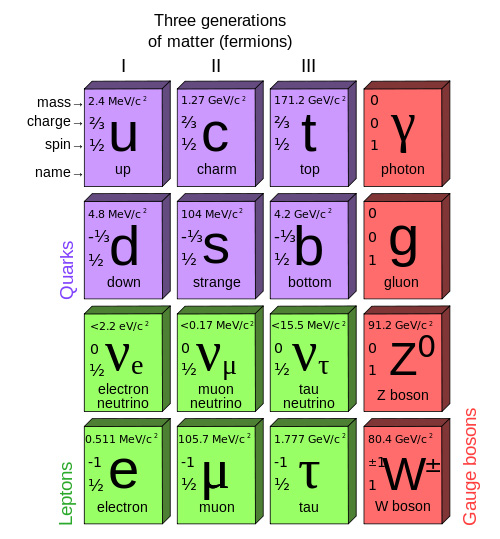

Nuclear physicists predicted the existence of a different form of super symmetry in certain atomic nuclei. Nuclei with even numbers of protons + neutrons versus those with odd numbers of protons + neutrons.

A composite particle containing an odd # of fermions is itself a fermion, but an even # of fermions produces a boson.

Theorists must use many tools to understand all facets of the complicated physics of nuclei. The new results adds SUSY to the toolkit and it shows that super symmetry is not just a mathematical curiosity but exists in the world.

read more …

Similar Posts

  • Gut bacteria / viruses?

    Our bodies contain ≈100 Trillion bacteria versus ≈10 Trillion cells. The DNA of those different microbes account for 3.3 Million genes, vs 23.000 genes for the body’s DNA. There are ≈1000 different species. We carry ≈150, mostly in the gut. Each of us has a different cast of characters, thus each of us has a…

  • Summer Palaces

    Qingyiyuan, Gardens of Clear Ripples, the Summer Palace with Kunming lake Around 1749, the Qianlong Emperor decided to build a summer palace in the vicinity of Jar Hill to celebrate the 60th birthday of his mother, Empress Dowager Chongqing. Longevity Hill is about 60 m-high and has many buildings positioned in sequence. The front hill…

  • Qinglong Emperor

    (25/9/1711 – 7/2/1799) 乾隆帝 (lasting eminence) Strong/intense/grand/prosperous/ eminently thriving Emperor Qianglong’s Manchu Family tree Cherished Empress Xiaoxianchun (Lady Fuca Rongyin: Mu-28/3/1712-8/4/1748) “Plaisir d’amour ne dure qu’un momentChagrin d’amour dure toute la vie” Hongli became Emperor Qianlong Qianlong Emperor before abdication Only 10 sons & 17 daughters reached adulthood General Fuk’anggan (Mu-1753-1796) Some of his 29…

  • Stupa Temples

    In ancient Indian art, Buddha Shakyamuni was not represented as a being but as a stupa, a reliquary containing the relics of an individual associated with great spiritual power and insight, most often (since the 3rd century BCE) with the Buddha himself. The shape, a hemisphere topped by a spire and surrounded by a gate…

  • Reverse the cause?

    How to Reverse the Causes In order to reverse a disease, we have to reverse its cause. This means reversing our physical, emotional, and mental habits, and free us from the conditioning of the past. Curing ourselves, one thought or belief at a time, was and is still the most exciting venture we have engaged…

  • Stem Cells

    Stem cells are un-programmed cells that could divide forever. Since stem cells can become bone, muscle, cartilage or other specific cells, they may help cure diseases, such as cancer, diabetes, Parkinson’s, and Alzheimer’s. They are found in embryos and in some adult organs. Basal cells are stem cells. Mitochondria play a key role. Human bone…