Shape Shifting Fungi
The world’s most creative shape shifters
Because of the limited understanding of the fungi’s potential shapes, physiology, fermentative capacity, and ways of reproduction, fungi are still the most powerful and best organized micro-organisms known to humanity.
Fungi are able to change their metabolism as often as necessary, so as to overcome all defense mechanisms of the host’s immune system. They can increase cell production, be plasmatic, biochemical, or volumetric.
Our indiscriminate use of nature-based pharmaceuticals led to mutations in the nuclei of many parasite fungi, which led to very aggressive pathogens in the organisms of the many hosts.
Fungi can develop from a few micron-sized mono-cells to a threadlike filament body, to a beak-shaped form that can penetrate the host organism easier.
Their shape is defined by the environment in which they propagate. They can switch back and forth between these 2 forms and may produce different types of colonies.
This shift from a mono-cellular to a multi-cellular filament depends upon the type of actions caused by the immune system of the host organism.
Different fungi can all have the same shape if their environments are the same. Spores develop in clusters along the filament, which may be active or lie dormant until later.
They prefer oxygen rich, but can also survive in oxygen depleted environments. They use biofilms to protect themselves from our immune system and antifungals.
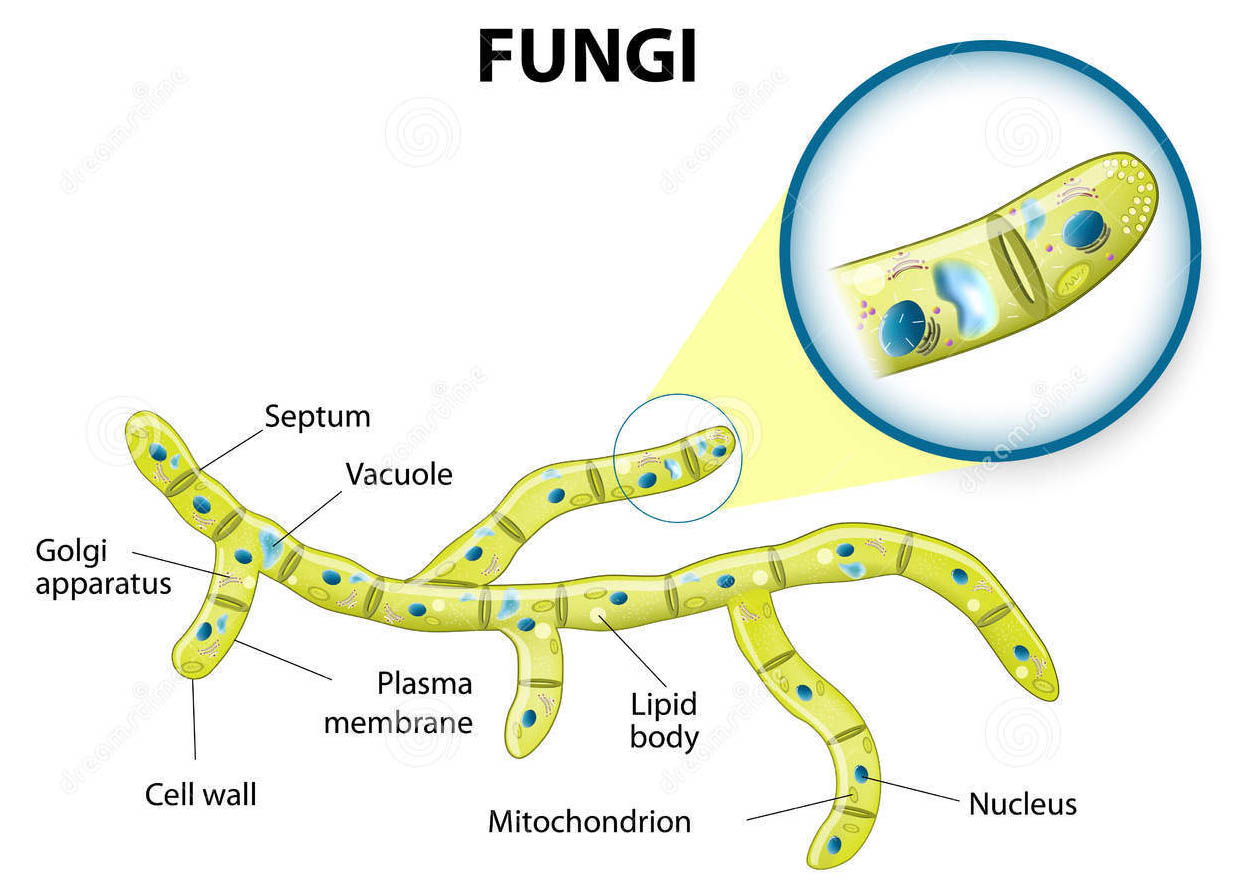
The outer cell wall of a fungus consists of vegetable, polysaccharide, and protein matter and may contain several layers that varies within strains. It ensures survival of the cell, and provides a surface to interact with the environment.
The vegetable portion is called chitin. Inside a cell wall there is a membrane consisting of fat and protein and just beyond that are mitochondria and then a nucleus.
Changes in food supply cause mutations in the fungi. This could lead to filament fusion of different fungi to explore a limited supply in a more social setting, a feature totally distinct from all other micro-organisms.
Many fungi have openings in their intercellular tissue walls that allow the replacement of unhealthy nuclei and cytoplasm in dying or damaged cells by healthy specimen, thus completely conserving its future biological potential.
Candida possesses an aggressive and diversified toolkit that can make itself easily adapt to the object targeted. Thus, Candida may find a hospitable environment for growth in the various tissue connections. The main function of connective tissue is to convey and supply nourishing substances to the cells of the whole organism.
In order to obtain Nitrogen, fungi are capable of strangling nematodes, using ring traps to immobilize these worms who vary from 1 mm till 8 meters long.
The organism’s elements try to defeat all forms of invasion, but our fungal cells try to absorb ever-growing quantities of nourishing substances, for they have to obey the species’ biological imperative to form ever-larger and diffused colonies.
Therefore, fungi appear to be an extremely logical candidate for being the cause of an abnormal and extremely rapid reproductive growth of cells (neoplasm) in certain tissue of the human organism, often called tumors.
What to do?
Candida is an insidious and extremely complex health condition. We first need to understand if/how the spore transcends; what mechanisms it uses to hide itself.
Suppose, Candida Albicans is the agent responsible for tumors, a targeted therapy should include both its static and macroscopic manifestations, and the ultra-microscopic ones especially in their dynamic, reproductive state.
The most probable targets to attack are the fungi’s dimensional transition points, thus the whole spectrum of its biological expression: parasitic, vegetative, sporal, multi-dimensional, and even viral.
A clumsy approach would be to attack the enigmatic tumoral masses with surgery, radiotherapy or chemotherapy. The sole result would be their further propagation. Most of the research so far has been focused on the outer tissue of an object, gland, or organ to be attacked.
Only by attacking the fungi across the spectrum of all its forms, at points where it is most vulnerable from the nutritional point of view, would it be possible to hope to eradicate them from the human organism.
Many steps need to be taken together, requiring a lot of time, patience and persistence. Candida is extremely resilient and difficult to treat. It requires a comprehensive and long-term approach.