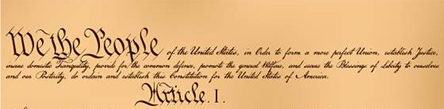
US Constitution
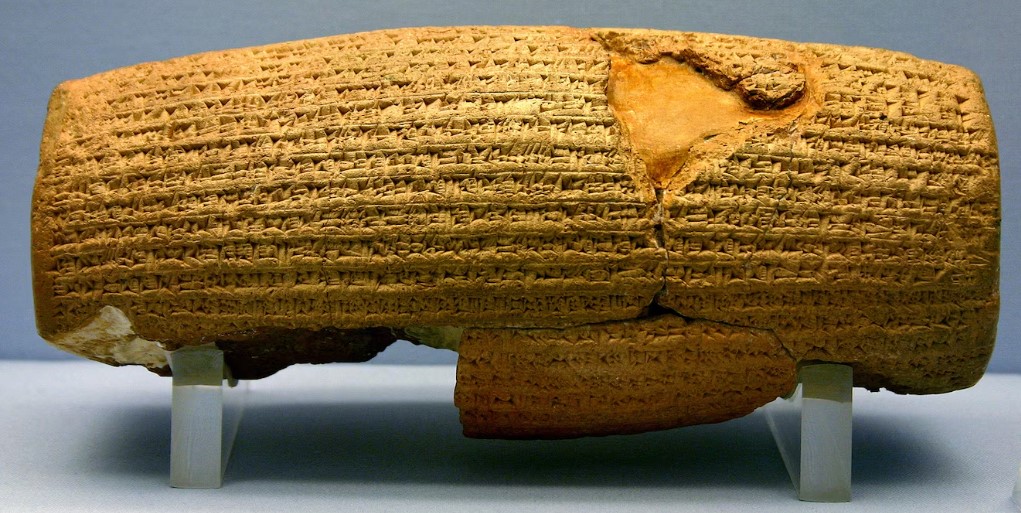
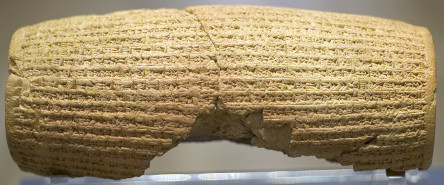
Cyrus Cylinder
The Cyrus Cylinder is a 6th-century BC baked-clay artifact (539 BC) that serves as the world’s first known declaration of human rights. Created by Cyrus the Great of Persia, it granted religious freedom, banned slavery, and allowed displaced people to return home after the conquest of Babylon.
After long fighting within their tribes, the Iroquois created the Iroquois Confederation, championed by the Great Peacemaker (Deganawidah), Hiawatha, and Jigonsaseh. The original confederation consisted of 5 tribes: Seneca, Mohawk, Oneida, Cayuga, and Onondaga. They united to form a political system with a 2-house legislature.
The house representatives were called sachems, their advisory council members were called Pine Trees. There were 50 delegates, all men, all chosen by the clan mother. Pine Trees, could be male or female, and the right to be a member was earned through heroic feats as a warrior.
The Onondaga had 14 sachems and could break ties and veto decisions within the confederacy. The Cayuga had 10 sachems, the Mohawks and Oneida had 9, and the Senecas had 8. Each council had its own methods for deciding on issues, but their representatives and system based on kinship and loyalty helped to settle conflicts.
The Iroquois Confederation was much more advanced than any other government around that time. Benjamin Franklin greatly admired their form of council. Aspects of their confederation can be seen in the United States Constitution:
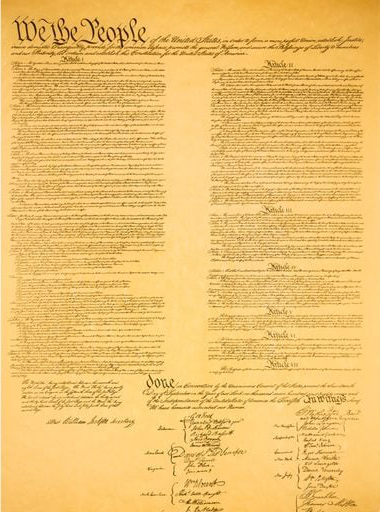
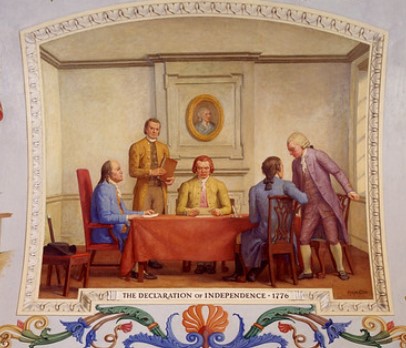
The US Constitution was created by 55 white wealthy men, many freemasons, who looked down on common people, and thus did not believe in democracy we see it today, because they were convinced that that would threaten property.
This political system was designed to constrain political democracy and prevent economic democracy. The system thus reinforces the dysfunctions of capitalism.
The U.S. Constitution begins with “We the people of the United States of America,” which is notable because it shows that the Constitution is “of the people, for the people, and by the people of the United States.” At the time it was written, the idea of a government “for the people” was novel.
One of the key principles in understanding the US Constitution is that famous saying that it provides “checks & balances”. What this means in essence is that each of the 3 branches of government have a certain number of enumerated and implied powers in the constitution.
Therefore, one branch can activate and act on its own without one or the other branches also acting.
The similar kind of checks & balances exists between the Federal Gov. and the States. But, ultimately the Federal Gov. has the final say under art. 6, the supremacy clause.
The way it works is that anywhere in the system, there exists “minority checks”. For the majority to be able to get what it wants in the end, it has to overcome the possibilities that its proposed bill will be blocked anywhere in congress.
A bill has to pass both Houses of Congress and it has to pass each committee that it is assigned to in addition to being signed by the President. If he/she vetoes the bill, the Congress has to override that veto with a super-majority of 2/3 of the votes, without changing the bill.
These are some of the well-known kinds of checks in the system that essentially give the upper hand to those who are opposed. If you block a bill anywhere in a committee, even if 100% of the members are voting “YES”, that bill is dead. It cannot go to the President, and thus cannot become law, a socalled death by a 1000 cuts.
There are numerous other checks as well. E.g. even if the President signs the bill, the new law can still be gutted in the regulatory process. It can also be challenged in the Courts and thrown out as unconstitutional.
Thus, all checks give an advantage to those who do not want change, and put those who want change in the position to having to make concessions and compromises that will water down and destroy the original intention of the legislation. Thus, we get locked into the political cycle.
Only massive strikes and upheaval can force the big changes that we need to solve the huge global crises existing today, such as the reconstruction after the 1860 Civil War, and the Depression of the 1930’s.
Therefore, the people of the US have to go beyond the Constitution and engage in one of 3 options:
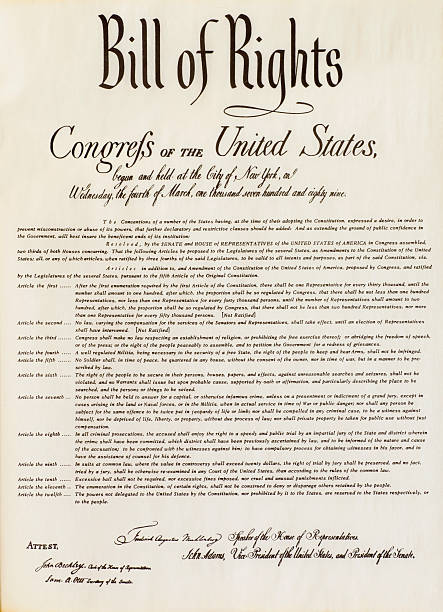
- Pursue necessary additional constitutional amendments. However, the framers were prepared for that. So, they wrote into Art. 5 a process for amending the constitution, that requires super-majorities that are very difficult to attain. Since the beginning there are only 27 amendments that made it. That is 27 out of over 10.000 that have been officially introduced, thus ¼%. The first 10, called the Bill of Rights, were accepted soon after the Constitution was signed.
- Call a constitutional convention. Art.5 demands also what to do here. Again, incredibly difficult. The lower class is not ready to partake successfully.
- The 3rd option is the most feasible, by following the intent of the framers, who did not allow the creation of a new Constitution, but amend the Articles of Confederation, during the next mass uprising. This would enable us to create a direct democratic governance system from below, by taking over and running the economic system democratically instead of now, plutocratically!.
On 7/19/2023, the US Senate has voted down Amendment SA 222 to the Constitution, that Article 5 of the North Atlantic Treaty does not supersede the constitutional requirement that Congress declare war before the United States engages in it.
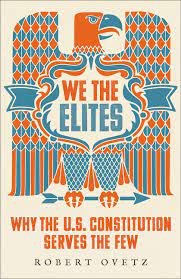
All of the above is explained in more detail in a book by Robert Ovetz, called “WE THE ELITES”:
Cyrus cylinder:
“first charter of human rights”