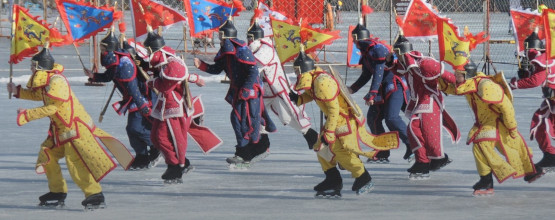
Qing-ice skating
Ice Games
Bingxi (冰嬉)
Winter recreations on ice was considered as one of four national traditions in the Qing Dynasty along with Manchu language, riding and shooting, and wrestling.
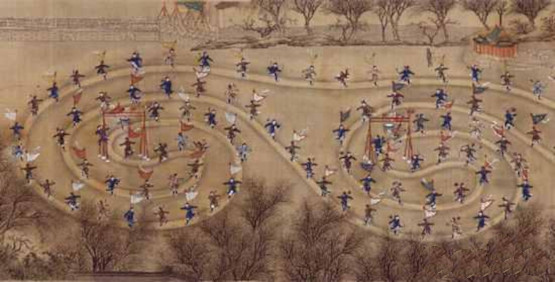
“Ice Games Painting“, a spectacularly detailed 578-cm long artwork by Qing court painters Yao Wenhan and Zhang Weibang, is now held in the Palace Museum in Beijing. The work depicts a cloud-shaped icetrack depicting various competitions and sports that could be seen on ice over 200 years ago. From hunters hitting the slopes to skating soldiers and alcohol-fueled sledding sessions, N-China has hosted centuries of snow and ice sport.
Cave paintings from 10,000 years ago depicting hunters on skis were discovered in the Altay Prefecture of NW China’s Xinjiang Uygur Region. Experts believe that skis like these, made of horsehide and wood, have been in use for more than 10,000 years in the area till today.
Song Dynasty (960-1279) records mention an “ice game” played by members of the royal court during the winter. During the Qing Dynasty (1644-1911), ice games were held regularly for military purposes. Qing founder Nurhaci (1559-1626) organized a special force equipped with ice skates.
The Qing Dynasty was most prosperous under the 60+ year rule of Emperor Qianlong (1736-1796). He was known for indulging in luxury, literature and art. He hosted his famous “winter games event” every year in his imperial gardens in Beijing, now called Beihai Park:
They were held on the three lakes collectively known as Taiye Chi, or the Pools of the Supreme Fluid. The pools consist of North Lake, Central Lake and South Lake, located to the west of the Forbidden City.
Instead of traveling in a carriage or a palanquin, Emperor Qianlong came to the frozen pools in a dragon-boat-like vessel. Two long angle bars were attached to its base, allowing attendants to slide it across the ice. Emperor Qianlong sat in a wooden shed covered with yellow silk. A number of nobles, officials and servers stood behind the extravagant vessel, decorated with a gold lacquered top and colored patterns.
It was a grand festival of parades and competitions on ice, often held to celebrate the Lunar New Year in the Beijing. It was even praised as a “national custom” in a poem by the Emperor himself in 1745. In the end everybody was rewarded with gifts and treats from the emperor.
The purpose was to train soldiers, preserve Manchu culture, and show the dynasty’s military strength. Tribal leaders and foreign reps were invited to watch the event.
Emperor Qianlong ordered artists to paint scenes from the event, which he used as illustrations for his essays & poems. According to these paintings, Qianlong’s writings, and historical records, at least 1,600 soldiers competed every year in the games, which had 3 major events:
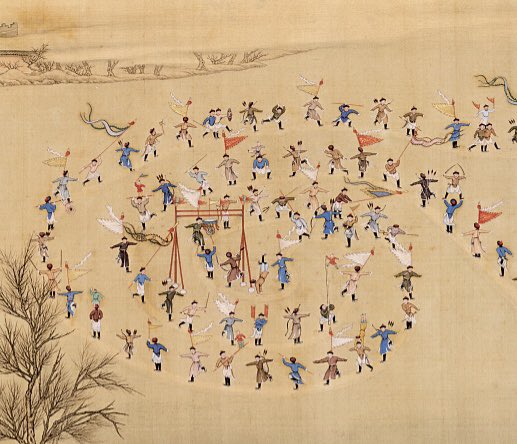
- One resembles modern-day biathlon: soldiers skate and shoot arrows at a ball set above a gate near the emperor’s shed. The 3 time ball-hitter won the contest.
- Speed skating. In one of his essays, Qianlong described racers going so fast that they resembled “flying bees, spooked dogs, and lightning and meteors.”
- Then there was ice football. Dozens of players were split into 2 teams that competed to catch and keep hold of a leather ball thrown into the air above ice by a referee. Unlike ancient Chinese “cuju” football and modern-day soccer, players were allowed to pass the ball with both their hands and feet.
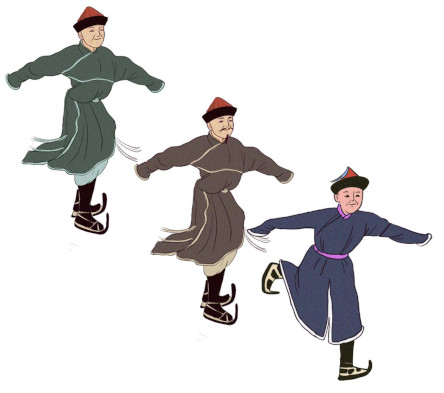
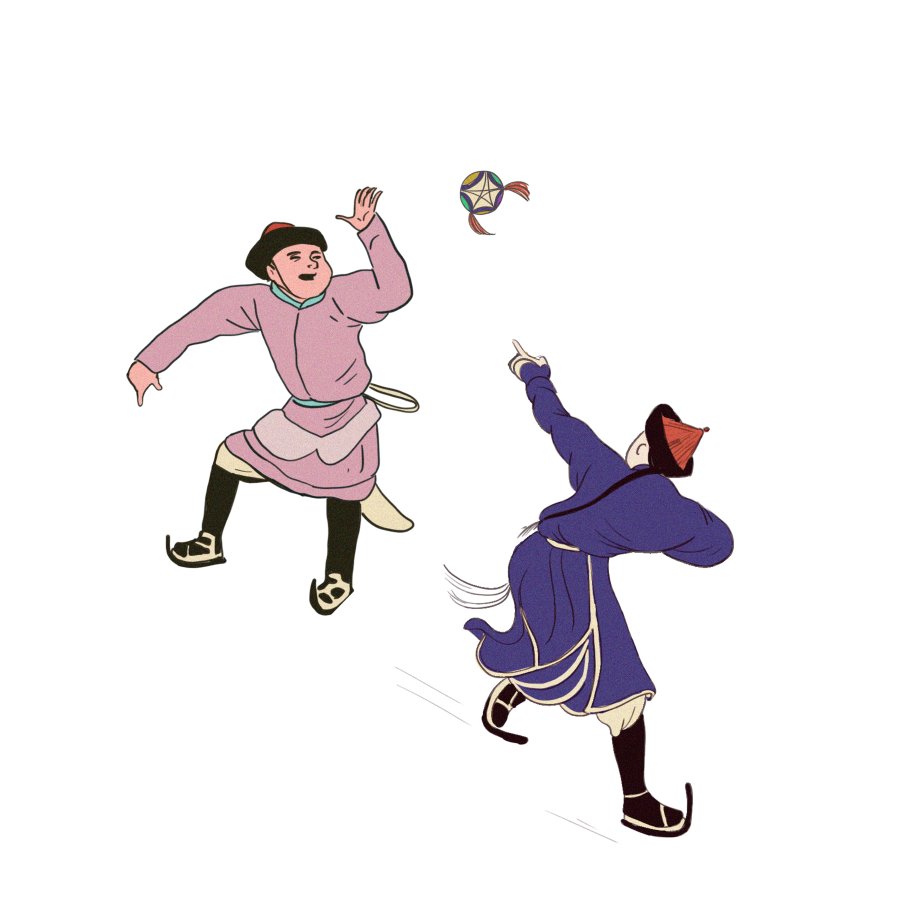
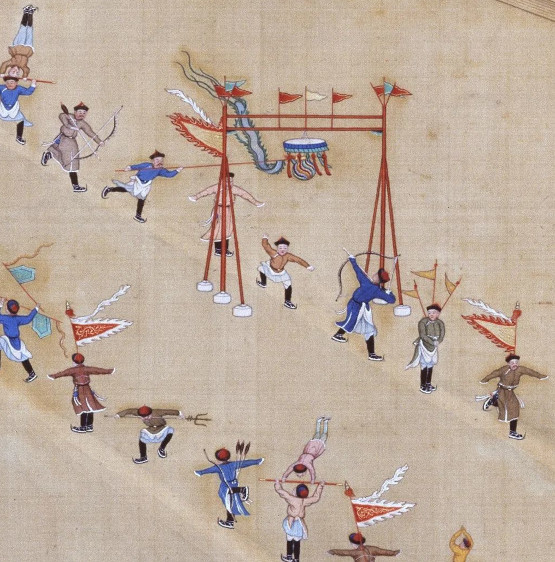
Although the equipment was not that professional, the ice-sports masters practiced many challenging actions, including standing on one foot, skating while shooting arrows, doing a handstand, making a human pyramid, drumming, and dancing with a sword.
A retired official, Pan Rongbi, explained the rules in his book Festival Customs of the Imperial Capital, chronicling the customs and scenes of Beijing in the winter.
After a loud start-explosion, the imperial skaters whizzed past the gallery, racing the length of the ice, twirling and leaping, demonstrating their martial prowess by firing arrows at targets with carefully placed shots while skating at full speed, a sport known as “Follow the Dragon Trail & Shoot.”
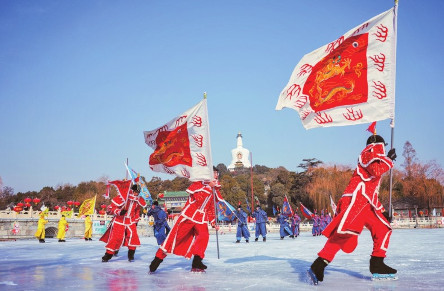
There were three archways positioned on the ice, flanked by colorful flags, with a silk ball hung by a rope in the middle of each arch. Many teams of dozens of players would skate across the ice, led by a flag-bearer, while attempting to entertain the crowd with acrobatic maneuvers such as skating backward and on one leg. Once they pass through an archway, the archer of the team would turn around, and attempt to shoot the silk ball with an arrow:
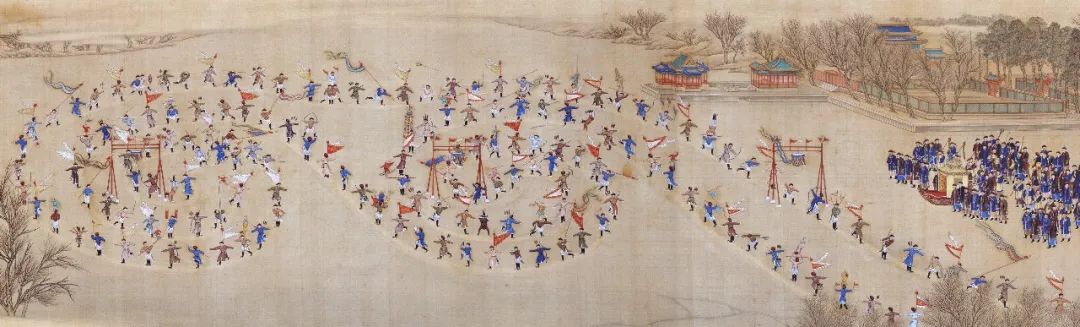
The performance was a fine spectacle, as 200 players joined in together, moving in a line like a dragon’s tail, all while weaving in and out of other teams on the ice. The sport was performed by members of the various Manchu Banners:
Skating like a mountain. Similar to modern synchronized skating, or calisthenics performed by Chinese schoolchildren between classes, this sport involved groups of 100s of players together performing coordinated skating moves on ice. The heavily choreographed routines include skaters raising their hands to replicate the style of a swallow in flight, or performing spins and skating backward.
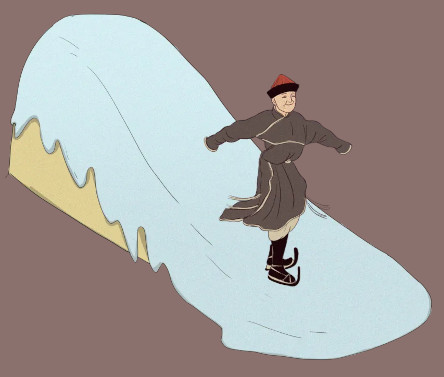
Downhill ice skating, also known as “ice slide” is like downhill skiing, but on more slippery terrain. On freezing days, organizers would water a 10 m. slope to create a treacherous ice trail for participants. Wearing primitive leather ice skates, competitors would take turns to slide down the slope with as much flair as possible.
Those who made it down the slope without falling would be named the winner, acc. to Records of a Mediocre Official, a collection of anecdotes and history from the Qing dynasty by Chen Kangqi. Like modern downhill skiing, downhill skating could be dangerous and risk of injury was high.
During the bingxi parades, each team would be judged on its performance, with the most precise, unified, and entertaining team winning the competition.
Ice sledding has been a popular activity in China. Riders sit on a small wooden bench or chair which were pulled by others or themselves along the ice with short poles. Some fixed iron strips under the seats to make them glide like an ice skate. Ice sledding was first mentioned during the Song Dynasty.
Ice sleds were also used for transportation. Poor people living on Beijing’s outskirts would make money by transporting wealthy passengers on the “ice bed”. One of Qianlong’s senior officials, once rode an ice sled from Beijing to Tianjin, being 125 kilometers. He wrote that the sled went faster than a good horse, and the experience was like “flying in a boat.”
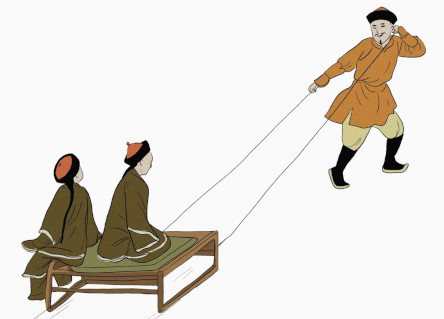
Jin Tingbiao, a royal artist during Qianlong’s rule, painted a group of children ice skating and laughing on a pond. In one of his poems, the Emperor once described the reflection of imperial skaters on the smooth frozen surface as looking like “phoenixes flying across the sky.”
Modern Olympics has taken inspiration from depictions of the Qing Dynasty ice games for the design of the central garden of the Olympic/Paralympic villages in Beijing.
It was the winter of 1794 – 1795, and the aged Qianlong Emperor was celebrating 60 years on the throne. A most unusual skating party took place on a frozen lake in the heart of the capital, with flying arrows, crashing skaters, and two countries competing for national pride on the ice.
The court invited guests from all over the world. Manchu nobles, Chinese officials, Mongolian chieftains, and Tibetan lamas mingled with Vietnamese envoys and Korean diplomats at parties, and banquets.
While the emperor was the star attraction, most conversations focused on a group of unusually attired and coiffed visitors from faraway: The Dutch East India Company had sent a delegation to China, led by Isaac Titsingh, to congratulate the emperor on the longevity of his rule.
The emperor turned to Titsingh and asked if the ambassador would like to join in the fun. Titsingh, whose last outing on ice was 3 decades earlier, demurred. Still, some of the younger members of the delegation were excited about the chance to show these Manchus a trick or two:
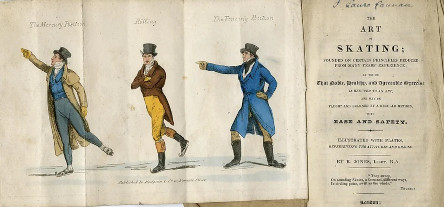
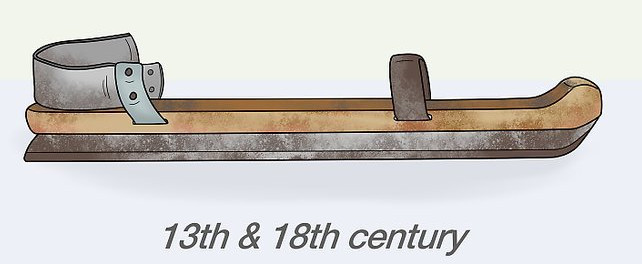
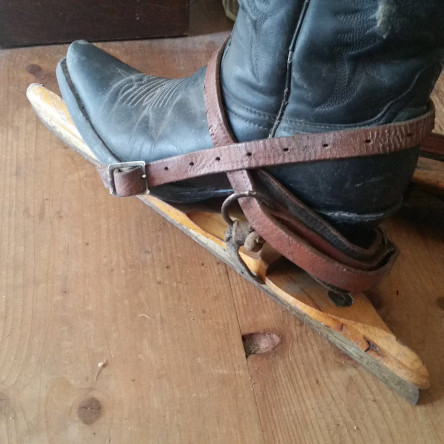
Servants hurried back to the delegations’ quarters to fetch skates. The Dutch had come to Beijing prepared. It was probably a good thing, as the Manchu skates differed from the European design both in their bindings and blades, which were shorter and ended abruptly at a right angle, rather than curving upward as most skates do.
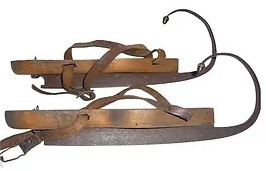
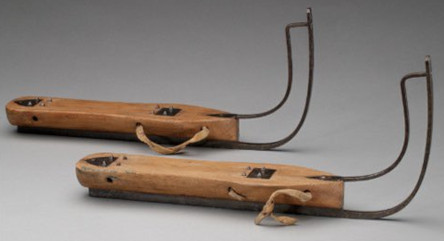
While the imperial skaters were graceful and impressive in motion, their method of stopping was startling to the Dutch. “These Chinese let themselves fall upon the ice when they came close up to the Emperor’s shed, so as not hit him,” recounted Andreas E. van Braam Houckgeest.
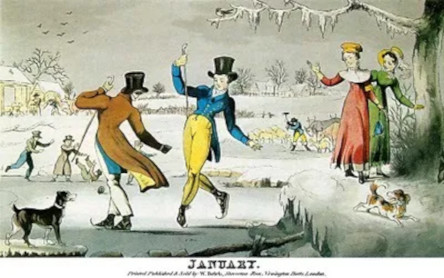
As more Europeans took to the ice, a crowd of imperial officials and other guests gathered to watch the Dutchmen spin and speed around the lake as the emperor finished his breakfast. Then, as the emperor signaled that he was ready for the games to begin, the Dutch skaters returned to their seats in the audience and let the professionals take the ice.
The 1795 Dutch mission was the last ever mission the Emperor received. The mission members saw it as one of congratulation rather than negotiation. They were to be guests at a party, building goodwill, developing relationships, and discussing business only if the opportunity arose.
The 1795 Ice Games were not the only time the delegation enjoyed skating in the Chinese winter. Skating on the canals and ponds around the capital had become a popular way for younger and more energetic foreign delegates to pass time waiting for the imperial court to receive them.
The sight of the foreigners with their strange dress and hair zipping across the ice drew large crowds of onlookers. A skating party on Christmas Day, 1794, ended abruptly when one of the Dutch skaters fell through the ice and was rescued.
Today’s 8-banner’s skating
on the same lakes: