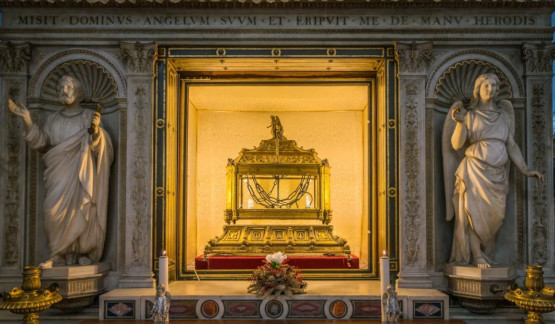
Chains of St Peter
2 lengths of fetters fused in a single chain,
displayed in a church near the Colosseum.
The bonds, as per tradition, once held fast the limbs of Peter the Apostle and have been cherished by Christians ever since.
The story of their veneration first appeared in the Acts of Saint Alexander, an early pope who died as a martyr in 115. As he awaited his execution, he received a visit from Quirinus, the nobleman who oversaw Rome’s prisons. His daughter Balbina was desperately ill, and he had heard that Bishop Alexander had the power to heal her. She was completely cured when he touched her with his chains. She wanted to kiss the chains in gratitude, but Alexander instructed her to find the chains of St. Peter and honor them instead.
Balbina became a consecrated Christian virgin. She had a shrine built for St. Peter’s fetters. It would be rebuilt, moved, and expanded through the centuries.
In scripture we find St. Peter imprisoned twice in Jerusalem. Once he was jailed with the rest of the apostles and set free by an angel (Acts 5:17–25). The 2nd time, the authorities assigned him two guards and bound him in his cell with double chains. But, again, “an angel of the Lord appeared, and a light shone in the cell; and he struck Peter on the side and woke him. And the chains fell off his hands” (Acts 12:7).

Once freed, Peter brought the Gospel first to Syrian Antioch and then to Rome. In the imperial capital, during the reign of Nero, he was jailed briefly in the Mamertine Prison before suffering death by crucifixion.
Iron chains became an early symbol of Christian freedom. St. Polycarp, wrote in the 2nd century: “They are the fitting ornaments of saints, and indeed the diadems of the true elect of God and our Lord.” Though emperors possessed the power to chain a pope, the Church endured and triumphed.
Christians, from at least the 4th century, celebrated a feast of St. Peter’s chains on August 1, the beginning of the month named for Rome’s first emperor, Augustus.
As Rome’s Christians honored Peter’s chains from the Mamertine, so the Church in Jerusalem kept his chains from the Herodian prison. In the 5th century, the Christian empress Eudocia, the wife of Theodosius II, sent a length of Peter’s Jerusalem chains to Pope Leo the Great. According to tradition, Leo held it beside Peter’s chains from the Mamertine Prison, and the two miraculously fused together.
There are many testimonies to the presence of these chains in Rome. Pope Gregory the Great, (590 – 604), was intensely devoted to the relic and often sent small filings as gifts to dignitaries, such as Constantina Augusta, the Byzantine empress; to a bishop named Columbus; to King Childebert of the Franks; to King Rechared of the Visigoths; and to Theodore, Constantinople’s court physician.
He would place the filing in a key-shaped reliquary — the key representing Peter’s authority. He sent each particle with a prayer “that what bound [Peter’s] neck for martyrdom, may loose yours from all sins.”
The chains are today exposed for veneration in a gold and glass reliquary in the Basilica of San Pietro in Vincoli, on Rome’s Oppian Hill, a church built in the 5th century during the reign of Pope Leo the Great.
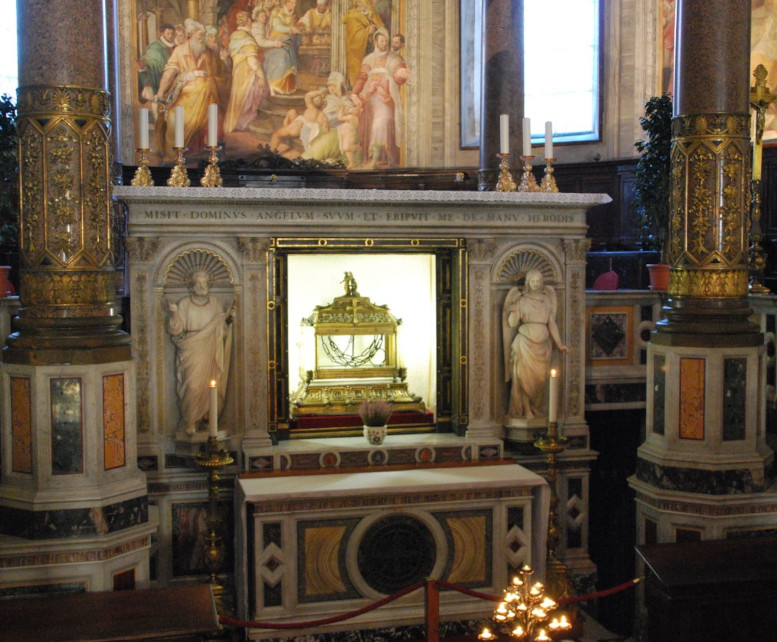
Peter’s chains remain a sign of the relationship, often uneasy, between throne and altar, bishops and emperors.