ENS part of PNS?

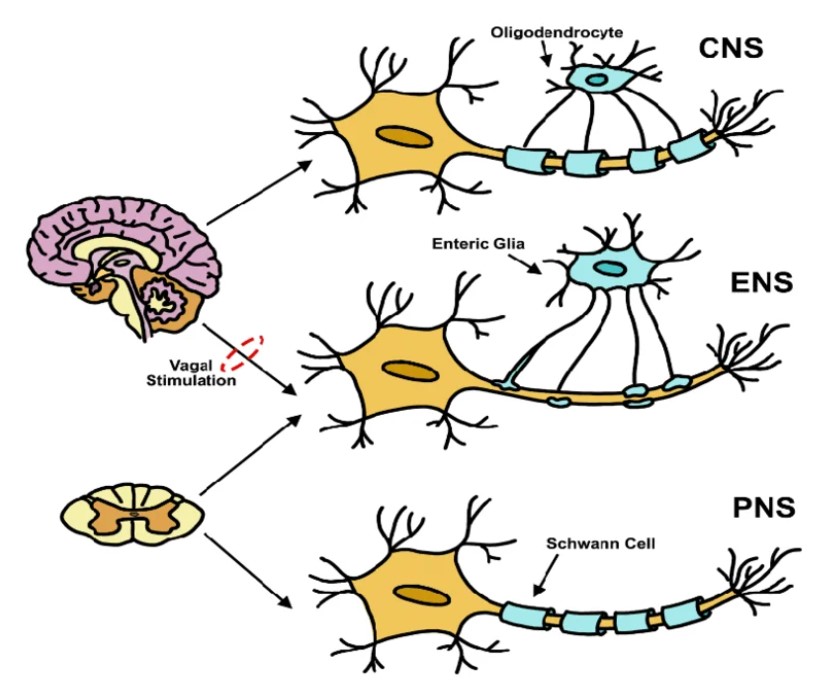
The Enteric Nervous System (ENS) is a part of the Peripheral Nervous System (PNS), which is directly controlling the gastro-intestinal (GI) system. The ENS receives considerable excitations from the ANS. The ENS has been described as the “2nd brain”, because it can operate autonomously.

The ENS communicates mostly with the ANS through its parasympathetic vagus nerve and sympathetic prevertebral ganglia. Studies show that when the vagus nerve is severed, the ENS continues working.

Many research papers detail how the ENS mirrors the CNS. Just like the skull-brain, this system sends and receives impulses, records experiences and responds to emotions. Its nerve cells are influenced by the same neurotransmitters.

These cells are located in the sheaths of tissue lining the esophagus, stomach, small and large intestine (8.5 meters). The network of over 100 million neurons, neurotransmitters, and proteins zap messages between them and support cells like those found in the brain.

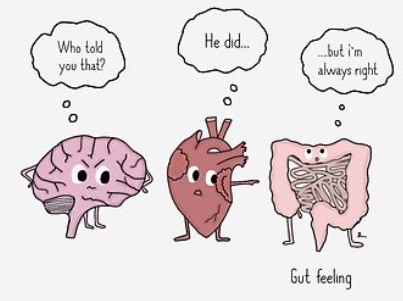
It’s complex circuitry enables it to act independently, learn, remember, and produce gut feelings.

read more …

Similar Posts

  • Types of Beliefs?

    I have observed in myself two types of beliefs: consciously adopted beliefs (some of which might qualify as “knowledge”) and unconsciously adopted beliefs. They usually have an emotion attached. Consciously adopted beliefs are easily accessible to my conscious mind. I decided to adopt them because they make sense, feel satisfactory and/or comfortable, and fit the…

  • Bio-Resonance-Devices

    MORA Devices Bioresonance therapy has its roots with Dr Franz Morell, a German medical doctor who used homeopathy in his practice. Homeopathy is believed to be an ‘information therapy’. One of the concepts of homeopathy is that water has a memory. Homeopathic remedies use information from substances diluted many, many times in water. Morell wondered…

  • MFB + PVS

    Aversive stimuli that provoke action responses activate the brain’s punishment (pain) circuit which enables us to cope with unpleasant situations. It includes brain structures, such as the hypothalamus, thalamus, amygdala, hippocampus, and insular cortex. The Peri-Ventricular System (PVS) or punishment circuit, functions by means of acetylcholine, which stimulates the secretion of adrenal cortico-trophic hormone (ACTH)….

  • Akshardham Temple and other Temples

    Swaminarayan Akshardham is a Hindu temple in Delhi. The modern (2005) complex displays millennia of traditional and modern Hindu culture, spirituality, and architecture. The temple, at the center of the complex, was built according to the Vastu shastra. Originating in ancient India, Vastu Shastra ( वास्तु शास्त्र, vāstu śāstra “science of architecture”) is an ancient…

  • Draco consciousness

    Draco constellation and its consciousness as intelligent energy The constellation Draco has a dragon-shape and is one of the largest constellations in the sky and one of the Greek constellations. It is located in the northern celestial hemisphere, and part of the Ursa Major constellation family. It has single, double, triple, and quadruple star systems. There…

  • Geometric-Periodic Table

    Dr. Robert Moon, an early fission physicist of the University of Chicago, developed a synthetic geometric structure of the periodic table for the 92 naturally occuring elements and the particles in their nucleus. The spark to his work came from Nobelprize laureate Klaus von Klitzing, who studied conductivity of very thin slices of semiconductors. The…