
Amygdala Pathways

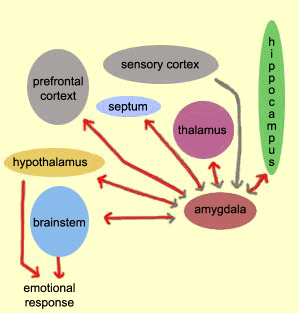
The amygdala twins have also many connections with the hypothalamus, the septum, the reticular formation of the brainstem, and the hippocampus. Since the hippocampus is involved in storing and retrieving explicit memories, its connections to the amygdalas are the origin of strong emotions triggered by particular memories.

The primary and automatic bodily responses involved in emotions such as fear are controlled mainly by the outputs of the amygdala to the nuclei of the sympathetic nervous system in the brainstem and to the hypothalamus, which itself controls the hormonal secretions of the pituitary gland.

The amygdala’s actions show us what is necessary to experience an emotion such as fear. The connections from the amygdala to the cortex can influence perception and memory of dangerous situations.

The amygdala also influences the cortex indirectly, through its connections within the brainstem. Parts of the brainstem can trigger a cascade of physiological reactions associated with fear that is then sent as feedback to the brain.

The connections from the prefrontal cortex to the amygdala involve secondary emotions. They give us a certain conscious control over those emotions, as anxiety.

However, the cortex can create anxiety by allowing us to imagine the failure of a given scenario or even the presence of dangers that do not actually exist.

Most of the neural pathways that enter the amygdala twins are paired with other pathways that exit it. The gratifying or aversive nature of a stimulus is associated by connections of this pathway to the nucleus accumbens.

read more …

Similar Posts

  • Basilica Sagrada Familia

    Temple of Cosmic Light and Sound A musical instrument of colossal dimensions Gothic Naturalism at its best: Basilica de Sagrada Familia The tallest Christian Church on Earth The original Sagrada Família church was inspired by José Bocabella, founder of the Spiritual Association of Devotees of St. Joseph, and designed by the architect Francisco de Paula…

  • PC Characteristics

    Pain-Catcher’s characteristics have to do with:   attitude posture memories relationships moral standards language phrasing sensual preferences opinions and beliefs habits and addictions imagined self-importance chronic pains and emotions facial and physical expression   The face of testicular pain: Doctors at Queen’s University thought they were going nuts when they saw what appeared to be…

  • Protein Peptide Bonds

    An amino acid is a small molecule with an amine group (NH2) at one end and a carboxylic acid (COOH) group at the other end. The peptide bonds formed between these groups create chains, or polymers, of amino acids.  A peptide bond is a covalent bond that is formed between two molecules when the carboxyl…

  • Perception or Impression?

    When you direct attention particles toward some-thing, you perceive that object directly, by feeling it, or indirectly via a reflection that stimulates nerves in one or more sensory organs and is translated into a mental replica of the object. Indirect perception creates consciousness + a sense of consecutive moments in time. Direct perception, everything exists…

  • Spheres & Domes

    Star sizes A sphere is a geometrical object that is a 3D analogue to a 2D circle. Stars and planets are often seen as spheres. Naturally occurring stone spheres Over 130 manmade “living” self-reproducing perfectingly round metal spheres embedded in Precambrian rock have been found in S-African mine. They are over 3B yrs old, emitting…

  • SNS & PSNS

    SYMPATHETIC NERVOUS SYSTEM: The SNS actions prepare the organism for physical or mental activity. When facing a major stressor, the SNS orchestrates the response. It dilates the bronchi and the pupils, accelerates the heart rate and the respiration, and increases perspiration and arterial blood pressure, but reduces digestive activity. Two neurotransmitters are primarily associated with…