Morrigan & Dagda
Core Attributes
To understand the full scope of the Morrígan, it helps to look at her primary roles in pre-Christian Irish mythology:
- War & Fate: She influences the outcomes of battles, incites warriors to frenzy, and foretells death—often appearing on battlefields in the form of a hooded crow or raven.
- Shape-Shifting: She fluidly transforms into different animals, including crows, eels, wolves, and red heifers, to aid her allies or challenge heroes.
- Prophecy & Sovereignty: She acts as a prophetess, announcing victories to the land and acting as the spiritual guardian of Celtic territories.
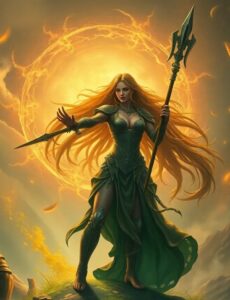
Mor is an ancient Goddess of Sun & Sea, bringing to mind the shining days of summer and the abundance of the harvest. As a paradox, she is also a Dark Goddess of Death & Rebirth, like Kali in Hindu India.
She is a sovereignty goddess in the most ancient sense — as a protector and guardian of the land, as the spirit of Earth itself.
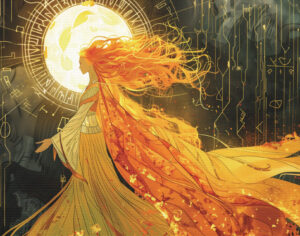
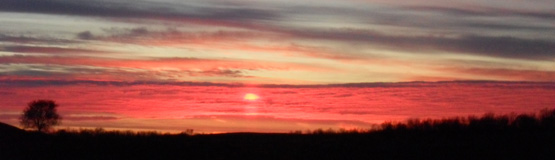
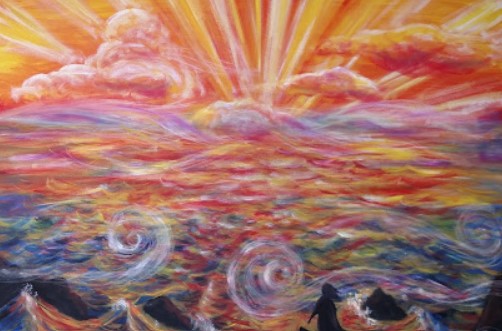
Mor is connected to the setting sun, the transition time into night and the dark womb of rebirth. She sits on her throne as the sun sets, reigning over the transformation of our bright moments into the dark, inner world of night and sleep. It is here that our souls are fueled with riches of insight and inspiration — preparing our return — refreshed and nourished — into the light.
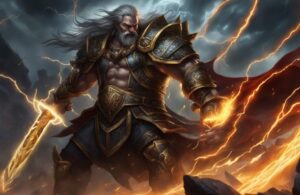
The Dagda, the chieftain and father figure of the Tuatha Dé Danann, whose name translates to “the peoples of the goddess Danu”. Depicted as supernatural, divine, and highly skilled in magic, crafts, and druidry, they are said to have arrived in Ireland on flying ships enveloped in dark mist.
The encounter between the Morrígan and the Dagda symbolizes the union of life and death, fertility, and the cyclical nature of existence. It takes place during the festival that is marking the end of the old year and the beginning of the new, a time when the spirits of other worlds are believed to be more accessible. They meet by the River Unshin near Ballysadare. The Morrígan is washing herself in the river, tying her to themes of purification and transformation.
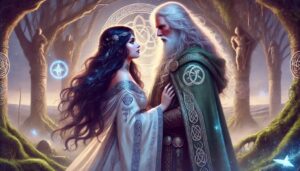
The Dagda approaches the Morrígan to seek her aid in the upcoming battle. She agrees to assist him, but in return, she demands a tryst, a sacred/secret romantic encounter.
Their intimate bodily union is not merely a physical act, but a powerful orgasmic ritual, that enforces the merging of new (cell) life and the death of remnants of old trauma.
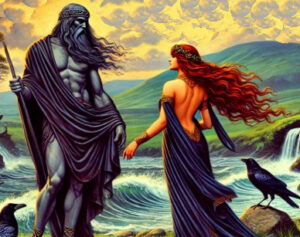
The Dagda’s role as a fertility god and the Morrígan’s association with death highlight the cyclical nature of life. Death leads to rebirth and renewal.
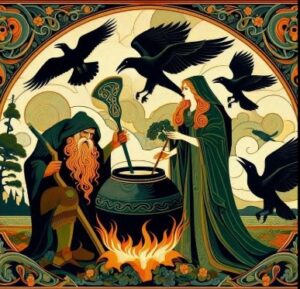
Their union is believed to ensure the fertility of the land and the prosperity of the people. Following their union, the Morrígan provides the Dagda with crucial information about the plans of his enemies. She foretells the outcome of the battle and offers support. Her prophecies and direct battle intervention reflect her role as a goddess of fate & war.
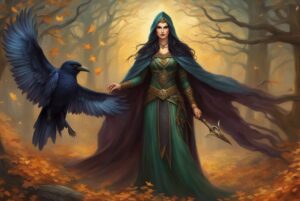
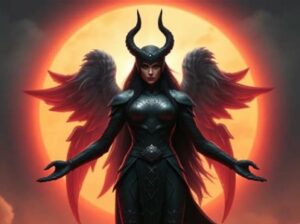
She stands as a complex and multifaceted deity, often shape-shifting into various forms reflecting her diverse roles and attributes, as a beautiful yet formidable woman, embodying both allure and terror, but she also takes the form of a crow or raven, birds symbolizing war, death, and prophecy. She transforms into different human forms as well, thus representing various natural and elemental forces.