Epi-Genetics
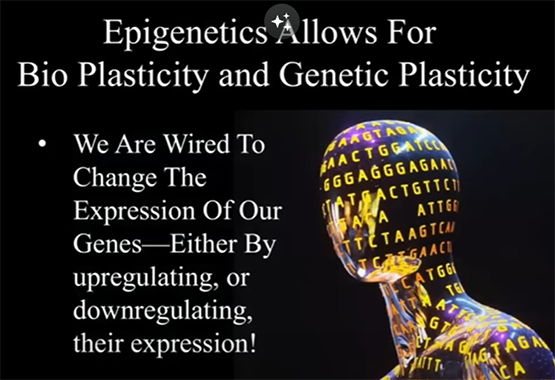
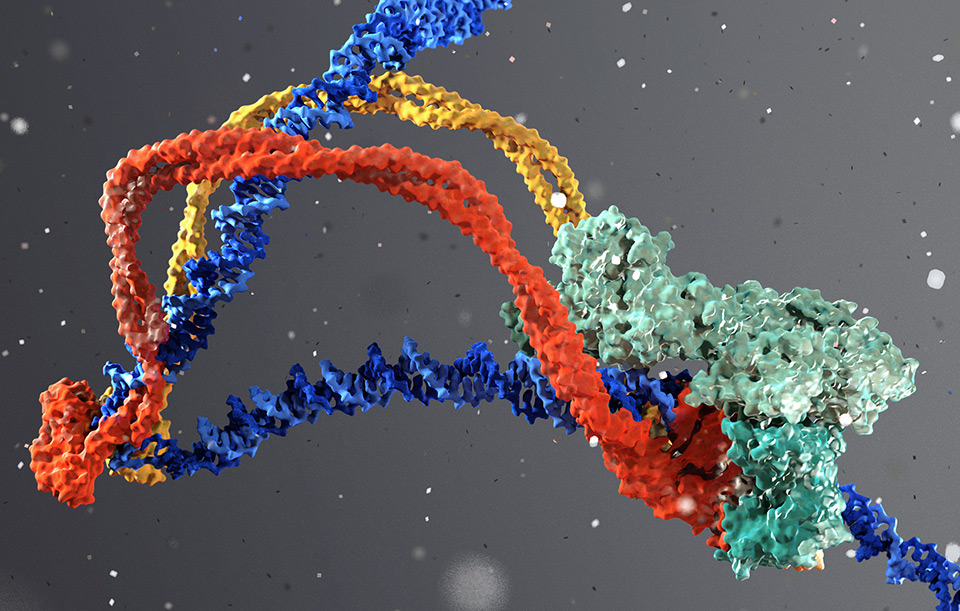
The unique sequence of more than 3 Billion base-pairs in our DNA molecule is what makes each of us unique. Our DNA is like a cookbook full of ‘recipes’ and ‘bookmarks’.
Different cells use different recipes, which we call ‘genes’. The bookmarks help each cell know which genes to use. These bookmarks exist as chemical add-ons to the DNA and to the proteins (histones) that our DNA is wound around.
They are called epi-genetic marks (Greek: επί- over, above, outer). They regulate gene expression without altering the underlying DNA nucleotide sequence. These marks are put in place as our body develops from a single cell to an adult.
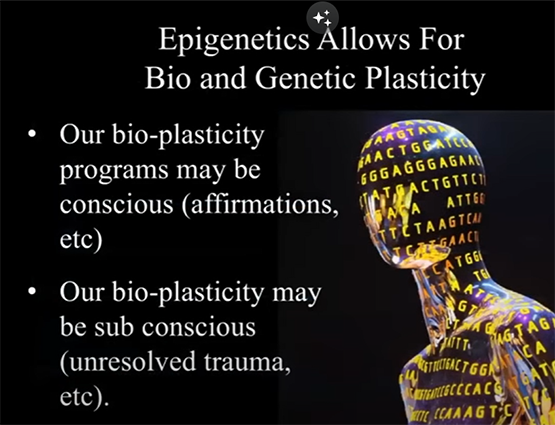
Epigenetic marks can activate or silence certain genes so that nascent cells with the same DNA code can differentiate and become muscle or nerve cells, etc. If the marks don’t work properly, cancer or cell death is possible.
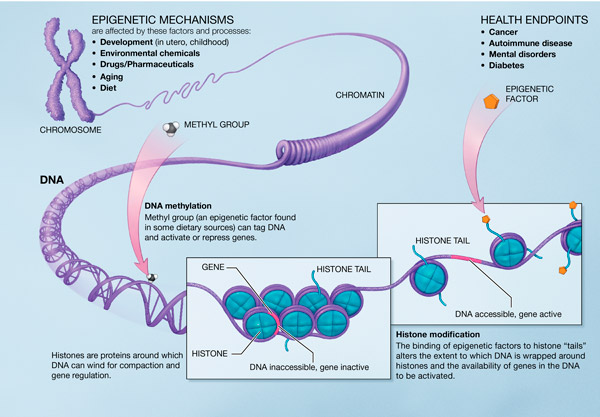
Rich diets, stress, smoking, as well as vitamins, etc. can activate epigenetic marks or add methyl groups to DNA strands in both men and women. These changes can turn genes on or off and will affect people’s offspring good or bad.
Drugs have been developed that treat a dis-ease by simply silencing some genes and jump-starting others. Researchers aim for finding the biochemical switches that set those genes that cause a disease, like cancer, schizophrenia, Alzheimer’s, autism, diabetes, to a permanently ”off” position.



Analogy: if the genome is the computer’s sw-program, then the epigenome contains all the comments/annotations, that render parts of the program’s source code in-active.
Most epi-genetic marks occur in non-coding regions that don’t make proteins or regulate gene expression. Various genes can be the same, but their patterns of expression can be set to on/off, or weaker/stronger.
The Human Genome Project took $3B to map the 3B rungs of the DNA ladder, leading to about 25,000 genes. The Human Epigenome Project, estimated to map millions of epigenetic marks, will make the HGP look like a kindergarten project.
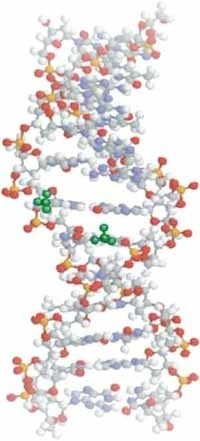 Methyl (CH3) groups (green)
as epigenetic markers
R&D showed that although genes control how the brain wires up, our experiences modify the connections between neurons, resulting in changing personas and behavior.
Recent research results show that repeated exposure to drugs of abuse can produce adaptive changes that lead to the establishment of dependence. It has been shown that allelic variation in the α5 nicotinic acetylcholine receptor (nAChR) gene CHRNA5 is associated with higher risk of tobacco dependence.
In the brain, α5-containing nAChRs are expressed at very high levels in the interpeduncular nucleus (IPN). Here we identified two non-overlapping α5+ cell populations (α5-Amigo1 and α5-Epyc) in mouse IPN that respond differentially to nicotine.
Chronic nicotine treatment altered the translational profile of more than 1,000 genes in α5-Amigo1 neurons, including neuronal nitric oxide synthase (Nos1) and somatostatin (Sst). In contrast, expression of few genes was altered in the α5-Epyc population. We show that both nitric oxide and SST suppress optically evoked neurotransmitter release from the terminals of habenular (Hb) neurons in IPN.
In-vivo silencing of neurotransmitter release from the α5-Amigo1 but not from the α5-Epyc population eliminates nicotine reward, measured by using place preference. This loss of nicotine reward was mimicked by shRNA-mediated knockdown of Nos1 in IPN.
These findings reveal a pro-addiction adaptive response to chronic nicotine in which nitric oxide and SST are released by a specific α5+ neuronal population to provide retrograde inhibition of the Hb-IPN circuit and thereby enhance the motivational properties of nicotine.