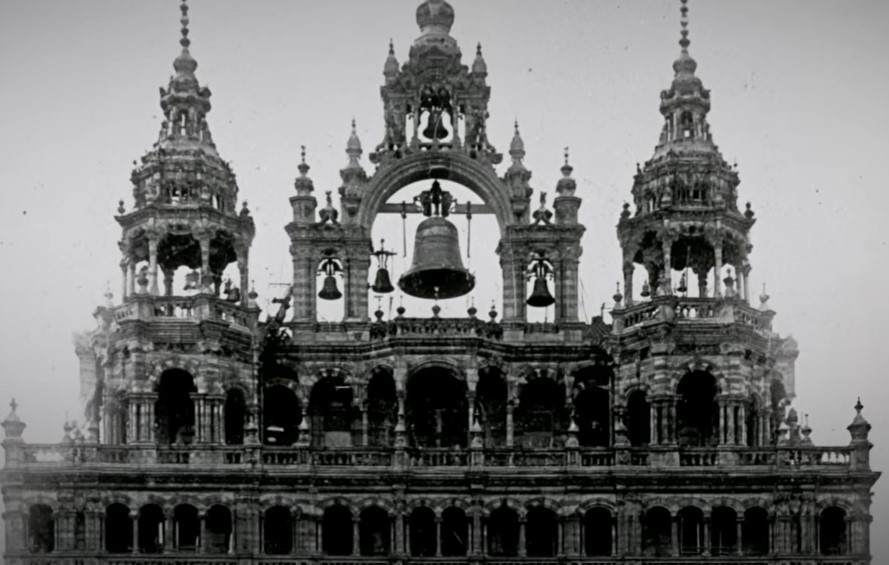
Frequency‑based Therapy
The Pre-1900 Hospitals that were
Erased from Every City on Earth
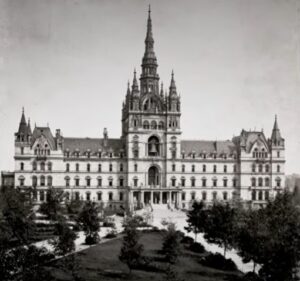
Humanity abandoned a healing tradition of hospitals, architecturally engineered around the bell, with ward arrangements, ceiling gradients, and resonant shafts designed to transmit specific tonal frequencies into patient spaces. It got replaced with a standardized, commercially driven medical infrastructure, without a single serious public reckoning about what that exchange actually cost us?
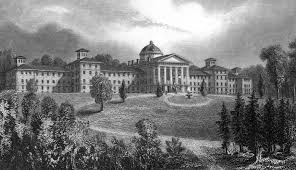
The standard explanation — that modern medicine simply won out through scientific advancement — collapses when you examine what it replaced. This was Not a primitive or superstitious tradition, but a system that was built around the relationship between the human body, sound frequency, and the designed environment. Buildings so acoustically deliberate that their internal geometry corresponded more closely to the interior of a cathedral and its organ, than to any known tradition of hospital construction.
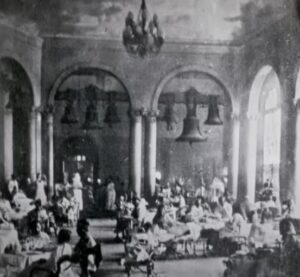
Spaces engineered not merely to contain the sick, but to work on them. By investigating various architectural records, from a misfiled photograph in a Lyon municipal storage unit, to plastered-over acoustic shafts in Milan, to a concrete-filled chamber beneath St. Bartholomew’s in London, to bolt holes in the stone at the Charité in Berlin where something large and heavy had hung for a very long time — a disturbing pattern materialized.
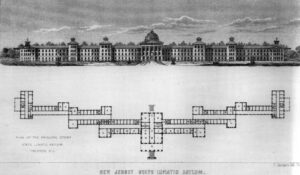
These buildings were not designed for patient access or surgery, but as acoustic instruments—radial wards, curved corridors, graduated ceilings, and resonance chambers. The bells appear to have been used for frequency‑based therapy, with some physicians documenting marked improvements in respiratory, cardiac, and nervous system conditions through scheduled ringing sessions. Yet these practitioners and their records have been almost entirely erased from medical history—no refutations, no debates, no institutional records of abandonment, only silence.
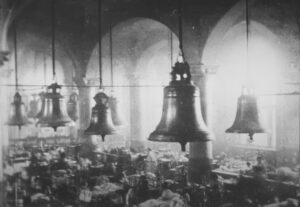
These weren’t parallel coincidences across unconnected cultures. They were the same underlying erasure, executed within the same 30-year window, across every continent where this older infrastructure had taken root. And the bells came down with the buildings. Melted. Requisitioned. Repurposed for wartime bronze — with gaps in the archive that cluster, with unsettling precision, around the exact decades the new pharmaceutical system was being institutionalized.

The physicians who understood by their writings about it, what those instruments were doing, like Dr Wenner in Dresden, Dr Alvarado in Buenos Aires, Dr Subramanian in Madras, Dr Connaught in Dublin, do not appear in any standard medical history. Not misattributed. Not argued against. Absent. As if they had never written a word.
The Carnegie-Flexner Report of 1910 evaluated 155 medical schools with meticulous comprehensiveness. It does not mention acoustics. Not to dismiss their practices. Not to find them inadequate. Simply not at all — as though the decision about what would be excluded from the medical history and future had already been made, somewhere, in a conversation that left no written record. Actions taken, after the report was published:
Key Goals and Reforms
• Standardized Science: Required schools to use a strict, lab-based science curriculum modeled after Johns Hopkins University.
• School Closures: Led to the shutdown or merging of more than half of North America’s medical colleges for failing to meet new standards.
• Licensing Rules: Urged states to enforce stricter rules for who could get a medical license.
Social Impacts
• Reduced Access: Caused the closure of five out of seven historically Black medical schools (leaving only Howard and Meharry), which severely limited the number of Black physicians for decades.
• Alternative Medicine: Marginalized and nearly erased non-allopathic, homeopathic, and holistic training programs.
Because here’s what the replacement also did. It didn’t just reorganize how medicine was practiced. It had severed something older. And the financial structure of what replaced it is telling: a bell, once cast, does not require ongoing purchase. A frequency applied, once understood, does not generate quarterly revenue. A building designed as an acoustic instrument treats patients through its very existence — without consumables, without supply chains, without proprietary knowledge that can be licensed and sold.
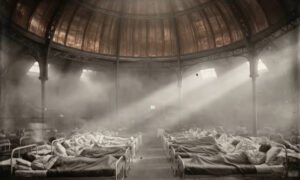
Spherical copper ceiling for harmonic resonance.
Which system has better structural incentives for the people who invest in it? So, what we inherited was designed not to serve the healing of human beings — but to replace a system that may have understood something about those methods of healing we are only now beginning to ask questions about. And that something older, something that cannot be patented or commercially distributed, was not lost by accident.

The bells were systematically removed across continents within a single generation, often melted down for wartime bronze. Their disappearance correlates with the rise of transactional, pharmaceutical‑based medicine—a system structurally incompatible with a treatment that required no consumables, no supply chain, and no proprietary product. A deliberate transition with powerful structural incentives to forget what came before.
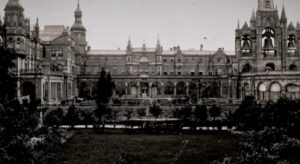
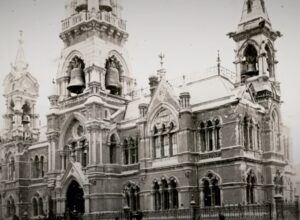
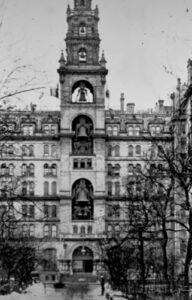
As per the pictures above, some of these buildings, originally called Asylums, still stand, and still retaining their EM and acoustic features, as well as the iron mounting rings that hint at their original purpose.
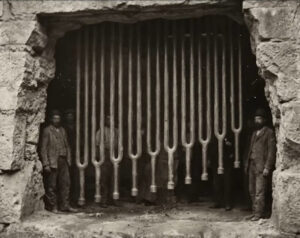
The central question is: what did the bells and walls know? and does this knowledge still linger in the architecture, waiting to be heard and felt again?