Gut bacteria / viruses?
Our bodies contain ≈100 Trillion bacteria versus ≈10 Trillion cells. The DNA of those different microbes account for 3.3 Million genes, vs 23.000 genes for the body’s DNA.
There are ≈1000 different species. We carry ≈150, mostly in the gut. Each of us has a different cast of characters, thus each of us has a unique bacterial “fingerprint”.
There are tens of thousands of newly discovered viruses and 142,809 viral species that call the human gut home, the majority of which are bacteriophages – viruses that infect bacteria – and additional single-celled organisms.
Dis-eases
Most diseases have an inflammatory basis, mostly starting in the GI tract, the primary seat of the immune system, due to dietary, emotional or mental disturbances.
Stress signals from the head’s brain can alter nerve function between the stomach and esophagus, resulting in heartburn. Many gastrointestinal disorders like colitis and irritable bowel syndrome originate from problems within the gut’s brain.
Prozac in small doses can treat chronic constipation. Larger doses can cause constipation, where the colon actually freezes up. Since Prozac stimulates sensory nerves, it also can cause cramps & nausea.
Drugs like morphine and heroin attach to the gut’s opiate receptors, creating constipation. Alzheimer’s and Parkinson’s (PD) diseases cause also constipation. The nerves in the gut are as sick as nerve cells in the brains.
The main pathological characteristic of PD is:
- excessive cell death in the brain’s basal ganglia (severely damaging ≈70% of the dopamine secreting neurons in the substantia nigra by the end of life).
- The alpha-synuclein proteins become misfolded, then clump together with other alpha-synuclein, and as such become cytotoxic and damage the cells, who are unable to remove them.
These clumps can be seen in neurons under a microscope. Loss of neurons is followed by the death of astrocytes (star-shaped glial cells) and a significant increase in the number of microglia in the substantia nigra:

Braak staging is a way to explain the progression of the parts of the brain affected by Parkinson’s disease. According to this staging, PD starts in the medulla and the olfactory bulb before moving to the substantia nigra pars compacta and the rest of the midbrain & basal forebrain.
There are five major pathways in the brain connecting other brain areas with the basal ganglia. These are known as the motor, oculo-motor, associative, limbic and orbitofrontal circuits, with names indicating the main projection area of each circuit. All of them are affected by PD, and their disruption explains many of the symptoms of the disease, since these circuits are involved in a wide variety of functions, including movement, attention and learning.

However, the least diagnosed but the most common all invasive dis-ease is a weakened immune system, causing Candida Overgrowth, a fungus that forms reservoirs made of biofilms of yeast throughout the body that become colonized by micro-organisms like bacteria that will cause all kinds of debilitating discomforts and infections, such as:
- Skin and nail infections, such as athlete’s foot or toenail fungus.
- Feeling worn down, or suffering from chronic fatigue or fibromyalgia.
- Digestive issues such as bloating, constipation, gas, IBS, diarrhea.
- Autoimmune diseases such as thyroiditis, rheumatoid arthritis, ulcerative colitis, lupus, psoriasis, scleroderma, muscle aches, gingivitis, sinusitis and recurrent colds, GERD, multiple sclerosis, or cancer.
- Poor concentration & memory, lack of focus, ADD, ADHD and brain fog.
- Skin issues: ringworm, eczema, psoriasis, staph, blemishes, rashes.
- Irritability, dementia, mood swings, headache, anxiety or depression.
- PMS, rectal or vaginal itching or yeast & urinary tract infections, thrush.
- Male prostate, kidney, and bladder infections; decreased libido.
- Sensitivities to common foods, chemicals, perfumes.
- Alcohol intolerance, seasonal allergies, sores, or itchy ears.
- Strong sugar, alcohol, drugs, tobacco, and carbohydrate cravings.
- Lime disease, which triggers auto-immune type symptoms!
- Deep sleep & REM sleep deprivation. Eyesight degeneration.
- Paralysis of the creative impulse. Inability to fully manifest.
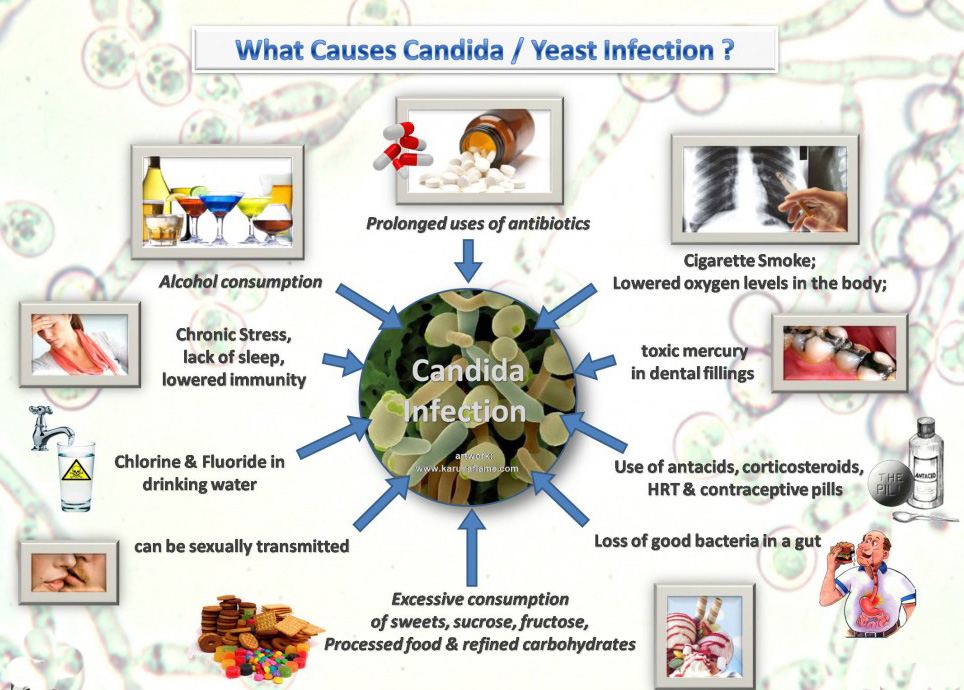
Although the healthy gut bacteria normally keep Candida levels in check, a weakened immune system can cause the Candida population to grow out of control.

The Candida Monster
We become fixated on these discomforts and try to get rid of them via medications and treatment. Unless we discharge the traumas that led to the weakened immune system and subsequent overgrowth, these symptoms will re-appear.
 Nature’s miracle cure?
(click picture)
Sugars feed the yeast. Remedies: an anti-candida diet + blue/red light + ACV + iodine drops + baking soda + castor oil + lauric & caprylic acid, found in coconut oil. These acids “poke holes” in the yeast cell wall, causing it to die.

“I’m afraid that your irritable
bowel syndrome has progressed.
Now you have
furious and vindictive bowel syndrome.”