English Gothic
English Gothic Architecture
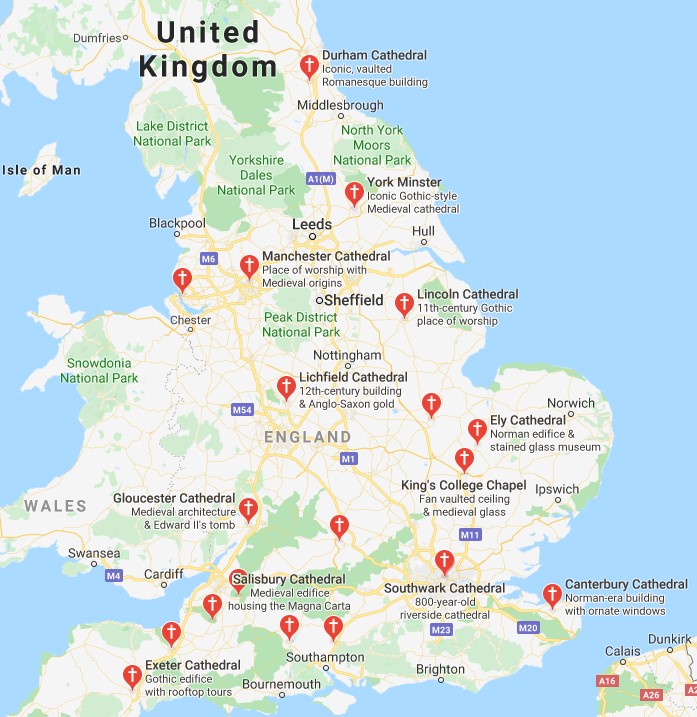
English Gothic is an architectural style, which originated in France and flourished in England from ≈1180 until ≈1520.
English Gothic is also defined by its pointed arches, vaulted roofs, buttresses, large windows, and spires. These various elements had first been used within a single building at the choir or “quire” of the Basilica Saint-Denis in 1144. The earliest large-scale applications of Gothic architecture in England are at Canterbury Cathedral and Westminster Abbey.
Many features of Gothic architecture had evolved naturally from Romanesque architecture, in England known as Norman architecture. This evolution can be seen first and most particularly at the Norman Durham Cathedral.
English Gothic developed sometimes parallel and sometimes diverged from those of continental Europe. Gothic architecture continued to flourish in England for a hundred years after the precepts of Renaissance architecture were formalized in Florence in the early 15th century.
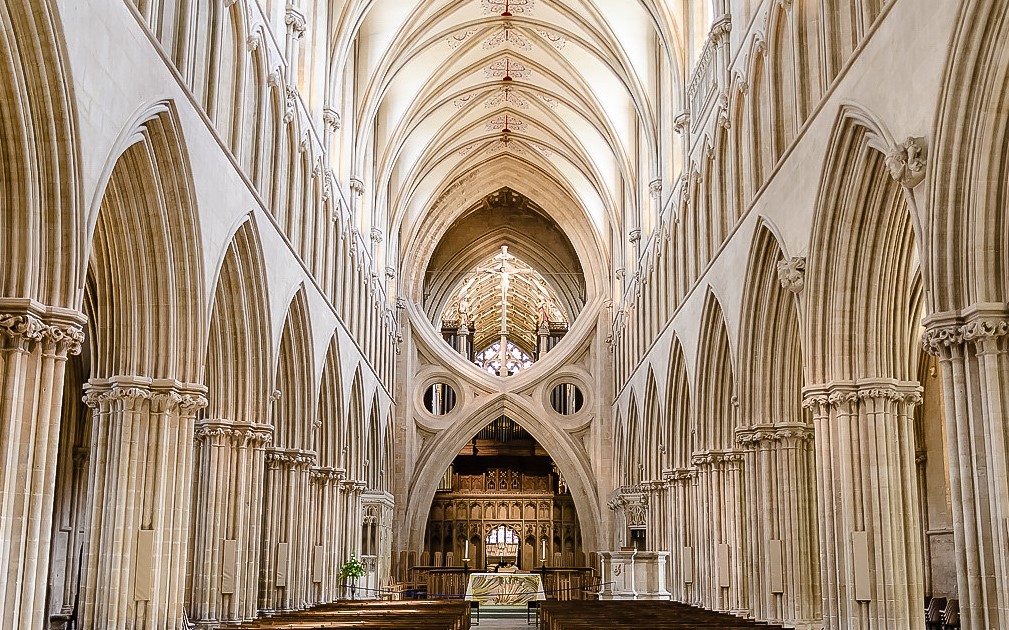
Wells Cathedral
The Gothic style gave way to the Renaissance in the later 16th and 17th centuries, but was revived in the late 18th century as an academic style and had great popularity as Gothic Revival architecture throughout the 19th century.
Most of the largest & finest works of English architecture, are built in the Gothic style. So are many castles, palaces, trade halls, as well as parish churches, which, like the medieval cathedrals, are often of earlier, Norman foundation.
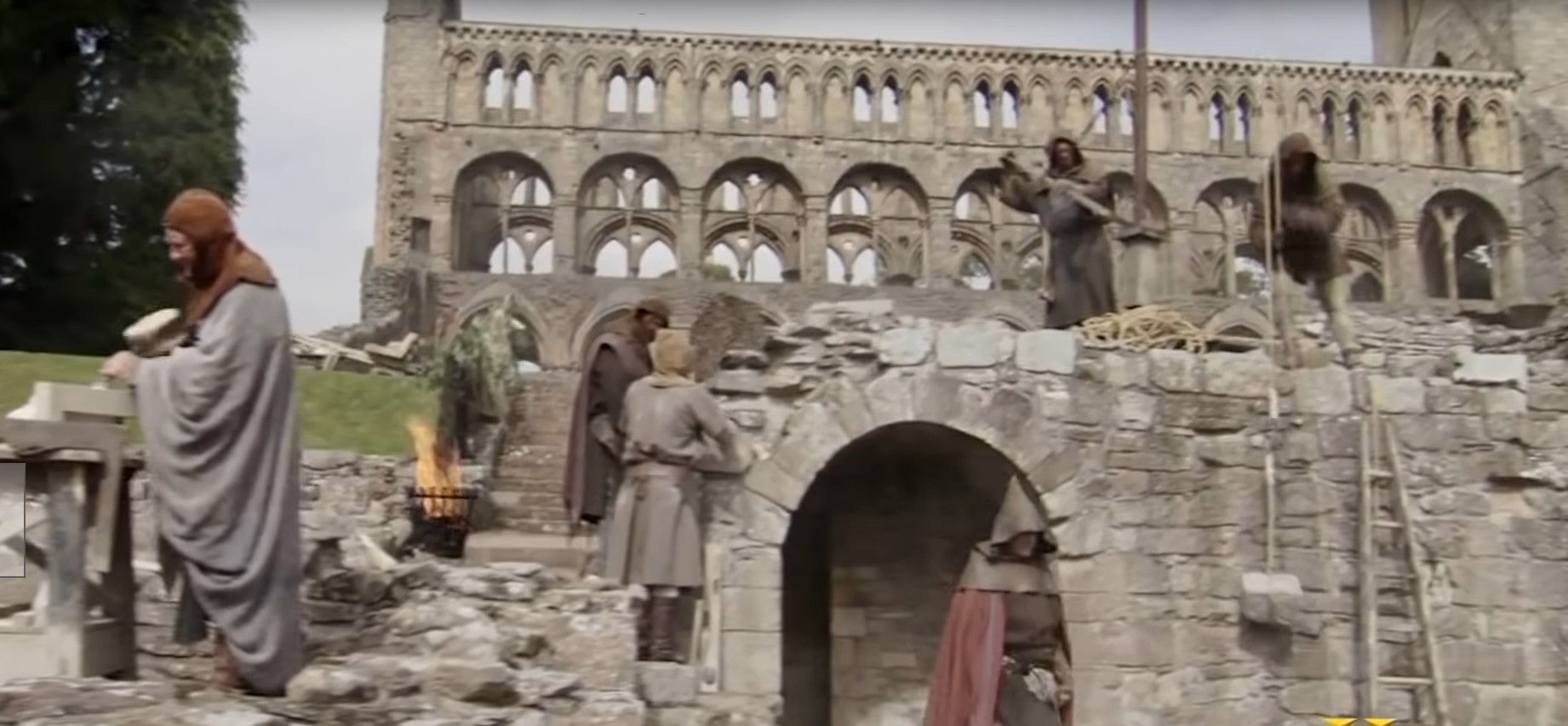
Historians refer to the English Gothic architecture styles as “periods”. They are seen at their most fully developed in the cathedrals, abbey churches and collegiate buildings.
It is a distinctive characteristic of the cathedrals of England that all but one of them, Salisbury Cathedral, show great stylistic diversity and have building dates that typically cover over 400 years. These periods are:
- Early English (≈1180–1275)
- Decorated (≈1275–1380)
- Perpendicular (≈1380–1520)
Early English Gothic

Besides the tower and spire, the entire Salisbury Cathedral is in the Early English style. There is less embellishment than is found in Romanesque buildings, and less detailed tracery than would be used in later buildings.
In the late 12th century, the Early English Gothic style superseded the Romanesque or Norman style. New elements were often used alongside older ones, especially in large buildings such as churches and cathedrals, that took longer.
With the completion of the Choir at Canterbury Cathedral in 1174, the style was firmly established in England:
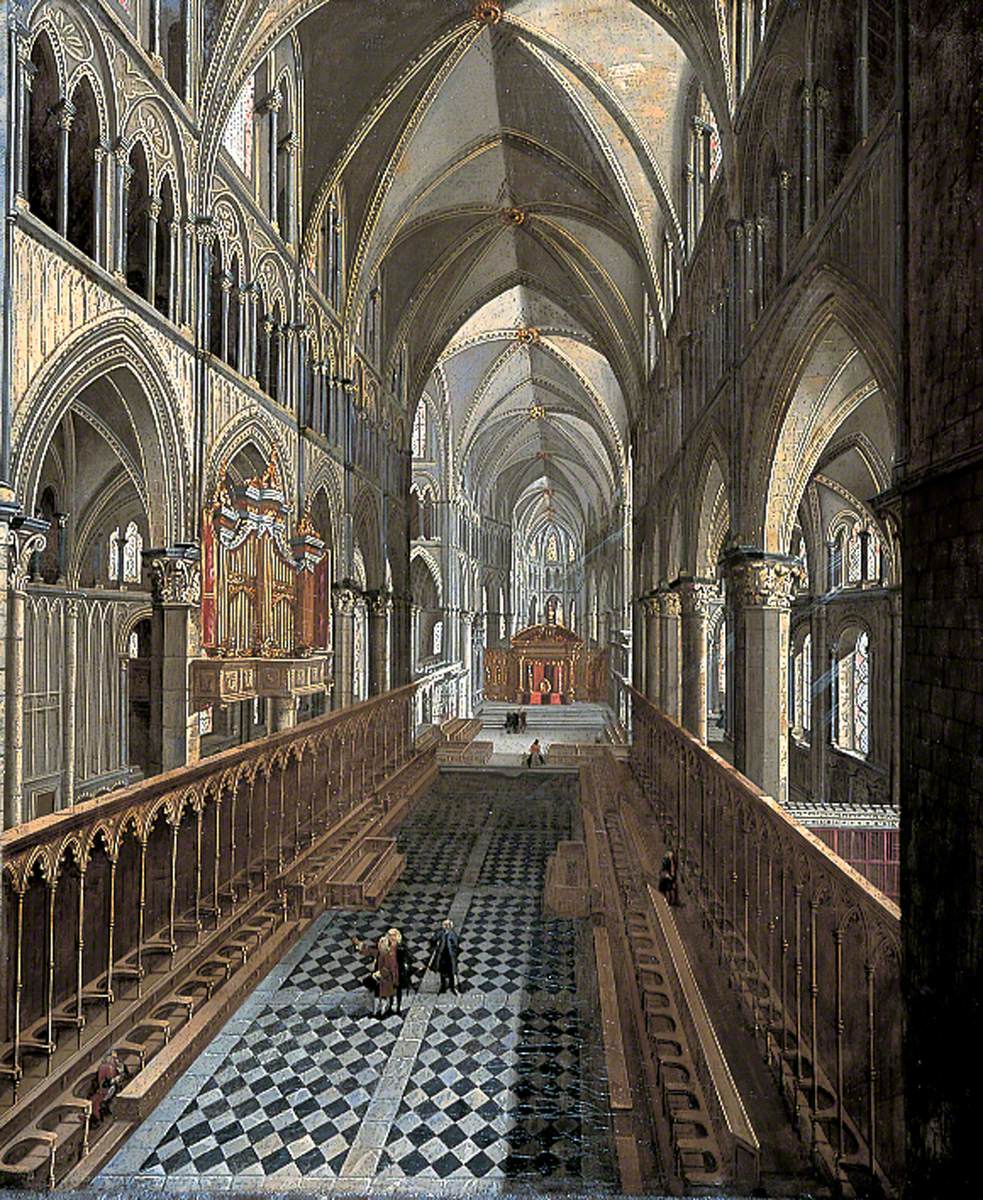
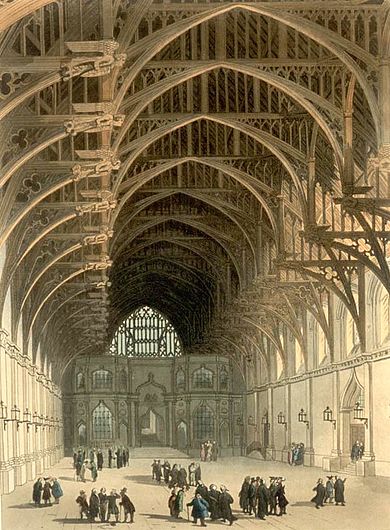
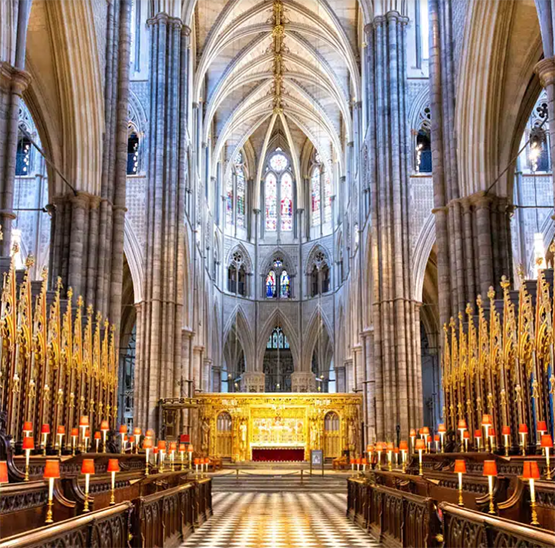
Westminster Abbey was rebuilt in the Gothic style
in 1245 by the grand-son of King Henri II,
Henri III, who was crowned King on 28/10/1216.
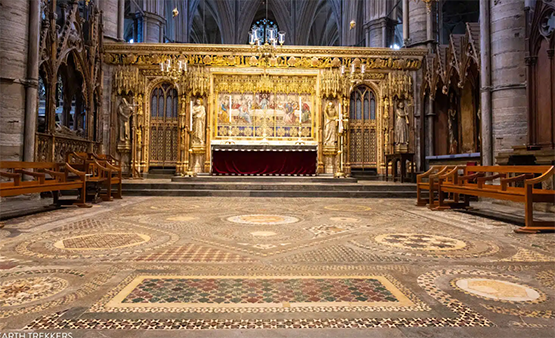
Last Supper mosaic displayed
above the high altar
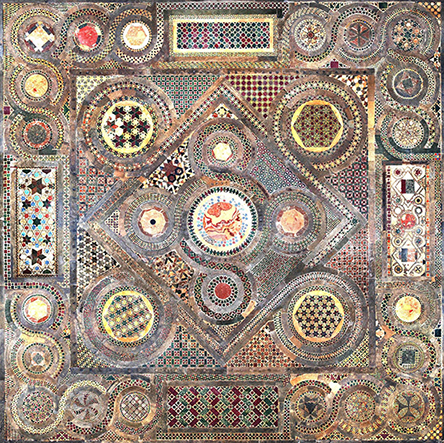
The Cosmati mosaic-floor was laid down in 1268 by order of Henry III.
Its center symbolizes us as humans
in an earth centric world (square)
within the cosmos.

The design consists of a broad border with a rectangle in the middle of each side and five roundels between each rectangle. The border encloses another square, set transversely with its corners pointing north, south, east and west. Between the inner border and the transverse square are four triangular spaces occupied by large roundels. Within the transverse square is a pattern known as a quincunx, with a large roundel in the very center flanked by four roundels as if in orbit around the center. The basic layout is a four-fold symmetry, but in detail the variations are endless. No two roundels are the same. Of the four ‘orbiting’ roundels one is circular, one hexagonal, one heptagonal and one octagonal. The infill patterns are all different.
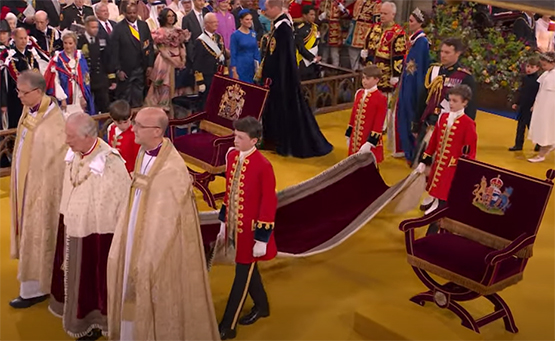
Royal Code of Arms Throne chairs
During the reign of the House of Plantagenet in England and half of France, the following exoteric and esoteric (hidden wave-signatures of energy & information) elements were established that ring powerfully through till today:
- a set of rules known as Common Law, put together by the 1st Plantagenet King Henri II, in the 12th century;
- the establishment of the Magna Carta, as the royal charter of rights, in the early 13th century;
- the commissioning in the mid-13th century by King Henri III of the cosmati coronation pavement, made from stones & crystals taken from ancient royal & religious ruins throughout the Mediterranean;
- the commissioning of the coronation/initiation/anointing chair at the end of the 13th century by King Edward I, the great-grandson of King Henri II.
- the Royal Arms of England, introduced by the House of Plantagenet in the 12th century, to be used in sacred & secular services:
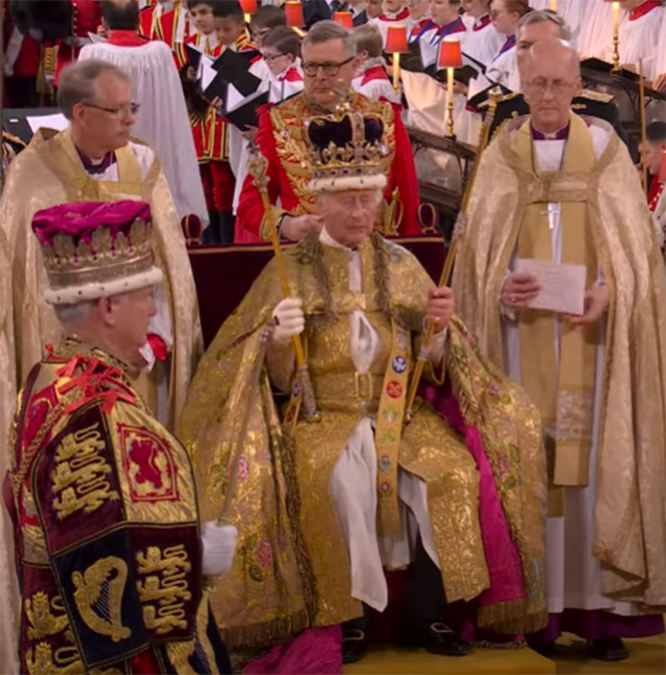
Most of the world is still ruled by the English through the use of their language as the main means of communication, especially the effects of their sound wave-signatures.