The Baldacchino
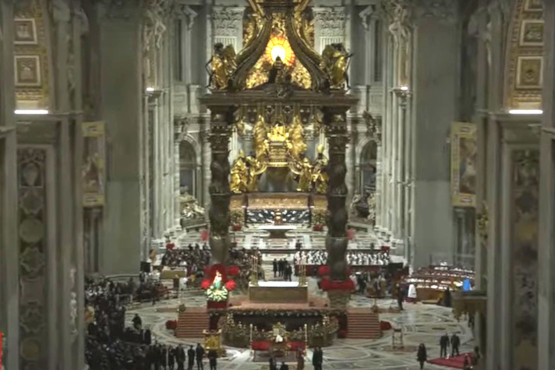
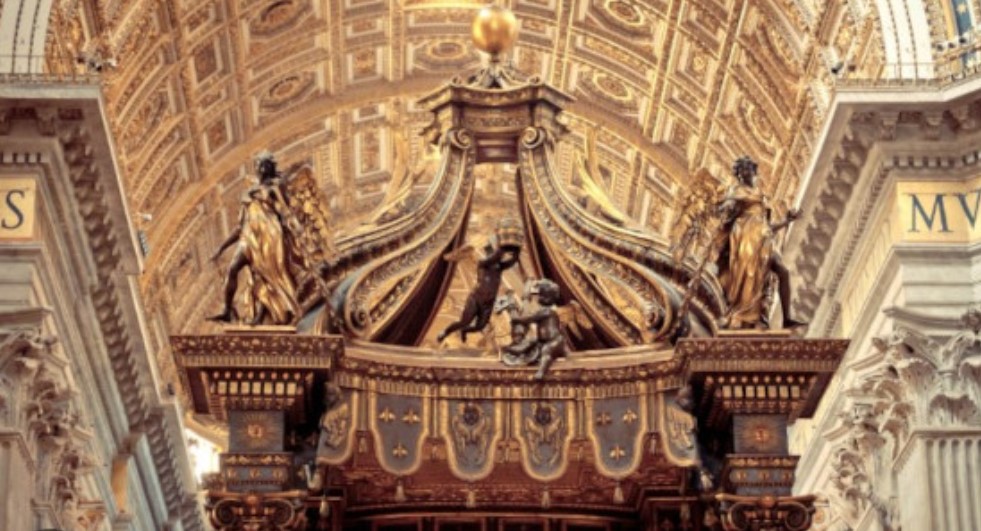
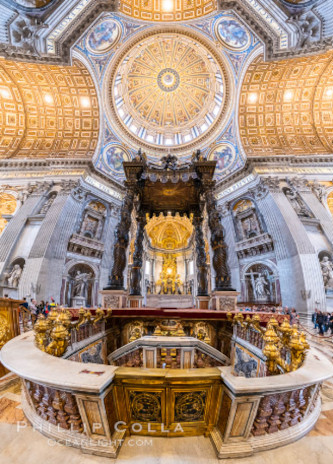
St. Peter’s Baldacchino is a towering bronze canopy sculpted over the High Altar of St. Peter’s Basilica in Rome. It was built over the tomb of St Peter.
Even though sculpted canopies are ordinary in medieval churches and buildings, the Baldacchino in St. Peter’s church was noted for its grandeur and the man who executed it, famous and skillful Italian baroque architect and artist Gian Lorenzo Bernini.
Its 9 year construction was finished in 1633. He used bronze to create an illusion of cloth while creating lightweight spiral columns. He also incorporated pictorial elements and details, most of them related to the family of Pope Urban VIII, who’s brainchild this was.
The 6200 kgs of bronze used were scrapped from the Roman Pantheon. It was placed directly under the dome of St. Peter’s Basilica, thus making the center of the Basilica a grand one:
Design & architecture
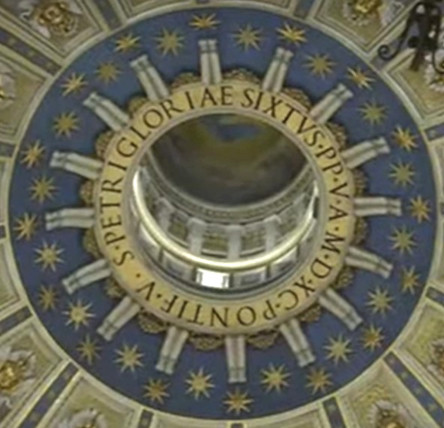
St. Peter’s Baldacchino is a masterpiece and an instant visual treat for devotees visiting the St. Peter’s Basilica.
Soon after its creation, numerous attempts were made to recreate or imitate it. But Bernini’s vision was unique. For that reason, the Baldacchino remains an undisputed marvel of his artistry.
The most visually stunning parts are the gigantic twisted columns, rising 20 mtr in height and decorated with olive and bay twigs, intertwined with sculpted cherubs.
The sculpture was designed to give maximum depth to the altar, by using the look of portable cloth canopies made of pure bronze. The marble statue with St. Peter is on the right:
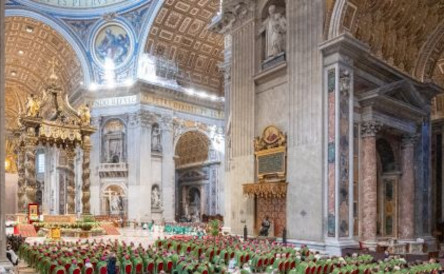
The columns stand on 4 marble pedestals, with the papal ode of arms, and liberally scattered with the heraldic bees of the Barberini family, of Pope Urban VIII.
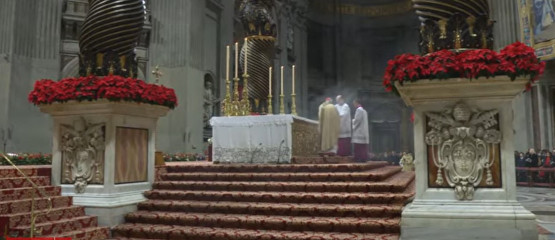
Above the Confession, the papal Altar rises on 7 steps, where only the Pope can celebrate Mass, facing the people and looking toward the east as in the old Christian churches.
It was installed and consecrated here in 1594 by Pope Clement VIII using a large block of marble coming from the Forum of Nerva, including the altar of Callisto II consecrated in 1123.
Acanthus leaves entwine the base and the capitals. The spiral fluting of the columns suggests upward movement. Fringes and tassels dangle from the top of the covering.
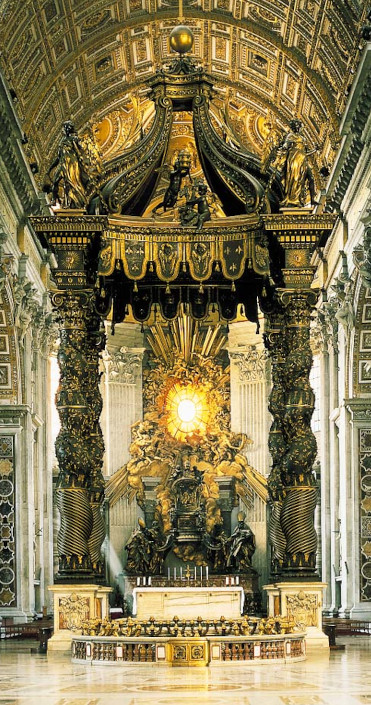
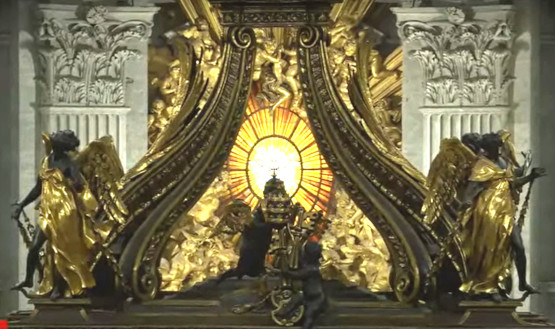
Above the frieze on each capital, 4 angels offer garlands, while between them couples of smaller angels support Pope’s emblems:
the keys, the tiara, the book and sword. The vertex, where 4 vast ribs and palm branches converge from the 4 corners, is crowned by the cross, set on a golden globe:
Although 29 mtr heigh, it is harmoniously inserted into the immensity of the church. It compensates for an emptiness that would have been too dominating over the small altar, it is a graceful and streamlined design.
Though imposing, it appears free since it allows the background to be seen quite easily and does not reduce the impression of depth of the Basilica. It is making the apse, to be glimpsed between the columns, seem farther away.
Replacing a pictorial element with an architectural element, Bernini created a cover imitating cloth, producing the feeling of a lightweight structure that is almost mobile and temporary, by using 4 streamlined gilded bronze spiral columns.
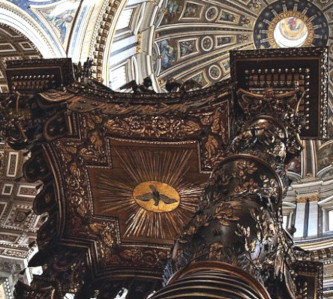
Inside the “ciborium” is a dove, the symbol of the Holy Spirit, in a burst of golden rays:
He divided these columns into 3 levels: the bottom with helical grooves and the two top ones with olive and bay leaf branches, populated by small putti and flying bees, the symbol of the Barberini, inviting the observer to move from one curve to the other of their spiral winding, generating a dynamic and ascending view.
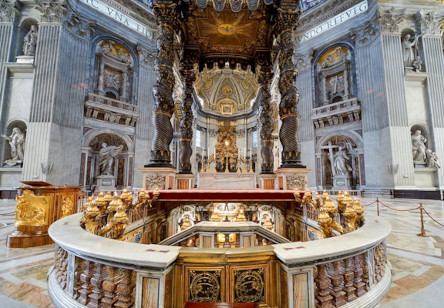

The columns rest on marble pedestals, decorated with the coat of arms of the Barberini. They terminate with elaborate Corinthian capitals which support with shelves, dentils and radiant suns. The canopy was revealed to the public on St. Peter’s Day in 1633.
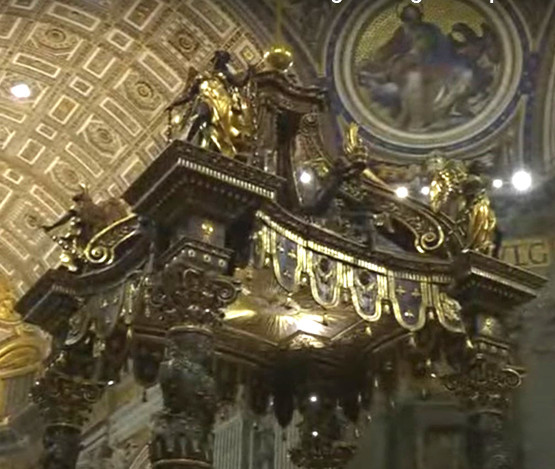
By removing the ribs of the dome of the Pantheon, 103,229 pounds of bronze were obtained, to which the same amount was added from sources in Venice and Livorno.
With more needed, Urban VIII had the bronze of the beams removed from the Pantheon. This made Pasquino state : “What the barbarians did not do, the Barberini’s did”.
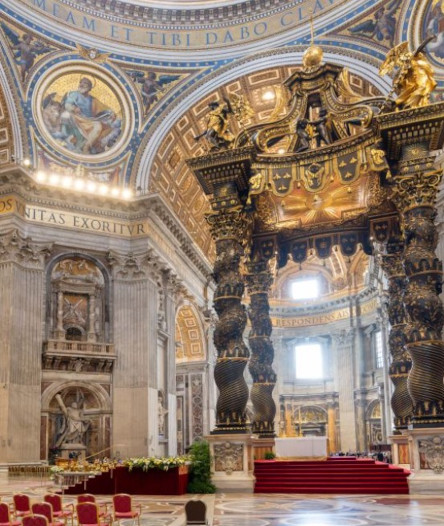
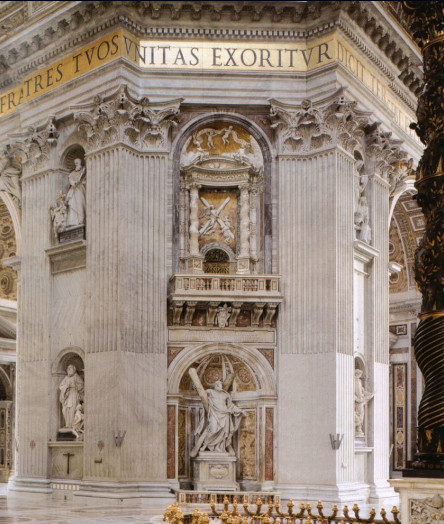
St Andrew Statue facing both
the grave and the chairs of St Peter:
To compensate for the “theft” of its ornaments, the Pantheon was enriched by two bell towers that were immediately shrewdly baptized by the people as “the donkey ears of Bernini.” The towers were demolished 250 years later.
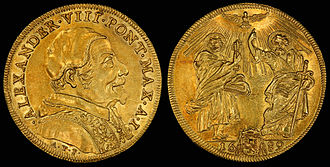
scudo d’oro: Ptr/Paul
Despite the pungent statements by the Roman people, Urban VIII earned the glory of such an expensive 200.000 scudos project and for Bernini 250 monthly generous payments. On October 27, 2024, a 10 month restoration of both Bernini’s artworks, since 250 years, was finished. The €700,000 project was financed by the Knights of Columbus order.
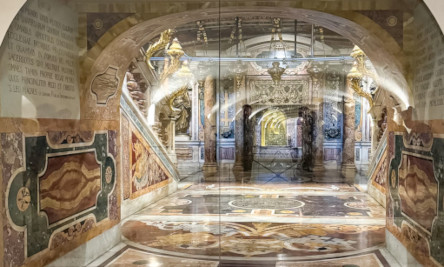
Entrance to the various grottoes
right under the baldacchino altar