MITOCHONDRIA
The Origins of Mitochondria
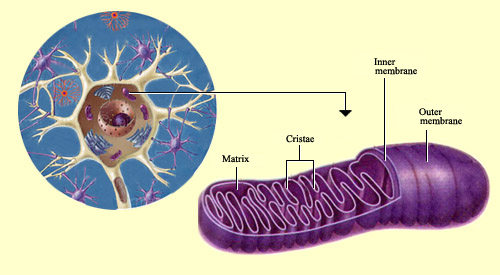
Like any other cell, neurons need a lot of energy to function. The brain accounts for only 2% of the body’s weight, but almost 20% of its energy consumption. This energy is produced in mitochondria, elongated organelles placed throughout the cell body.
They use oxygen to extract energy from fats and sugars, and then produce molecules of the energy-storage compound ATP, which means Adenosine Tri-Phosphate. These molecules fuel the various chemical reactions within the neuron’s body:
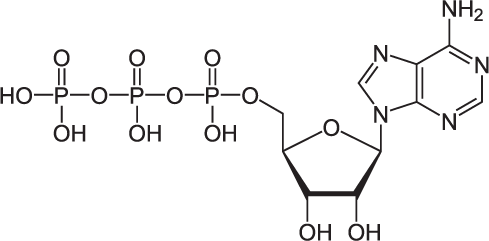
Adenosine triphosphate is stored energy. It becomes active when broken down by hydrolysis, the insertion of water molecules between its chemical bonds. Hydrolysis causes an ATP phosphate to become detached, and release energy.
The toxins of cell stranglers choke out your body’s nutrients at the DNA level by depriving mitochondrial cells of oxygen, or shutting them down. Insufficient essential nutrients leads the body to cell mutation, and thus aging and disease. Detox and specific breathing exercises can slow this down. Also CoQ10 stored in the mitochondria reduces oxidative damage.
Its weak magnetic field strongly effects the efficiency of ATP Synthase (ATPS) an enzyme that spans the membrane of a cell, and functions like a hydroelectric turbine that converts the kinetic energy of flowing water into electricity. The slower the water flows, the less electricity is generated.
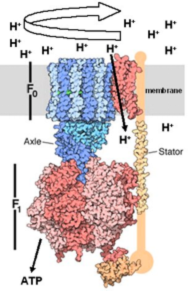
Protons of Hydrogen ions tunnel through the narrow channels within ATPS into the interior of the cell and, in the process, generate ATP. The efficiency of the process helps determine the biochemical energy balance inside the cell.
Mitochondria organelles in the cytoplasm are shaped like sausages and have evolved through a special process that benefits both parties concerned. It is called symbiosis.
Their ancestral bacteria lived in larger cells that offered a nutrient-rich environment. They used the Earth’s cheap oxygen to grow. O2 is a product that was not just useless, but actually toxic to these larger cells.
Researchers in the field of ageing have pointed out that the force that drives and sustains our lives is the system of electron transport in the mitochondria of our cells.
It is here that the air we breathe and the food we eat are combined, at a rate that determines our rate of ageing and hence our life expectancy.
Whereas the achievement of a slowing down of the combustion process within our cells through moderating the amount of energy delivered may be beneficial, another way of slowing down may be disastrous.
This is the poisoning of the electron transport chain. One possible way of being poisoned is chronic exposure to artificial electromagnetic fields. This ever-increasing pollution subjects the electrons of our mitochondria to external forces, slowing them down, depriving our cells of oxygen, and causing very serious symptoms of Electro-Hyper-Sensitivity.
.jpg)
Mitochondria are much more than Powerhouses: